People leave Monarch for a handful of specific reasons, and each one points to a different replacement. Find your reason below, see which app fits it, and test the one thing that matters before you pay.
There's no single best Monarch alternative, because people don't leave Monarch for a single reason. Someone who's tired of paying for an app they open twice a month needs something very different from someone whose credit union keeps disconnecting, or someone whose partner never logged in once. If you pick a replacement without naming your reason first, there's a decent chance you'll end up with a different app and the same problem.
So this guide is organized around reasons. We'll start with what Monarch does well (so you know what you're giving up), go through the common reasons people move on, match each one to the kind of app that actually fixes it, and finish with a short test you can run on any replacement before paying. Sumyfi is one of the options, and we'll say plainly where it isn't the right pick.
What you'd be giving up by leaving Monarch
Monarch is a good product, and it's worth being honest about that before shopping around. It has shared access for couples, so two people can see one household picture under their own logins. Its investment and net worth views are detailed. Budgets are flexible, transaction rules are well built, and the reports are some of the clearest in the category. A lot of former Mint users landed there for good reasons.
That means the bar for a replacement is fairly high. If your main complaint is small (a category you can't rename the way you want, a chart you'd like to see differently), the cost of switching will probably outweigh the benefit. Rebuilding categories, rules and goals in a new app usually takes a few evenings, and you lose some of the history you've already cleaned up.
If your complaint is bigger than that, keep reading.
The six common reasons people look for a Monarch alternative
Most of the frustration we see falls into one of these buckets. It's worth picking the one that fits you best, because the right replacement changes depending on which it is.
Paying for light use
Monarch has no free tier. If you only check balances and a couple of budgets each month, a paid subscription can feel like a lot for that.
Connections that keep breaking
One account that disconnects every few weeks can make the whole dashboard feel unreliable.
Too much to maintain
Rules, categories, tags, reports. Some people love that depth and some people stop opening the app because of it.
Wanting a stricter method
Monarch is flexible by design. People who need every dollar assigned often do better with a method-first app.
The partner never joined
Shared access only helps if both people use it. If you're the only one logging in, you're paying for a feature you don't use.
Wanting a different kind of help
Some people want more guidance on what to do next, not just better charts of what already happened.
Which Monarch alternative fits each reason
Here's how the reasons map to replacements. None of these is a perfect clone of Monarch, and that's the point. You want the app that fixes your specific problem, even if it's weaker somewhere you care less about.
If cost is the issue, look for a free plan you'd actually be happy staying on, not a free trial. Empower's free dashboard is strong on investments and net worth, though its budgeting is lighter and it's built around a wealth management business, so expect to be offered advisory services. Goodbudget has a free version for envelope budgeting with manual entry. Sumyfi's free plan covers budgets, goals and manual accounts. A plain spreadsheet costs nothing and works fine if you're disciplined about updating it.
If connections are the issue, be careful, because most apps rely on the same handful of data aggregators. Switching apps doesn't always fix a bank that's hard to connect. Test the problem account specifically during any trial. If it fails everywhere, the realistic answer is a manual account updated once a month, or a CSV export from that bank imported on a schedule.
If maintenance is the issue, pick something with fewer moving parts. Fewer categories, fewer rules, and a single screen you can review in ten minutes beat a powerful setup you've stopped maintaining. If you want a stricter method instead, YNAB is the obvious choice. It asks for more hands-on time each week, but people who stick with it tend to say that's why it works.
Paying for light use
an app with a real free plan (Empower for investments, Sumyfi or Goodbudget for budgeting)
Connections that keep breaking
test that one account first, and plan for manual updates if it fails
Too much to maintain
a simpler dashboard with fewer categories
Wanting a stricter method
YNAB
Spreadsheet people
Tiller, or your own sheet fed by CSV exports
Couples who both use it
probably stay on Monarch
A 30-day test for any Monarch alternative
Reviews and feature lists won't tell you much. What tells you whether an app fits is a month of real use with your real accounts. Here's a test that takes about an hour of setup and fifteen minutes a week after that.
- Connect the account that gives you the most trouble first. If that's a small credit union or a store card, start there, not with your main checking account at a big bank.
- Import 90 days of history, either through sync or a CSV, and see how many transactions land in the wrong category. If you're fixing more than one in five, budget for that time every week.
- Set up three budgets you care about (groceries, dining out and one irregular category like car costs) and one savings goal with a date. Keep it that small on purpose.
- Open the app once a week for four weeks. Note whether you opened it because you wanted to or because you'd planned to. That difference predicts whether you'll still be using it in six months.
- At the end of the month, compare balances against your bank statements. If they don't match within a few dollars, find out why before you commit.
Run this test on one replacement at a time, while your Monarch subscription is still active. Running two new apps at once gives you twice the setup and blurrier results.
Sumyfi as a Monarch alternative: who it suits and who it doesn't
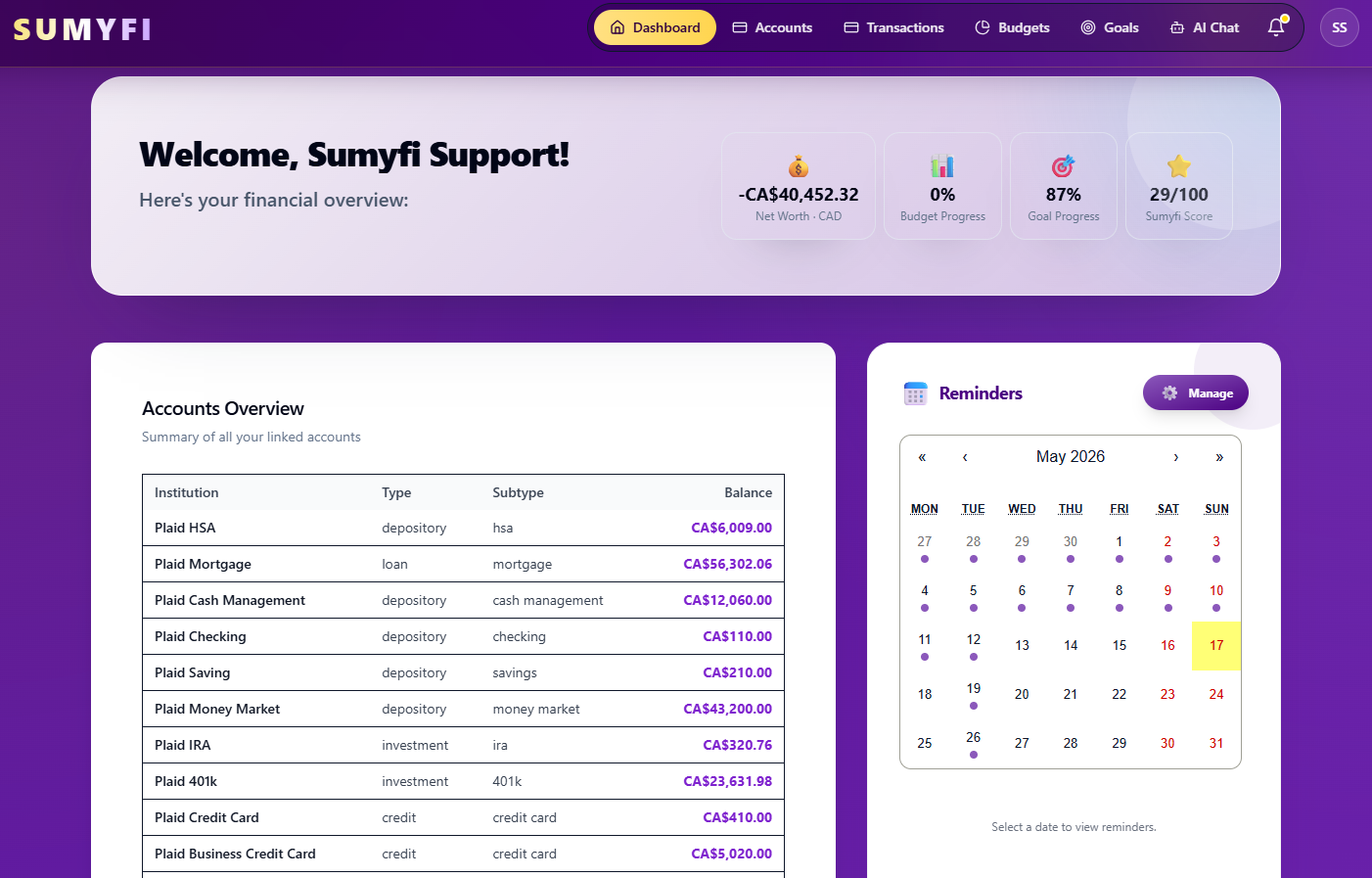
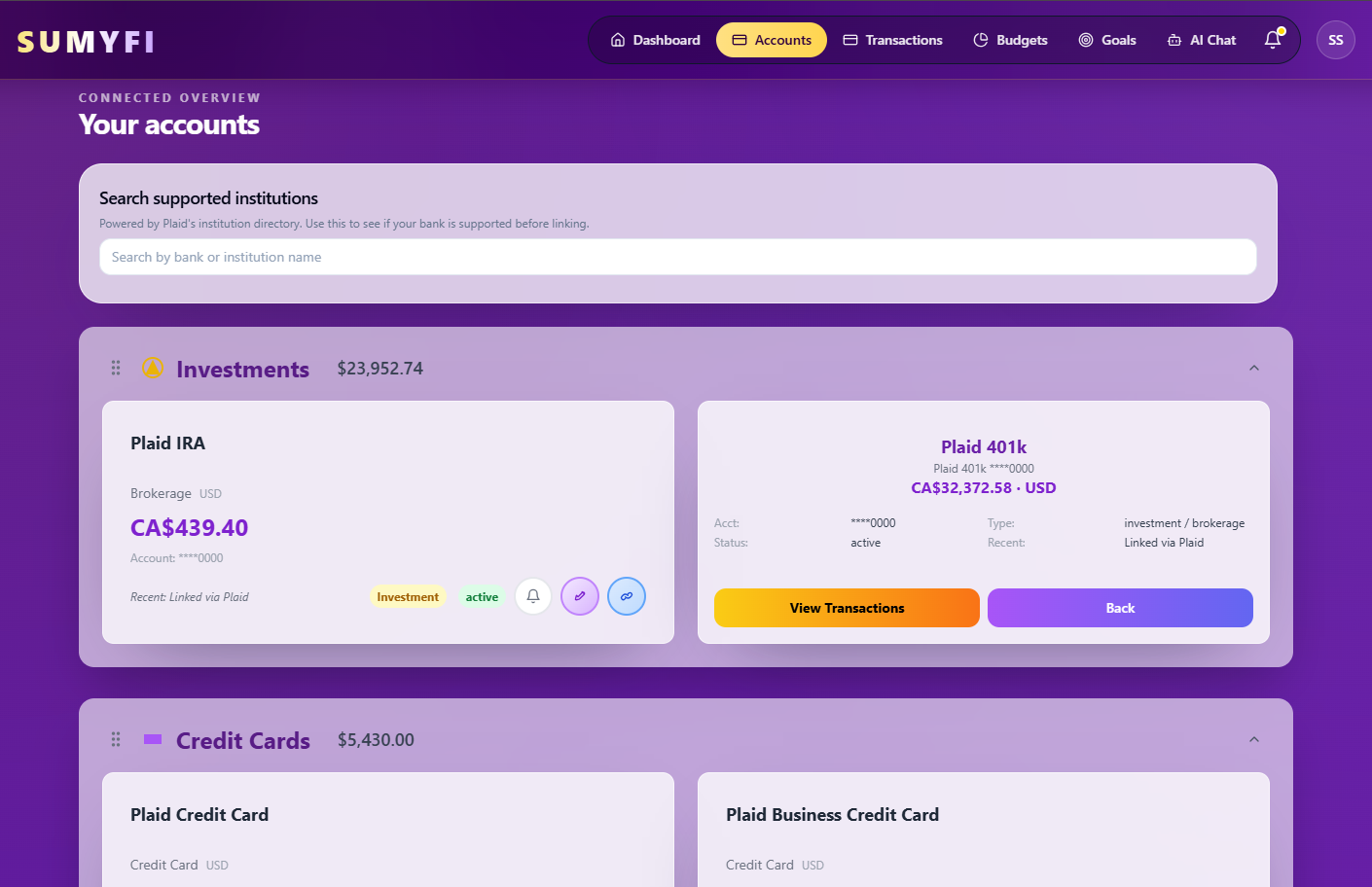
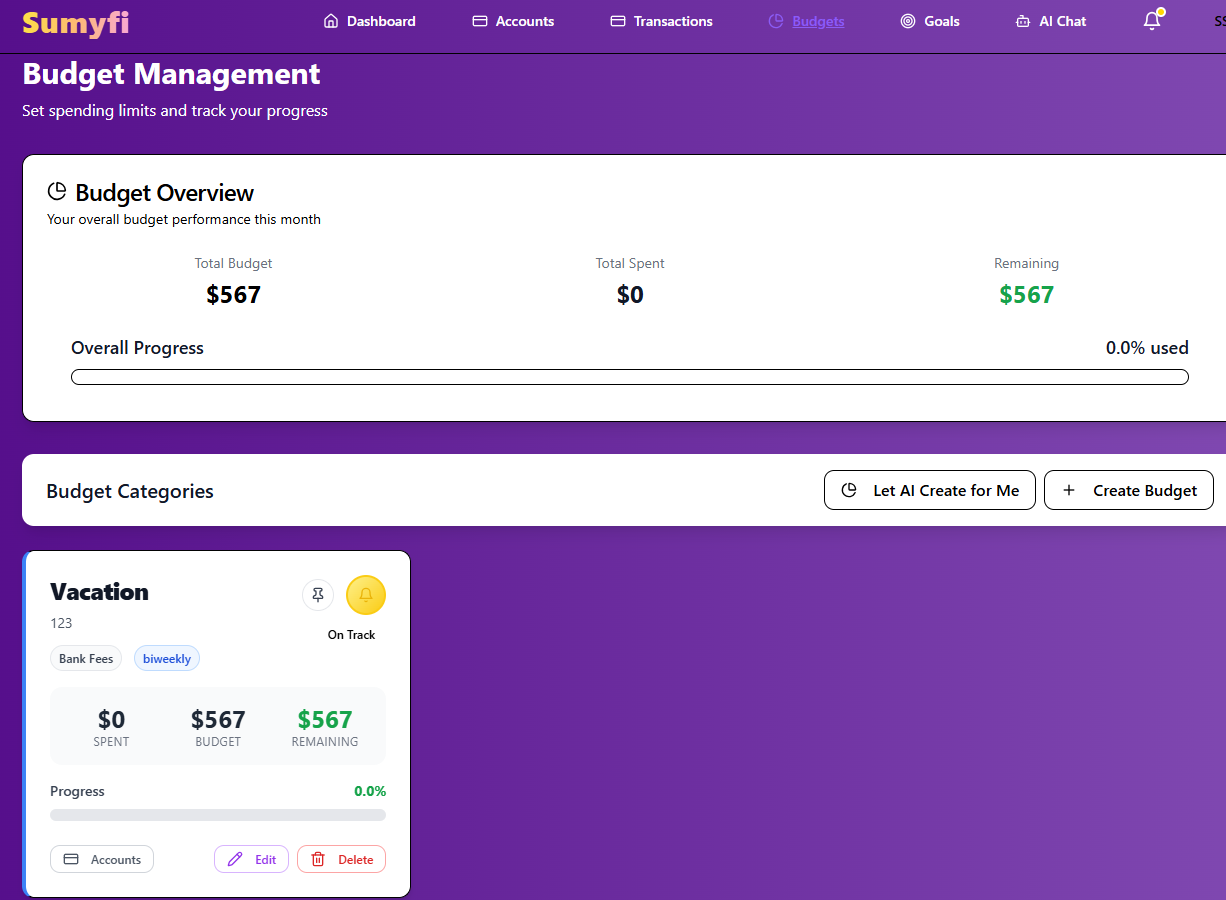
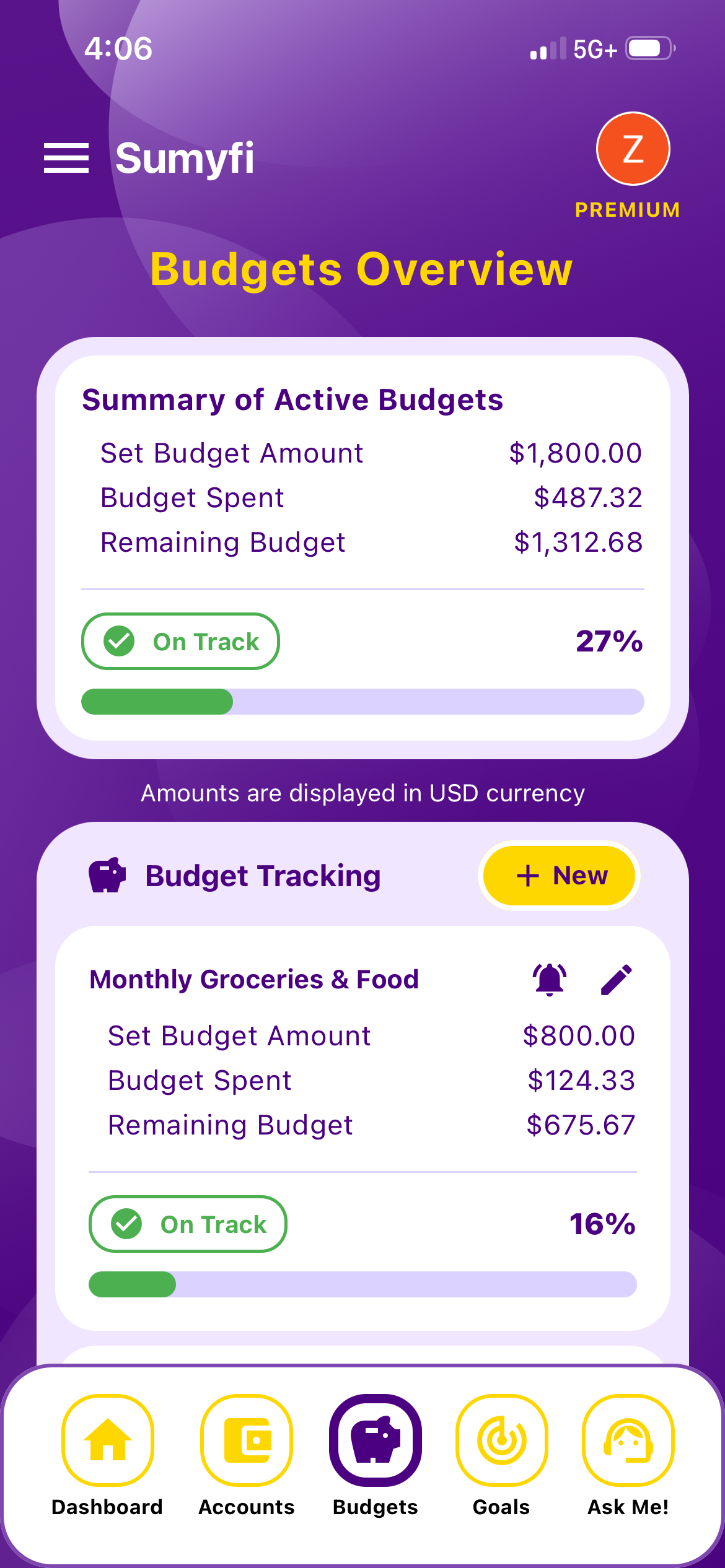
Sumyfi fits best for the 'paying for light use' and 'too much to maintain' reasons. The free plan, with no card required, includes budgets, savings goals, transaction categorization, manual accounts, basic reports and CSV or Excel import. You can rebuild your Monarch budgets there and see whether the simpler setup suits you before paying anything.
Premium adds automatic bank sync through Plaid (read-only, with US and Canadian institutions, and coverage depending on your bank), real-time updates, custom spending alerts, advanced analytics and an AI assistant you can talk to in plain language. You can ask it to 'lower my dining budget to $250' or 'create a goal called Summer Trip for $2,000 by August 31' and it makes the change. That's useful if the thing you wanted from Monarch was help deciding what to do, not just seeing what happened. Premium has a 7-day free trial.
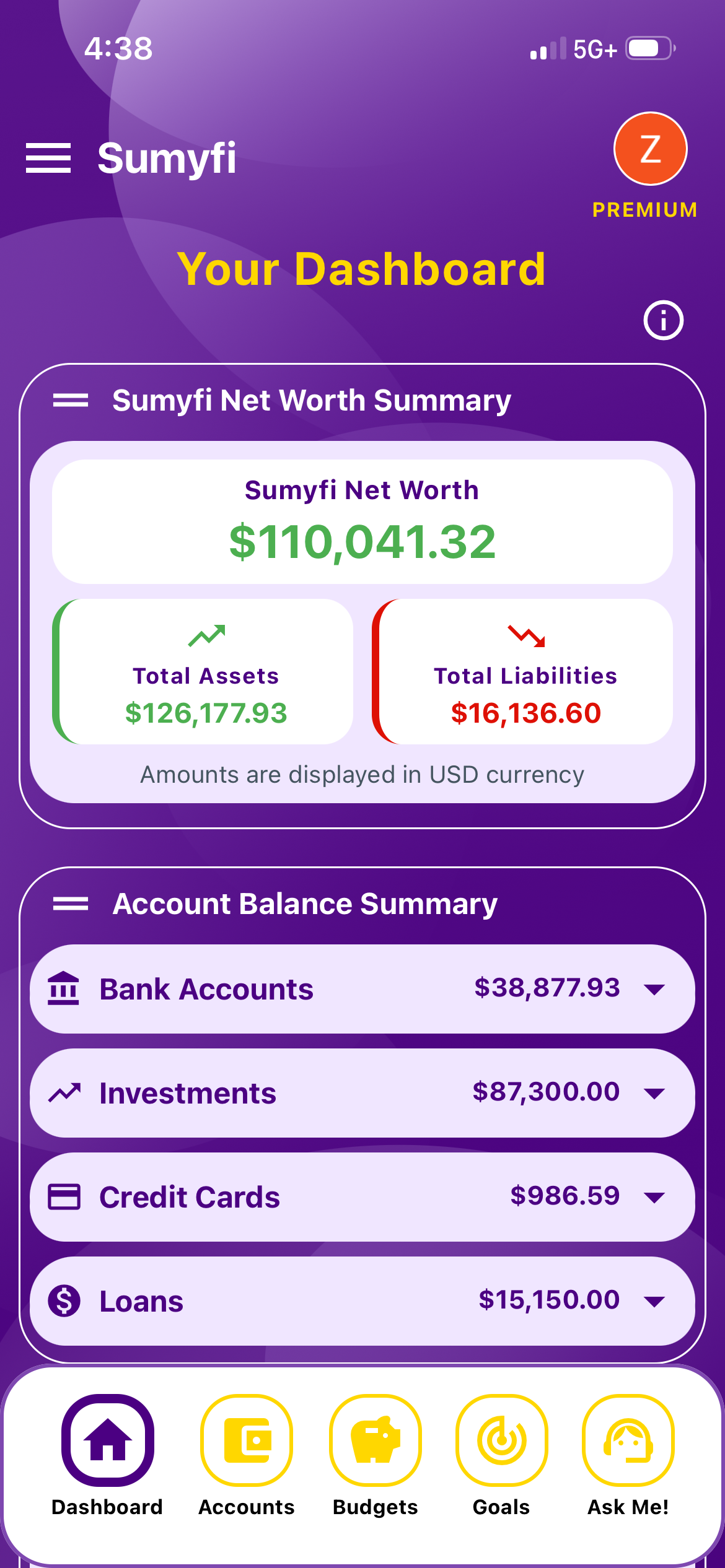
One screen holds budgets, accounts, goals, net worth and recurring charges. The subscriptions view pulls repeating charges out of your transactions, ranks them by monthly cost, shows a yearly total and lists what's due in the next 10 days.
Where it's the wrong pick: if you and a partner both actively use Monarch's shared access, or if detailed investment analysis is the main reason you open the app, Monarch is ahead on both. Sumyfi is also a newer product with a shorter track record.
Pros
- A free plan you can stay on, not only a trial
- Budgets, goals, recurring charges and net worth on one screen
- AI assistant that can make changes for you in plain language
Cons
- No shared household logins like Monarch's
- Less investment depth
- Automatic bank sync requires Premium
When the best Monarch alternative is staying on Monarch
It's a fair outcome. If your accounts connect reliably, you open the app most weeks, and the main complaint is the price, run the numbers on your actual use. A paid app that helps you catch one forgotten annual renewal or keeps your dining category $50 a month lower than it would otherwise be has more than paid for itself.
Switching makes sense when the problem is structural: a bank that never connects, a partner who never logs in, a setup you've stopped maintaining, or a subscription you pay for without opening. If one of those sounds like you, pick the replacement that matches the reason, run the 30-day test, and cancel Monarch only after the new setup has matched your bank balances for a full month.