Sumyfi
    Net Worth Hub
    Net Worth Search

    Debt + Net Worth Tracker

    In an increasingly complex financial landscape, understanding the intricate dance between your debts and your assets isn't just wise - it's absolutely essential for building lasting wealth. For too long, the pursuit of financial clarity has been mired in manual spreadsheets, fragmented accounts, and outdated software, leaving individuals feeling overwhelmed rather than empowered. But what if there was a smarter, more intuitive way to gain a panoramic view of your entire financial universe? What if you could effortlessly track debt, monitor net worth, and chart a clear course towards your financial aspirations?

    Coverage
    12,000+

    Financial institutions supported for connected account visibility.

    Conversion focus
    One dashboard

    Budgets, goals, recurring spending, and account data in one place.

    Trust
    Privacy-first

    Security, legal, AI usage, and support surfaces are public and reviewable.

    What to know before you choose

    A better finance system should reduce friction, not just rename it.

    Debt + Net Worth Tracker matters when the current setup still leaves too much guesswork. People may already have account access, a spreadsheet, a budgeting tool, or a subscription list, but they still do not feel clear on what changed, what is drifting, or what deserves attention first.

    The useful solution is the one that turns raw money data into orientation. Sumyfi fits that need by keeping accounts, recurring spending, goals, and planning close enough together that the next decision is easier to make.

    If you want one clean place to understand spending, track progress, review recurring charges, and move faster on decisions, Sumyfi is the product The product should lead you to next.

    At a glance

    What this comparison covers

    Estimated read
    21 min
    Guide depth
    28 sections
    Word count
    4,558
    FAQs
    5

    Table of contents

    Jump to the part you actually care about

    1What debt + net worth tracker needs to solve in real life2The workflow should answer a few important questions quickly3How to judge debt + net worth tracker without getting distracted by feature noise4Why Sumyfi makes more sense when the whole system matters5Why the everyday money routine matters more than the feature list6The Indispensable Role of a Debt and Net Worth Tracker in Modern Finance7Why Tracking Debt and Net Worth Isn't Optional, It's Foundational8The Psychological Edge: How Visibility Fuels Motivation9Deconstructing Debt: Types, Impact, and Strategic Management10How Debt Directly Impacts Your Net Worth11Strategic Debt Reduction: Pathways to Freedom12Understanding Net Worth: Assets, Liabilities, and the Equation13The Net Worth Equation: Assets - Liabilities = Net Worth14Why Tracking Net Worth Growth is More Important Than Just a Positive Number15The Limitations of Traditional Debt and Net Worth Tracking Methods16Manual Spreadsheets: The Illusion of Control17Paper-Based Systems: The Road to Disorganization18Legacy Software: Clunky, Limited, and Outdated19Enter the Modern Era: What Makes an Elite Debt and Net Worth Tracker?20Core Features: The Non-Negotiables for a Superior Tracker21Beyond the Basics: Features That Elevate Your Financial Management22Sumyfi: Redefining Your Financial Trajectory with the Ultimate Debt and Net Worth Tracker23Why Sumyfi Stands Apart: Agile Engineering Meets Financial Brilliance24How Sumyfi Works: Your Journey to Financial Empowerment25Maximizing Your Sumyfi Debt and Net Worth Tracker for Optimal Results26Future-Proofing Your Finances: The Long-Term Value of a Dedicated Tracker27Recommended Reading28Conclusion: Your Financial Future Starts with Clarity and Control

    What to compare first

    Three things to decide before you pick a tool

    See whether Debt + Net Worth Tracker actually solves the wider workflow problem behind the search.

    Best for everyday personal finance users who want seeing debt reduction and net worth growth together instead of in separate tools.

    Look for the product that moves you from scattered awareness to a repeatable weekly money routine.

    Buyer checklist

    What to compare before you pick a tool

    • Can the product support connected accounts and a clean cross-account view?
    • Does the dashboard explain spending, or only list transactions?
    • Can budgets, goals, subscriptions, and trends work inside one system?
    • Will the tool still feel manageable after the first month of use?
    • Does the company look trustworthy enough for financial data and long-term use?

    Why Sumyfi

    Built for a complete money workflow, not a partial fix

    The strongest case for Sumyfi here is that it connects everyday financial review to longer-term progress. It is designed to help users connect accounts, see recurring patterns, build budgets, track goals, and use AI to reduce ambiguity around what the numbers actually mean.

    Clearer spending visibility without spreadsheet dependency
    Connected account coverage across a wide institution set
    Budgets, goals, and recurring money review in one system
    Public trust surfaces through support, legal, and security pages

    Comparison table

    Sumyfi vs Many net worth tools

    Exact pricing and plans can shift over time, so the most useful comparison is whether the product helps users move from fragmented financial data to clearer decisions with less maintenance.

    Decision areaSumyfiMany net worth tools
    Primary workflowOne place for accounts, budgets, goals, recurring money decisions, and AI-supported explanations for people researching debt + net worth tracker.Often built around a narrower workflow tied more specifically to the main use case behind this search.
    Account visibilityDesigned to keep everyday spending and the bigger financial picture visible together instead of splitting them into separate tools.May emphasize one slice of the money picture more than the full system.
    Ease of ongoing useBuilt to reduce maintenance so the dashboard is easier to keep using week after week.Can be useful, but may require more manual review, heavier setup, or a more specialized workflow.
    Planning supportSupports budgeting, goal tracking, forward-looking decisions, and a cleaner review process in one experience.Planning support varies depending on the product and the subscription tier you choose.
    Trust surfacePublic support, security, privacy, and AI usage pages help lower risk for serious shoppers before signup.Trust signals depend on the company, and not every buyer gets the same level of clarity upfront.
    Best fitBest for people who want to see debt reduction and net worth growth together instead of in separate tools without juggling separate tools and disconnected reviews.Best for users who already know they want a narrower product centered on debt + net worth tracker.

    Product screenshots

    See the product behind the copy

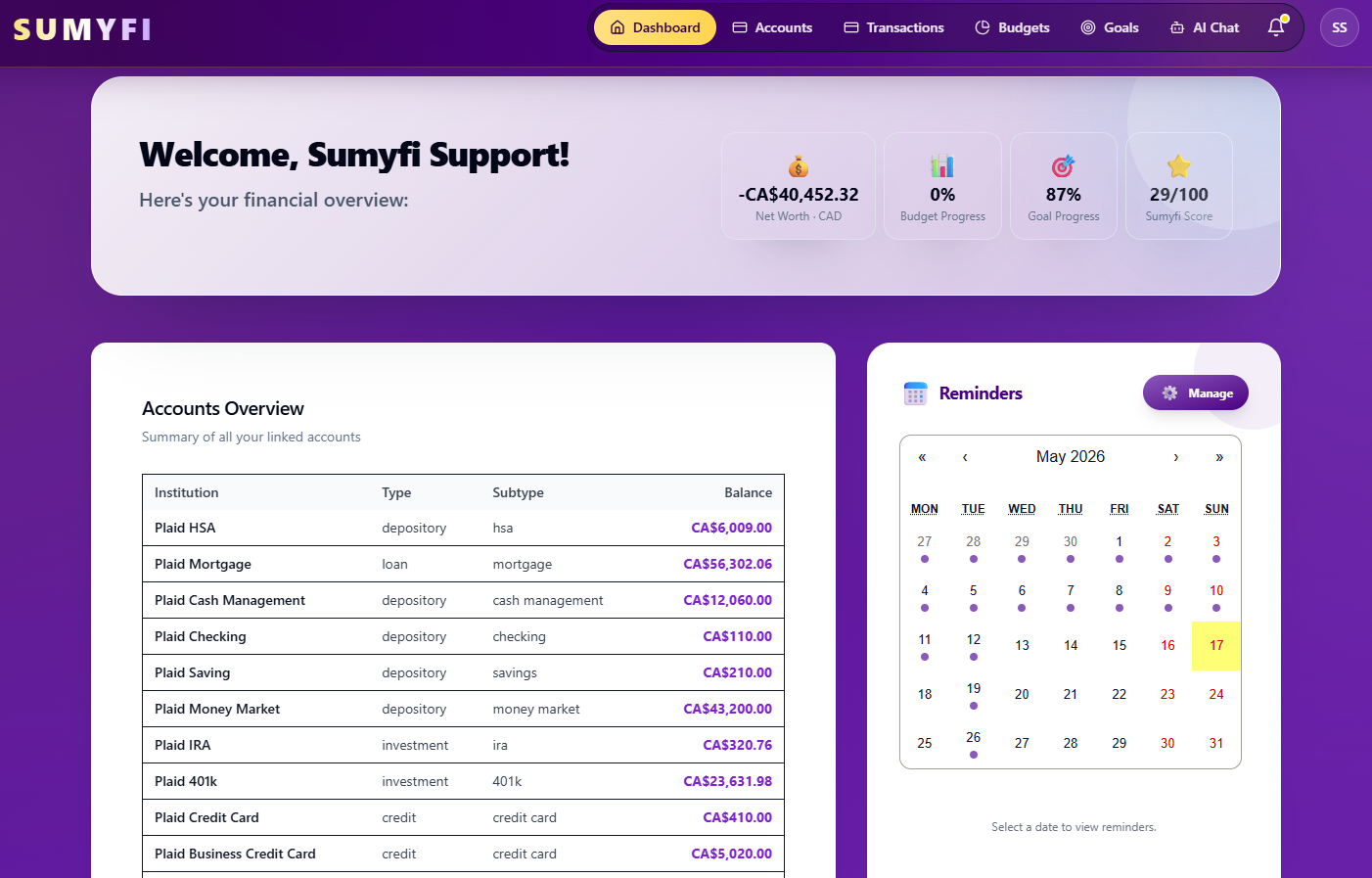
    The screenshots below make the dashboard, accounts, budgeting, AI, reminders, and progress surfaces more concrete for serious buyers.

    Net worth oriented dashboard in Sumyfi

    See the bigger financial picture without losing the everyday context underneath it.

    Assets and liabilities across accounts in Sumyfi

    Assets, debts, and balances can be reviewed in one place.

    Goal progress view in Sumyfi

    Long-term progress is easier to trust when it connects to active goals and spending behavior.

    What matters in practice

    What debt + net worth tracker needs to solve in real life

    Debt + Net Worth Tracker matters when the current setup still leaves too much guesswork. People may already have account access, a spreadsheet, a budgeting tool, or a subscription list, but they still do not feel clear on what changed, what is drifting, or what deserves attention first.

    The useful solution is the one that turns raw money data into orientation. Sumyfi fits that need by keeping accounts, recurring spending, goals, and planning close enough together that the next decision is easier to make.

    What to look for

    • Built around helping people see debt reduction and net worth growth together instead of in separate tools
    • Useful for everyday personal finance users
    • Designed to reduce fragmented weekly money review

    What to test first

    The workflow should answer a few important questions quickly

    A finance tool earns its place when it helps you answer practical questions without a lot of cleanup. Can you see what changed this week? Can you spot a recurring charge, a balance shift, or a category problem quickly enough to do something about it? Can you move from review into action without opening three more tools?

    That is where many products still fall short. They centralize information but leave interpretation scattered. Sumyfi works better when the goal is to keep balances, recurring charges, goals, and next actions close enough together that the review feels usable instead of performative.

    What to compare first

    How to judge debt + net worth tracker without getting distracted by feature noise

    The comparison framework is usually simpler than buyers expect. Look at whether the product makes account visibility easier, whether it explains spending clearly, whether recurring costs and goals stay connected to the rest of the money picture, and whether the workflow still feels manageable after a busy month.

    That is where Sumyfi tends to stand out. It is built to help users see the broader financial picture quickly, interpret what changed, and keep planning visible without forcing a dozen separate tools or a heavy maintenance ritual.

    What to look for

    • Account visibility
    • Spending clarity
    • Goals and recurring-spend context
    • Low-friction repeat use
    • Trust and reliability

    Why Sumyfi fits

    Why Sumyfi makes more sense when the whole system matters

    Sumyfi helps with this problem because it is not limited to one narrow money use case. Users can connect accounts, review recurring costs, track goals, and understand changes inside one environment instead of solving one visible symptom while leaving the rest of the system fragmented.

    That broader fit matters for everyday personal finance users because the most useful finance app is usually the one that makes the next decision easier without demanding a complicated setup or a spreadsheet mindset. Sumyfi is most useful when the dashboard still helps after the first obvious problem has been handled.

    How it fits real life

    Why the everyday money routine matters more than the feature list

    The best finance product is usually the one that fits how people already review money when life is busy. If the workflow requires too much cleanup, too many separate tools, or too much mental translation, it usually gets abandoned no matter how good the feature list sounds.

    Sumyfi is built to reduce that fragmentation. The product helps users keep the bigger money picture visible while still making the next decision easier, which is what most serious shoppers are actually trying to buy.

    The Indispensable Role

    The Indispensable Role of a Debt and Net Worth Tracker in Modern Finance

    Imagine navigating a vast ocean without a compass or a map. That's akin to trying to manage your finances without a clear understanding of your debt and net worth. A sophisticated debt and net worth tracker acts as your financial GPS, providing real-time coordinates and historical trends, enabling you to make informed decisions that propel you forward.

    Why Tracking Debt

    Why Tracking Debt and Net Worth Isn't Optional, It's Foundational

    1. Unveiling Your True Financial Position: Many people have a vague idea of their financial standing, but few possess an accurate, up-to-the-minute snapshot. A robust debt and net worth tracker aggregates all your assets (what you own) and liabilities (what you owe) into a single, cohesive view. This clarity is the first step towards genuine financial empowerment.

    2. Informed Decision-Making: Should you pay down that high-interest credit card, or invest more in your retirement account? Is now the right time to buy a home, or should you focus on aggressive debt reduction? Without a clear picture of your net worth and debt obligations, these decisions become guesswork. A tracker provides the data needed for strategic financial planning.

    3. Goal Setting and Progress Monitoring: Whether your goal is to save for a down payment, retire early, or achieve debt freedom, you need a benchmark. A personal net worth tracker allows you to set specific, measurable goals and visually track your progress over time. Seeing your net worth grow, or your debt diminish, is a powerful motivator.

    4. Identifying Trends and Patterns: Your financial life isn't static. Income fluctuates, expenses change, and investments evolve. A dedicated debt and net worth tracker helps you identify long-term trends in your financial health, allowing you to anticipate challenges and capitalize on opportunities. Are you consistently accumulating more debt? Is your asset growth stagnating? The data will tell the story.

    5. Peace of Mind and Reduced Stress: Financial uncertainty is a leading cause of stress. By bringing order and clarity to your finances, a comprehensive tracker can significantly reduce anxiety, replacing worry with confidence and control.

    The Psychological Edge:

    The Psychological Edge: How Visibility Fuels Motivation

    There's a profound psychological impact when you can visually observe your financial progress. Seeing your net worth line steadily climb, or your debt balance shrink month after month, provides tangible evidence of your efforts. This positive reinforcement encourages consistency, reinforces good habits, and makes the journey towards financial freedom feel less daunting and more achievable. It transforms abstract financial concepts into a game you can win.

    Deconstructing Debt: Types,

    Deconstructing Debt: Types, Impact, and Strategic Management

    Debt, often viewed negatively, isn't inherently bad. It's a tool that can be used wisely or unwisely. Understanding its nuances is critical for effective management and for accurately calculating your net worth. A superior debt and net worth tracker must provide granular insights into all your liabilities.

    How Debt Directly

    How Debt Directly Impacts Your Net Worth

    Your net worth is a direct reflection of your assets minus your liabilities. Every dollar of debt you carry reduces your net worth. High-interest debt, in particular, erodes your financial power by diverting funds that could otherwise be saved or invested. A debt management tool within a comprehensive tracker helps you visualize this impact, showing how reducing liabilities directly boosts your net worth.

    Strategic Debt Reduction:

    Strategic Debt Reduction: Pathways to Freedom

    A powerful debt and net worth tracker doesn't just show you your debt; it empowers you to conquer it. Two popular strategies for debt reduction are:

    1. The Debt Snowball Method:

    2. The Debt Avalanche Method:

    A sophisticated debt and net worth tracker like Sumyfi can help you model these scenarios, allowing you to see the projected impact of each strategy on your debt-free date and overall net worth growth.

    What to look for

    • Concept: Pay the minimum on all debts except the smallest one. Aggressively pay off the smallest debt first. Once it's paid, take the money you were paying on that debt and add it to the payment of the next smallest debt.
    • Benefit: Provides psychological wins and momentum as debts are eliminated quickly, regardless of interest rates.
    • Example:
    • Credit Card A: $500 (18% APR) - Min. $25
    • Personal Loan B: $2,000 (10% APR) - Min. $50
    • Car Loan C: $10,000 (5% APR) - Min. $200
    • *Strategy:* Pay $250 on Credit Card A (Min. $25 + extra $225). Pay minimums on B and C. Once A is paid, apply the $250 to Personal Loan B.
    • Concept: Pay the minimum on all debts except the one with the highest interest rate. Aggressively pay off the highest-interest debt first. Once it's paid, take the money you were paying on that debt and add it to the payment of the next highest-interest debt.
    • Benefit: Mathematically saves the most money on interest over time.
    • Example: Using the same debts as above, you'd prioritize Credit Card A first due to its 18% APR, despite it being the smallest debt.
    • *Strategy:* Pay $250 on Credit Card A. Pay minimums on B and C. Once A is paid, apply the $250 to Personal Loan B (next highest APR).

    Understanding Net Worth:

    Understanding Net Worth: Assets, Liabilities, and the Equation

    Your net worth is the single most important metric for gauging your financial health. It's a snapshot of your financial standing at any given moment, and a powerful indicator of your progress towards long-term wealth accumulation. A comprehensive financial net worth tracker simplifies this complex calculation.

    The Net Worth

    The Net Worth Equation: Assets - Liabilities = Net Worth

    This fundamental equation underpins all personal finance. Let's break down its components:

    #### Assets: What You Own

    Assets are anything of monetary value that you possess. They can be categorized into various types:

    1. Liquid Assets: Easily convertible to cash without significant loss of value.

    2. Investment Assets: Held for potential appreciation or income generation.

    3. Real Estate Assets: Property owned.

    4. Personal Property Assets: Items with significant value, though often less liquid.

    #### Liabilities: What You Owe

    Liabilities are your financial obligations - debts you are responsible for paying.

    1. Secured Liabilities:

    2. Unsecured Liabilities:

    What to look for

    • Cash: Physical currency, money in checking accounts, savings accounts.
    • Money Market Accounts: Short-term, low-risk investments.
    • Certificates of Deposit (CDs): Savings accounts that hold a fixed amount of money for a fixed period, yielding fixed interest.
    • Stocks and Bonds: Direct investments in companies or government/corporate debt.
    • Mutual Funds & ETFs: Diversified portfolios of stocks, bonds, or other assets.
    • Retirement Accounts: 401(k)s, IRAs (Roth, Traditional), pensions, RSPs, TFSAs.
    • Brokerage Accounts: Non-retirement investment accounts.
    • Cryptocurrencies: Digital assets (e.g., Bitcoin, Ethereum).
    • Primary Residence: Your home.
    • Investment Properties: Rental homes, commercial properties, land.
    • Vehicles: Cars, motorcycles, boats.
    • Valuables: Jewelry, art, collectibles.
    • Business Equity: Your ownership stake in a private business.
    • Mortgages: Loans used to purchase real estate.
    • Auto Loans: Loans used to purchase vehicles.
    • Credit Card Debt: Revolving debt from credit cards.
    • Personal Loans: Unsecured loans from banks or credit unions.
    • Student Loans: Loans for educational expenses.
    • Lines of Credit: Revolving credit facilities.
    • Medical Debt: Outstanding bills for healthcare services.
    • Other Loans: Any other outstanding debts (e.g., furniture loans, appliance financing).

    Why Tracking Net

    Why Tracking Net Worth Growth is More Important Than Just a Positive Number

    While a positive net worth is certainly desirable, the true power lies in its *growth over time*. A personal net worth tracker that provides historical data and trend lines allows you to:

    An asset and liability tracker that clearly delineates these components and visualizes their changes is invaluable for strategic wealth building.

    What to look for

    • Assess Financial Health Trajectory: Are you consistently saving and investing more than you're spending and accruing debt?
    • Evaluate Investment Performance: How are your investment assets contributing to your overall wealth?
    • Identify Spending Leaks: If your net worth isn't growing as expected, it might signal excessive spending or insufficient income relative to your liabilities.
    • Measure Progress Towards Goals: Whether it's retirement or a major purchase, your net worth growth directly reflects your advancement.

    The Limitations of

    The Limitations of Traditional Debt and Net Worth Tracking Methods

    Before the advent of sophisticated financial technology, managing your assets and liabilities was often a cumbersome, error-prone, and time-consuming endeavor. These traditional methods, while once necessary, are now starkly inadequate for the demands of modern financial management.

    Manual Spreadsheets: The

    Manual Spreadsheets: The Illusion of Control

    For decades, the humble spreadsheet has been the go-to for DIY financial tracking. While offering a degree of customization, its drawbacks are significant:

    What to look for

    • Time-Consuming Data Entry: Every transaction, every account balance update, every investment change requires manual input. This is not only tedious but also a major deterrent to consistent tracking.
    • Prone to Human Error: Typos, missed entries, incorrect formulas - manual data entry is ripe for mistakes that can skew your financial picture entirely.
    • Lack of Real-Time Data: Spreadsheets are static. They only reflect your financial situation at the moment of the last update. In a dynamic financial world, this means you're always looking at outdated information.
    • Security Concerns: Storing sensitive financial data in unencrypted spreadsheets on personal devices can pose significant security risks if not properly managed.
    • Limited Visualization and Analysis: While you can create charts, generating insightful, interactive dashboards that truly reveal trends and patterns requires advanced spreadsheet skills and significant time investment.
    • No Automation: There's no automatic categorization, no bill reminders, no integration with financial institutions. It's entirely dependent on your manual efforts.

    Paper-Based Systems: The

    Paper-Based Systems: The Road to Disorganization

    Some individuals still rely on physical statements and ledgers. This method is, quite frankly, a recipe for chaos:

    What to look for

    • Disorganization and Clutter: Stacks of statements, receipts, and financial documents quickly become overwhelming.
    • Difficulty in Aggregation: Combining data from dozens of different statements (bank, credit card, investment, mortgage) to get a single net worth figure is incredibly difficult and time-consuming.
    • Lack of Accessibility: Your financial data is only available where the physical documents are.
    • Security Risks: Physical documents are vulnerable to theft, loss, or damage.
    • No Analytical Capabilities: Impossible to track trends, identify spending patterns, or forecast without manual transcription and calculation.

    Legacy Software: Clunky,

    Legacy Software: Clunky, Limited, and Outdated

    Older financial software, while a step up from spreadsheets, often falls short of modern expectations:

    These limitations underscore the critical need for a truly modern, agile, and comprehensive debt and net worth tracking solution - one built for the speed and complexity of today's financial world.

    What to look for

    • Clunky User Interfaces (UI): Often designed with outdated aesthetics and unintuitive navigation, making them frustrating to use.
    • Limited Bank Connections: May not support a wide array of financial institutions, especially smaller banks, credit unions, or institutions in different countries (e.g., Canada for US-centric tools).
    • Slow Updates and Maintenance: Lagging behind in incorporating new financial technologies or adapting to changes in banking APIs.
    • Subscription Fatigue: Many older models require hefty annual fees without delivering commensurate value or innovation.
    • Lack of Mobile Optimization: Often desktop-centric, failing to provide a seamless experience on mobile devices, which are now central to how people manage their lives.
    • Security Vulnerabilities: Older software may not have the most robust, up-to-date encryption and security protocols.

    Enter the Modern

    Enter the Modern Era: What Makes an Elite Debt and Net Worth Tracker?

    The evolution of financial technology has brought forth a new generation of tools that redefine how we manage our money. An elite debt and net worth tracker transcends mere data aggregation; it becomes an indispensable financial co-pilot, offering unparalleled clarity, automation, and insight.

    Core Features: The

    Core Features: The Non-Negotiables for a Superior Tracker

    1. Automated Bank & Investment Connections (US & Canada): The cornerstone of any modern tracker. It must seamlessly link with thousands of financial institutions, including banks, credit unions, investment brokerages, and even cryptocurrency exchanges, across both the United States and Canada. This eliminates manual data entry entirely.

    2. Real-Time Data Synchronization: Your financial picture is constantly changing. The best trackers update account balances, transaction histories, and investment values in near real-time, ensuring you always have the most current information.

    3. Comprehensive Asset Tracking: Beyond just cash, it should track all asset types:

    4. Detailed Liability Tracking: Accurately monitor all forms of debt:

    5. Intuitive Dashboard and Visualizations: A clean, user-friendly interface that presents complex financial data in easily digestible charts, graphs, and summaries. Visual trends for net worth growth, debt reduction, and asset allocation are critical.

    6. Net Worth Historical Trends: The ability to view your net worth over various timeframes (month-over-month, quarter-over-quarter, year-over-year) to identify patterns and measure long-term progress.

    7. Automated Transaction Categorization: Intelligently categorizes your spending and income, providing a clear breakdown of where your money is going without manual effort. Customizable categories are a bonus.

    8. Robust Security Protocols: Bank-level encryption, multi-factor authentication, read-only access to accounts (never storing your login credentials), and adherence to strict privacy standards are paramount.

    9. Mobile Accessibility: A fully functional, responsive mobile app that allows you to manage and monitor your finances on the go, from any device.

    What to look for

    • Checking & Savings accounts
    • Investment accounts (stocks, bonds, mutual funds, ETFs, retirement funds)
    • Real estate (with estimated values)
    • Cryptocurrencies
    • Other valuable assets (e.g., vehicles, valuables, business equity)
    • Mortgages
    • Auto loans
    • Student loans
    • Credit card balances
    • Personal loans and lines of credit
    • Other outstanding debts

    Beyond the Basics:

    Beyond the Basics: Features That Elevate Your Financial Management

    While the core features provide a solid foundation, truly elite debt and net worth tracker solutions offer additional functionalities that transform them into complete financial hubs:

    The synergy of these features creates an unparalleled financial management experience, moving beyond simple tracking to proactive financial stewardship.

    What to look for

    • Financial Goal Setting & Progress Monitoring: Tools to define specific financial goals (e.g., save for a down payment, pay off credit card debt by X date) and track your progress towards them.
    • Integrated Budgeting Tools: Seamlessly combine net worth tracking with budgeting capabilities, allowing you to create budgets, monitor spending against limits, and identify areas for savings.
    • Subscription Management: Automatically detect and list all your recurring subscriptions, helping you identify and cancel unwanted services.
    • Customizable Reporting: Generate detailed reports on specific aspects of your finances, such as spending categories, income sources, or investment performance.
    • Cash Flow Analysis: Understand the movement of money in and out of your accounts, identifying periods of surplus or deficit.
    • Forecasting Tools: Project future net worth based on current savings rates, investment returns, and debt repayment schedules.
    • Alerts and Notifications: Receive automated alerts for low balances, upcoming bills, or significant changes in your accounts.

    Sumyfi: Redefining Your

    Sumyfi: Redefining Your Financial Trajectory with the Ultimate Debt and Net Worth Tracker

    In a world saturated with fragmented financial tools, Sumyfi emerges as the quintessential modern solution - an all-in-one personal finance hub engineered for clarity, control, and accelerated financial growth. It's not just a debt and net worth tracker; it's your complete financial ecosystem, designed to replace the clutter of manual spreadsheets and the limitations of legacy software with an experience that is empowering, slick, and crystal-clear.

    Why Sumyfi Stands

    Why Sumyfi Stands Apart: Agile Engineering Meets Financial Brilliance

    Sumyfi was built from the ground up to address the frustrations of traditional financial management, offering a seamless, intelligent, and secure platform that empowers users across both the US and Canada.

    What to look for

    • Unrivaled Connectivity, US & Canada Wide: Sumyfi boasts lightning-fast, secure connections with *thousands* of financial institutions across both the United States and Canada. This means no matter where you bank or invest, Sumyfi can pull in your data, providing a truly holistic view of your finances without geographical limitations. From major banks to local credit unions, investment platforms to cryptocurrency exchanges, Sumyfi connects with unparalleled breadth.
    • Agile Engineering for Lightning-Fast Setup: Forget cumbersome onboarding processes. Sumyfi's agile engineering ensures a setup that is remarkably swift and intuitive. You can connect all your accounts and have a comprehensive view of your net worth in minutes, not hours or days.
    • Slick, Intuitive Dashboard Interface: Financial management should be a joy, not a chore. Sumyfi's dashboard is a masterclass in user experience - clean, modern, and incredibly easy to navigate. Complex data is transformed into beautiful, actionable visualizations that immediately tell you where you stand.
    • Automated Transaction Tracking & Categorization: Say goodbye to manual data entry. Sumyfi automatically imports and intelligently categorizes your transactions, giving you an immediate, accurate breakdown of your spending and income. You can customize categories to fit your unique financial life.
    • Crystal-Clear Net Worth Visualization & Historical Trends: Sumyfi's personal net worth tracker is second to none. See your assets and liabilities aggregated into a single, dynamic net worth figure. Track its growth or decline over time with elegant graphs, understand the contributing factors, and celebrate your progress towards wealth accumulation.
    • Robust Debt Tracking & Management Tools: Gain granular insight into every liability. Sumyfi allows you to track all your debts, monitor interest rates, and visualize the impact of your repayment strategies. See how quickly you can become debt-free and how each payment boosts your net worth. It's an intelligent debt management tool that motivates progress.
    • Beyond Just Tracking: A Complete Financial Hub: Sumyfi isn't just an asset and liability tracker. It integrates powerful budgeting tools, spending insights, and financial goal setting. Understand your cash flow, identify saving opportunities, and set concrete targets for your financial future, all within one unified platform.
    • Unparalleled Security and Privacy: Your financial security is Sumyfi's top priority. Utilizing bank-level encryption, multi-factor authentication, and read-only access to your accounts (Sumyfi never stores your banking credentials), your data is protected with the highest industry standards. We are built on trust and transparency.

    How Sumyfi Works:

    How Sumyfi Works: Your Journey to Financial Empowerment

    1. Connect Your Accounts: Securely link all your bank accounts, credit cards, investment portfolios, mortgages, loans, and even crypto wallets from thousands of institutions across the US and Canada. This takes just a few clicks.

    2. Automated Data Sync: Sumyfi instantly pulls in your historical data and continuously syncs new transactions and balances, providing a real-time, always-accurate picture of your finances.

    3. Explore Your Dashboard: Immediately see your aggregated net worth, a breakdown of your assets and liabilities, recent transactions, and spending categories. The intuitive interface makes understanding your financial health effortless.

    4. Deep Dive into Assets & Liabilities: Click into specific accounts to view details, track individual debt progress, and analyze asset performance.

    5. Set & Achieve Goals: Utilize Sumyfi's integrated tools to set specific financial goals - whether it's paying off a credit card, saving for a down payment, or boosting your investment portfolio - and track your progress visually.

    Sumyfi is more than software; it's a partner in your financial journey, providing the clarity, automation, and insights you need to make smarter decisions and build the future you envision.

    Maximizing Your Sumyfi

    Maximizing Your Sumyfi Debt and Net Worth Tracker for Optimal Results

    Possessing a powerful tool like Sumyfi is the first step; utilizing it to its full potential is where the real transformation happens. Here's how to leverage your Sumyfi debt and net worth tracker for maximum impact:

    1. Regular Dashboard Review: Make it a habit to check your Sumyfi dashboard at least once a week, if not daily. This consistent engagement keeps you connected to your financial reality, allowing you to quickly spot anomalies, track progress, and reinforce good habits.

    2. Adjust and Refine Financial Goals: Your financial life isn't static. As circumstances change (new job, family additions, market fluctuations), revisit your financial goals within Sumyfi. Adjust your savings targets, debt repayment schedules, and investment contributions to ensure they remain aligned with your evolving aspirations.

    3. Utilize Budgeting Features in Conjunction: Your net worth is a lagging indicator; your budget is a leading one. Use Sumyfi's integrated budgeting tools to control your spending and direct more funds towards debt repayment or savings. See how adhering to your budget directly impacts your net worth growth.

    4. Identify Spending Patterns & Optimize: Dive into Sumyfi's automated transaction categorization. Are there recurring expenses you can cut? Are you overspending in certain categories? Identifying these patterns is crucial for freeing up cash flow that can be redirected to accelerating debt payoff or boosting investments.

    5. Proactive Debt Management: Don't just track your debt; actively manage it. Use Sumyfi to identify your highest-interest debts and focus your efforts there. Consider setting up automated payments directly from your bank to ensure consistency and avoid missed payments. Sumyfi can help you visualize the "snowball" or "avalanche" effect as you tackle each liability.

    6. Monitor Investment Performance: Keep an eye on your investment assets. While Sumyfi isn't an investment advisor, it provides the data to see how your portfolio is contributing to your net worth. This can help inform discussions with your financial advisor or guide your own research.

    7. Leverage Alerts and Notifications: Set up custom alerts within Sumyfi for important financial events - low account balances, large transactions, or upcoming bill due dates. This proactive approach helps prevent overdrafts, late fees, and financial surprises.

    By actively engaging with your Sumyfi debt and net worth tracker, you transform it from a passive reporting tool into an active partner in your wealth-building journey.

    Future-Proofing Your Finances:

    Future-Proofing Your Finances: The Long-Term Value of a Dedicated Tracker

    The benefits of a sophisticated debt and net worth tracker like Sumyfi extend far beyond immediate financial clarity. They lay the groundwork for long-term financial resilience, strategic wealth accumulation, and peace of mind across all life stages.

    In essence, a dedicated debt and net worth tracker isn't just about managing today's money; it's about building a robust financial future, empowering you to navigate life's complexities with confidence and foresight.

    What to look for

    • Preparing for Major Life Events: Whether it's planning for retirement, saving for a child's education, purchasing a second property, or starting a business, having a clear, historical record of your net worth and debt obligations provides the foundational data for accurate planning and forecasting.
    • Estate Planning Insights: A comprehensive financial net worth tracker simplifies the often-complex process of estate planning. By having all your assets and liabilities meticulously tracked and valued, you provide invaluable data for your loved ones and legal professionals, ensuring your wishes are clearly understood and executed.
    • Adapting to Economic Shifts: Economic downturns, inflation, and market volatility are inevitable. With Sumyfi, you have the tools to quickly assess the impact of these shifts on your net worth and make timely adjustments to your financial strategy, whether it's de-risking investments or accelerating debt payments.
    • Cultivating a Legacy of Financial Literacy: By actively managing your finances with a sophisticated tool, you not only benefit yourself but also set an example for future generations. The habits of diligent tracking, budgeting, and strategic debt management are invaluable lessons for financial success.
    • Long-Term Wealth Building Strategies: Sumyfi provides the data necessary to evaluate the effectiveness of your wealth-building strategies. Are your investments performing as expected? Is your debt leverage appropriate for your goals? The insights gained from consistent tracking are crucial for optimizing your path to financial independence.

    Conclusion: Your Financial

    Conclusion: Your Financial Future Starts with Clarity and Control

    The journey to financial freedom is paved with knowledge, discipline, and the right tools. A truly effective debt and net worth tracker is no longer a luxury but a fundamental necessity for anyone serious about building wealth and securing their financial future. The days of fragmented data, manual updates, and guesswork are over.

    Sumyfi stands at the forefront of this financial revolution, offering an unparalleled, all-in-one personal finance hub that seamlessly connects your entire financial life across thousands of institutions in the US and Canada. Its agile engineering, lightning-fast setup, and slick dashboard are designed to transform your relationship with money, providing the clarity, control, and confidence you need to thrive.

    Stop managing your finances in the dark. Embrace the power of a modern debt and net worth tracker and unlock your full financial potential.

    Ready to take control of your financial destiny?

    [Start Your Sumyfi Journey Today - Sign Up Now!](https://www.sumyfi.com/signup)

    [Download the Sumyfi App and Experience Financial Clarity](https://www.sumyfi.com/download-app)

    FAQs

    Frequently asked questions about debt + net worth tracker

    Is Sumyfi really a strong option for debt + net worth tracker?

    Yes, especially if the real goal behind the search is reducing fragmentation. Sumyfi is strongest for users who want connected accounts, clear budgeting, visible goals, recurring-spend awareness, and modern AI-assisted explanations in one place rather than separate disconnected tools.

    What matters most when comparing options for debt + net worth tracker?

    Account connectivity, spending clarity, recurring-charge visibility, budgeting depth, goal support, trust posture, and ease of repeat use matter most. Those factors influence whether the tool becomes part of your real routine or remains a short-lived experiment.

    How does Sumyfi help people researching debt + net worth tracker day to day?

    Sumyfi helps by keeping the wider money picture visible for people trying to see debt reduction and net worth growth together instead of in separate tools. That makes it easier to understand tradeoffs, track progress, and act on recurring patterns without rebuilding the context in separate tools.

    What makes a finance app easier to keep using over time?

    Low-friction review loops matter most. If the dashboard helps you connect accounts, understand patterns quickly, and take the next action without extensive manual cleanup, you are much more likely to stay engaged. That ongoing usability matters more than a long feature list.

    Who is Debt + Net Worth Tracker usually best for?

    It is usually best for everyday personal finance users who want clearer financial visibility without building a heavy manual system. Sumyfi is strongest when the user wants practical weekly clarity more than niche complexity for its own sake.

    Topic cluster

    Keep exploring the same decision journey

    Guide hub

    Browse the full Sumyfi topic cluster

    Move from one question to the next through budgeting, dashboard, subscription, AI, and comparison guides that support the same decision journey.

    Budgeting and cash-flow guides
    Alternatives and competitor comparisons
    Net worth, dashboard, and AI finance guides