The debt snowball is simple on paper and hard to stick with for two years. A worked example, an honest look at snowball versus avalanche, and what a debt snowball tracker app should do to keep you going.
The debt snowball fits on an index card. List your debts from smallest balance to largest, pay the minimum on everything, and throw every extra dollar at the smallest one. When it's gone, roll its payment into the next one. Repeat until there's nothing left.
The hard part isn't understanding it. It's month 14, when the second debt is still there, a car repair ate your extra payment, and you can't remember whether this is working. That's where a debt snowball tracker app earns its place: it keeps the balances current, shows the total going down, and makes it obvious what to pay next. This guide walks through a real example, the tradeoff with the avalanche method, and how to set up tracking you'll actually keep up with.
How the debt snowball works, with real numbers
Here's a fairly typical set of debts:
| Debt | Balance | Interest rate | Minimum payment |
|---|---|---|---|
| Line of credit | $1,200 | 9.5% | $40 |
| Visa | $5,800 | 20.99% | $145 |
| Car loan | $9,000 | 7.9% | $270 |
The minimums add up to $455 a month. Say you can find another $200, so $655 a month goes to debt in total. With the snowball, it plays out like this:
- The line of credit gets its $40 minimum plus the full $200 extra. It's paid off in month 6.
- Its $240 rolls onto the Visa, which now gets $385 a month. The Visa is gone in month 22.
- All $655 now goes to the car loan, which is paid off in month 29.
Total interest paid comes to roughly $2,500. Your monthly outlay never changed. It was $655 from the first month to the last. What changed is where it went, and each payoff made the next payment bigger.
If you only paid the minimums, the Visa alone would take years and cost far more in interest, because $145 a month barely gets ahead of a balance at almost 21 percent. The $200 extra does most of the work. The snowball decides where it goes.
Snowball versus avalanche: what the difference actually costs
The avalanche method uses the same rollover idea but orders debts by interest rate, highest first. With the same three debts and the same $655 a month, the extra money goes to the Visa first. The Visa is paid off in month 21, the line of credit in month 22, and the car loan in month 28. Total interest comes to roughly $2,330.
So the avalanche saves about $180 and finishes a month sooner. That's real money, and mathematically the avalanche always wins or ties, because every extra dollar goes against the most expensive debt.
But look at when the first debt disappears. With the snowball, it's month 6. With the avalanche, you wait until month 21 for your first payoff. That's almost two years of watching a big Visa balance shrink slowly with nothing crossed off the list. Plenty of people quit in that stretch, and a plan you abandon in month 10 costs a lot more than $180.
My take: if your debts are close in interest rate, or the smallest balance is also expensive, the snowball costs you very little and the early wins are worth it. If one debt has a much higher rate and a large balance, run the numbers both ways, because the gap can be thousands rather than hundreds. Many people also do a hybrid: knock out one or two tiny balances for momentum, then switch to the highest rate.
You don't have to do the math by hand. Sumyfi has a free debt payoff calculator, no account needed, where you enter each debt's balance, interest rate and minimum payment plus your extra monthly amount. It compares snowball, avalanche and minimum payments only, side by side, with months to payoff, a debt-free date and total interest for each.
What a debt snowball tracker app should do
A payoff plan is a two-minute calculation. Tracking it for two or three years is the part that needs help. Here's what matters:
Current balances without retyping
If you have to update every balance by hand, you'll stop around month four. Connected credit cards and loans keep the numbers honest.
Total debt going down
Individual balances move slowly. The total across every debt is the number that shows progress, especially in the long middle stretch.
Clear liabilities in net worth
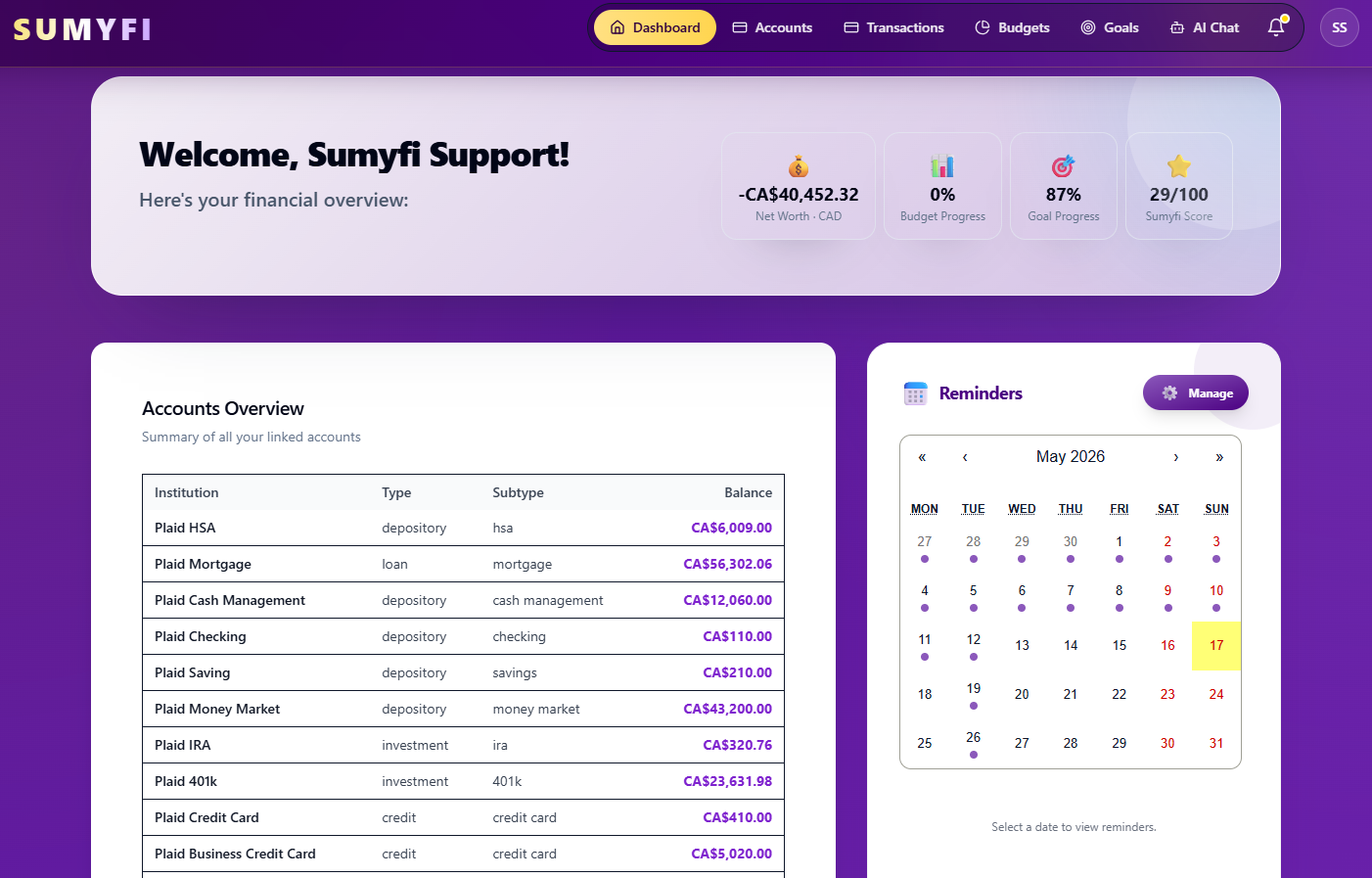
Debt should count against your net worth. Watching net worth climb from negative toward zero is motivating in a way a single balance isn't.
Room for manual debts
Family loans, a buy-now-pay-later plan or a store card that won't connect still belong in the plan, so you need a way to add them.
Help finding the extra money
The extra $200 has to come from somewhere. Seeing spending categories and recurring charges in the same place makes it easier to find and protect.
Using Sumyfi to track a debt snowball
To be straightforward about it: Sumyfi doesn't have a dedicated snowball screen that orders your debts and tells you what to pay. The free calculator handles the plan. The app handles the tracking, which is where most snowballs actually fail.
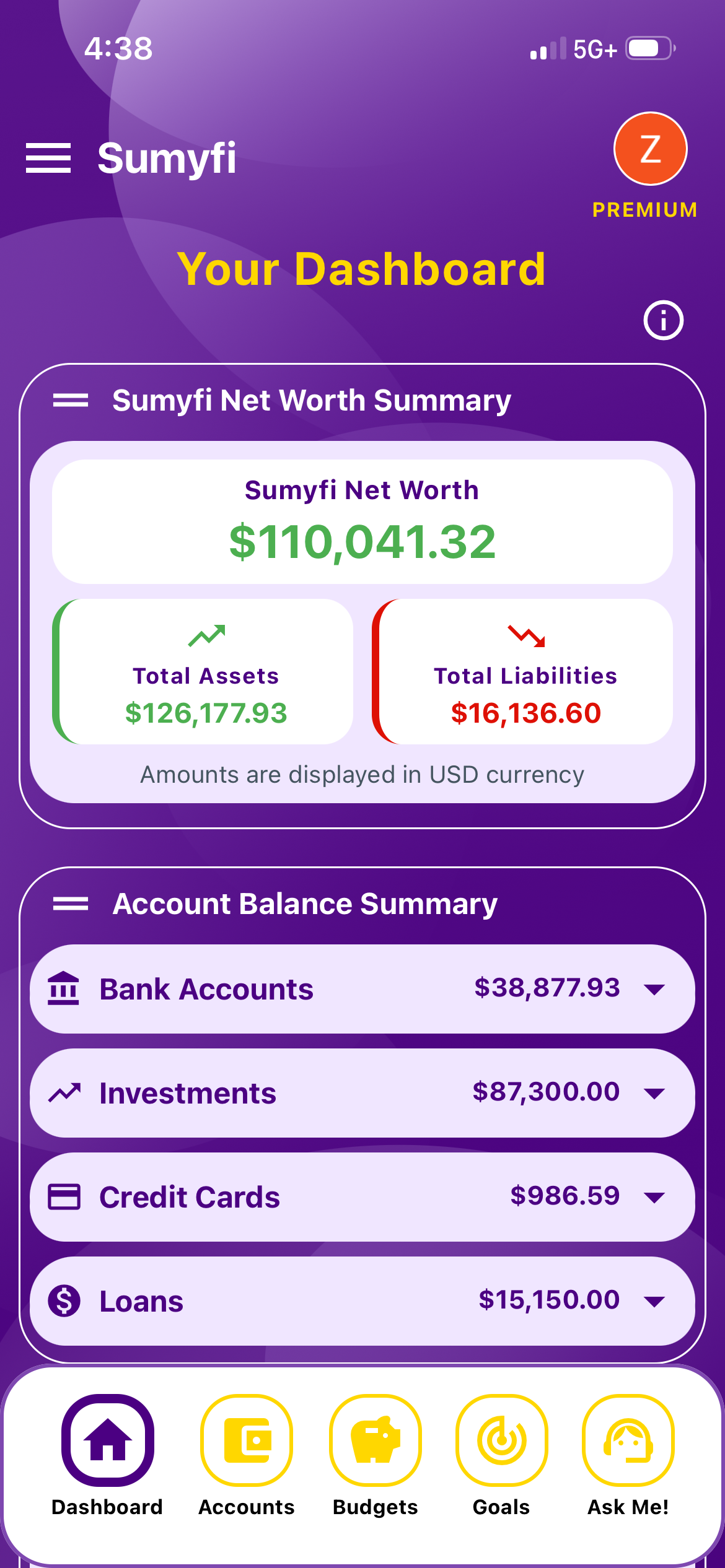
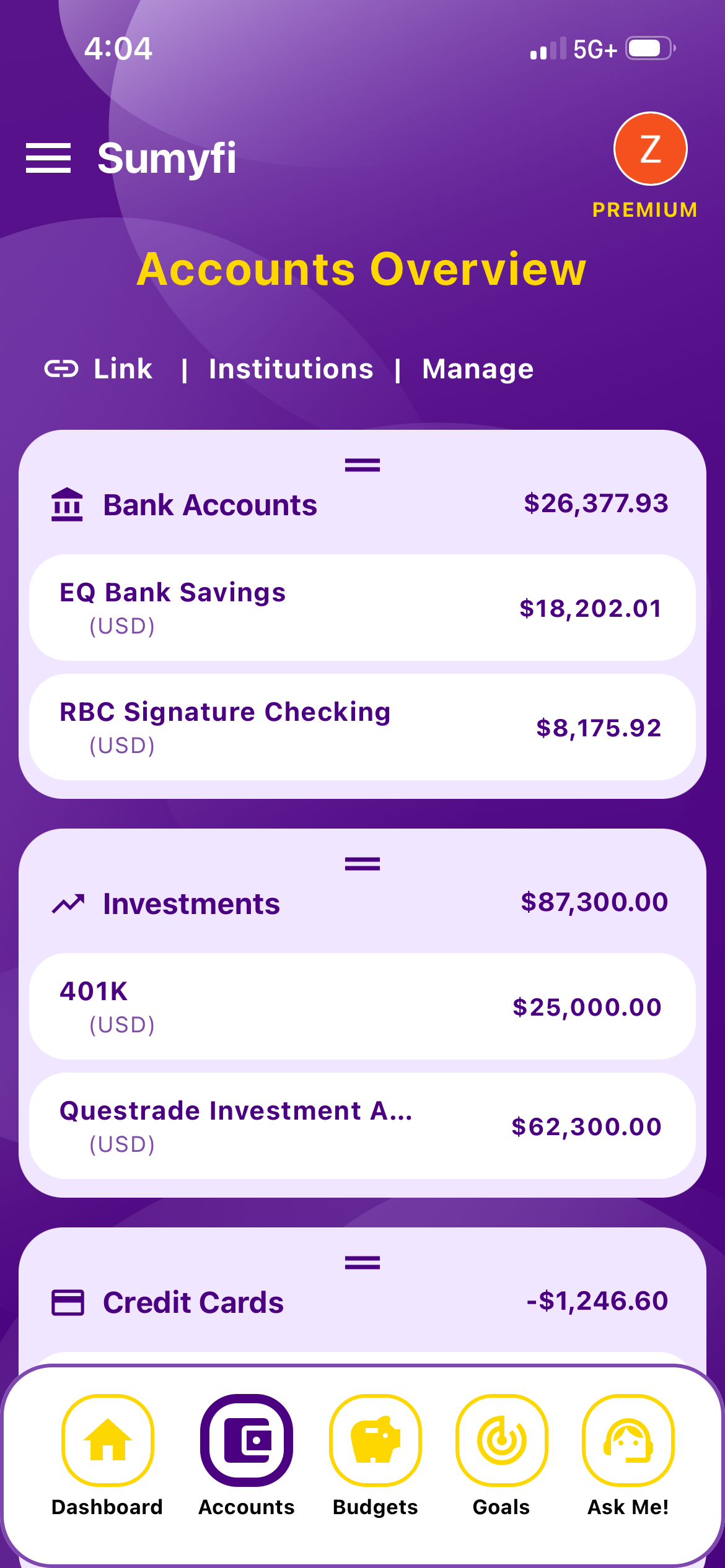
Credit cards and loans connect through Plaid, alongside your bank accounts, from more than 12,000 US and Canadian banks and credit unions, with read-only access. They show up as liabilities, net worth is assets minus liabilities, and you can see how each balance compares with last month. Anything that won't connect can be added as a manual account.
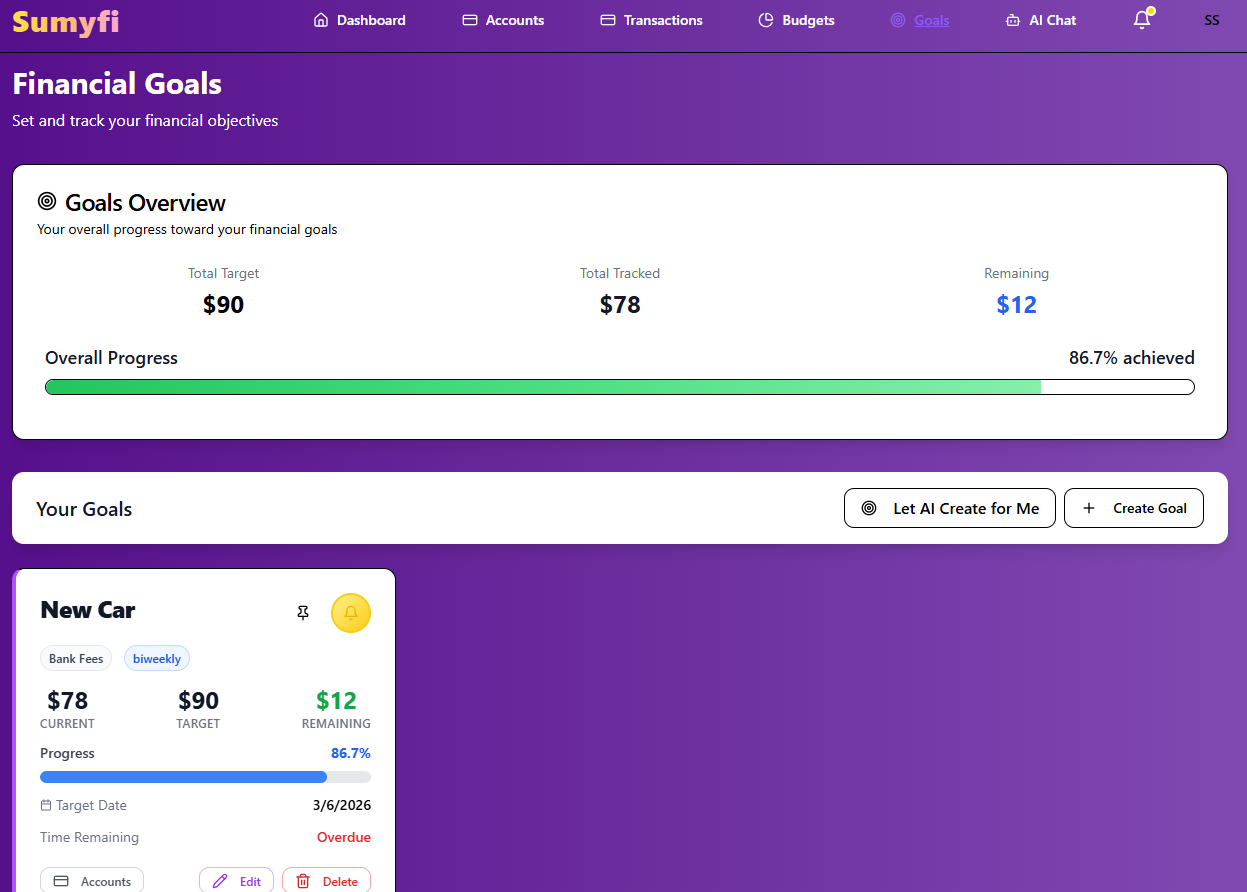
Goals take a target amount, a target date and a monthly contribution, and can be tied to a specific account. That makes it easy to set a goal like clearing the line of credit by June and see if you're on pace. The recurring charges view is useful for finding the extra money, since it lists subscriptions and shows annual renewals as a monthly cost.
A workflow that takes a few minutes a month:
- Run your debts through the free calculator and pick a method.
- Connect or manually add each debt so the balances are in one place.
- Set a goal for the current target debt with the payoff month the calculator gave you.
- Once a month, check that the target debt dropped by about what you paid, and that the total keeps falling.
- When a debt hits zero, set the next goal and move its payment over the same week.
How to keep going after the first payoff
Build a small cushion first. A starter emergency fund of around $1,000 means a flat tire or a vet bill doesn't go on the card you're trying to pay off. Without it, the snowball tends to go backwards the first time something breaks.
Send windfalls straight to the target debt. A tax refund, a bonus or a third paycheque month can knock months off the plan. In the example above, a $1,500 refund in month 3 would clear the line of credit right away and start the Visa phase early.
Re-run the numbers when something changes. If you move the Visa balance to a lower-rate option, get a raise, or take on new debt, plug the new figures into the calculator and update your goals. The order might change, and that's fine.
Think twice before closing paid-off cards. A card with a zero balance and no annual fee can be worth keeping open for your credit history. If having it around is a temptation, cut it up and keep the account.
And keep the check-ins short and regular. A debt snowball tracker app is only useful if you open it, and a monthly ten-minute look at the total going down is often what gets people through the slow middle. If you want the tracking side handled, Sumyfi's free plan supports manual accounts and goals, and Premium adds automatic sync for your cards and loans.