Use one clear workflow for financial accounts and personal assets inside one overview with practical comparisons, concrete product details, and fewer disconnected money tools.
For decades, individuals grappled with disparate spreadsheets, scattered statements, and a perpetual sense of uncertainty about their true net worth. Today, however, a revolutionary solution has emerged: the personal asset tracker app. This isn't just a digital ledger; it's your command center, your financial oracle, and the bedrock of your fiscal intelligence.
This comprehensive guide will delve into the profound impact of a cutting-edge personal asset tracker app, exploring its indispensable role in modern financial management, the advanced functionalities it offers, and how a platform like Sumyfi is redefining what's possible for individuals across North America. Prepare to transform your relationship with money, moving from reactive to proactive, from fragmented to holistic.
The Paradigm Shift: Why a Personal Asset Tracker App is Indispensable in the Modern Era
Consider the average individual's financial ecosystem: multiple bank accounts, credit cards, investment portfolios (stocks, bonds, mutual funds, ETFs, cryptocurrency), retirement accounts (401k, RRSP), mortgage, student loans, car loans, real estate holdings, and perhaps even alternative assets like precious metals or collectibles. Manually tracking all these moving parts is not just tedious; it's virtually impossible to do accurately and in real-time.
This is where a sophisticated personal asset tracker app becomes not just a convenience, but a necessity. It represents a fundamental paradigm shift from manual, reactive financial management to automated, proactive fiscal stewardship. By aggregating all your financial data into a single, secure interface, it empowers you with immediate, actionable insights, fostering a sense of control and confidence that was previously unattainable.
The Evolution from Ledger to Intelligent Hub
Historically, personal finance tracking involved paper ledgers, then basic spreadsheets. While these tools offered structure, they demanded immense manual input, were prone to error, and lacked real-time dynamism. The advent of early digital budgeting tools was a step forward, but many remained siloed, focusing predominantly on spending rather than a holistic view of assets and liabilities.
Modern personal asset tracker apps, exemplified by Sumyfi, transcend these limitations. They leverage advanced API technology to securely connect with thousands of financial institutions across the US and Canada, pulling in data automatically. This eliminates manual entry, ensures accuracy, and provides a living, breathing snapshot of your financial universe, updated in real-time. This evolution marks a transition from mere data recording to intelligent financial orchestration.
This fragmentation leads to
Lack of Clarity
Without a consolidated view, it's difficult to ascertain your true financial standing at any given moment.
Missed Opportunities
Inability to quickly identify underperforming assets or areas for optimization.
Increased Stress
The constant nagging worry about financial health, compounded by the effort required to gather information.
Ineffective Decision-Making
Financial choices made without a complete data set are often suboptimal.
What Exactly Does a Personal Asset Tracker App Do? Core Functionalities Explained
At its heart, a personal asset tracker app is designed to provide a comprehensive, real-time overview of your financial health. This encompasses understanding everything you own (assets) versus everything you owe (liabilities), ultimately calculating your net worth. But the capabilities extend far beyond a simple calculation.
Unified Account Aggregation
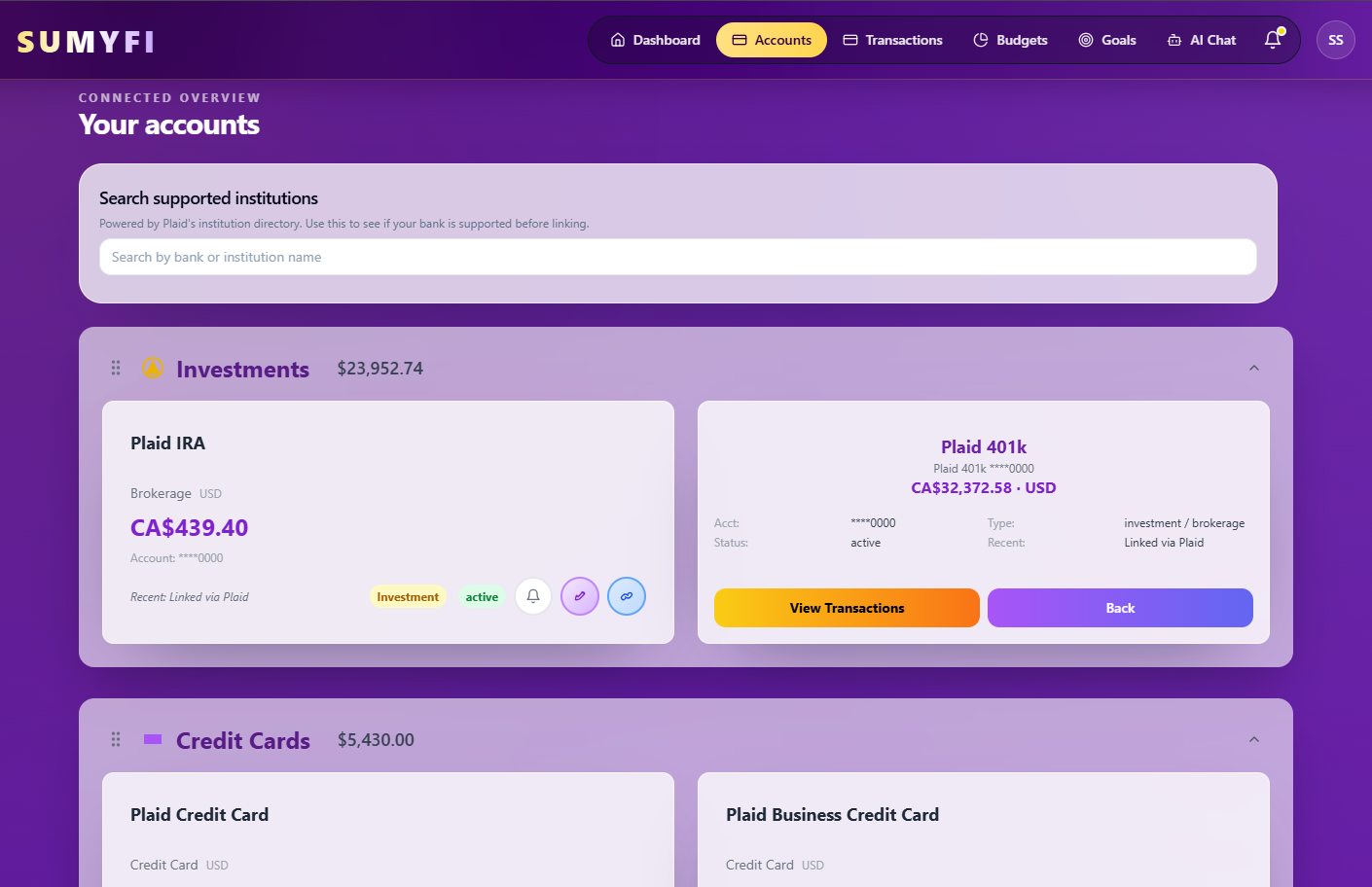
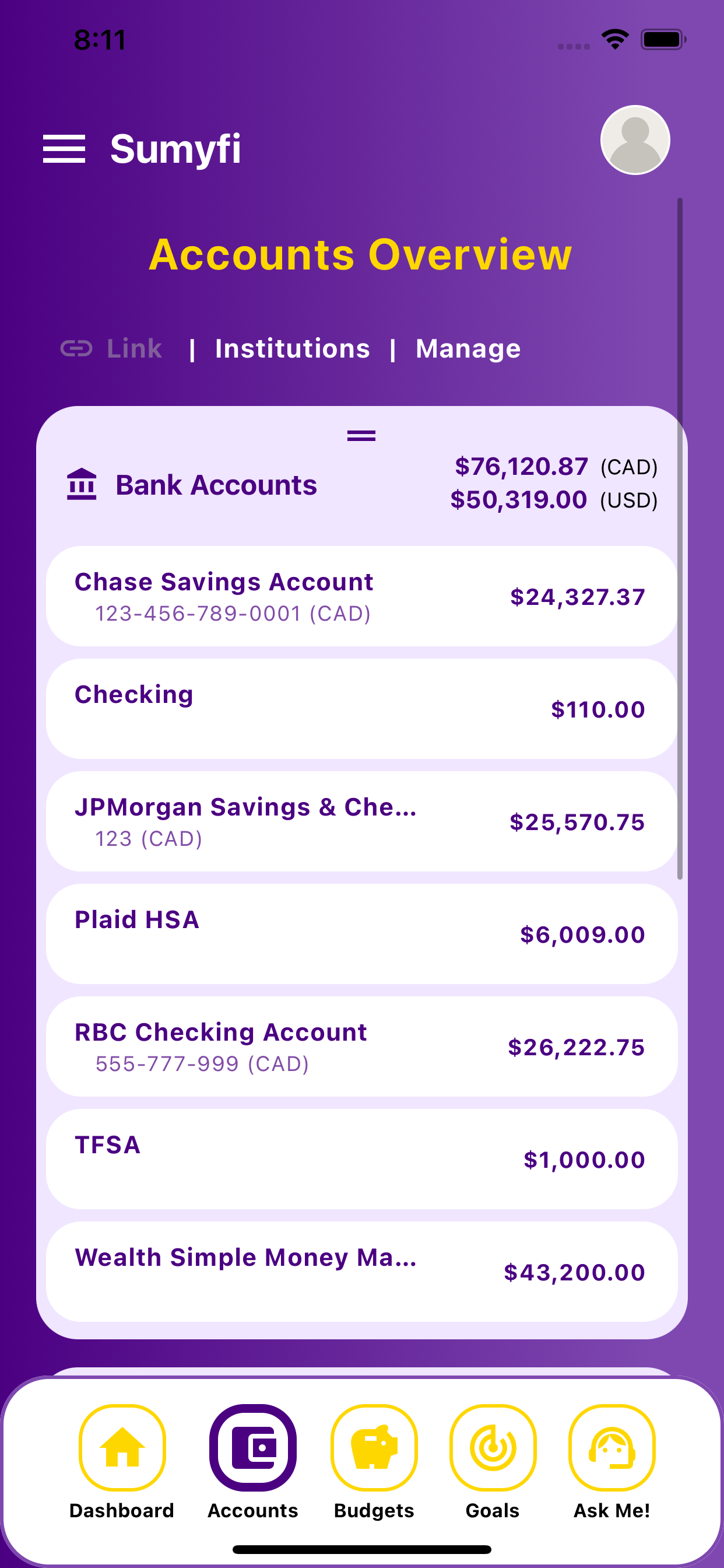
The cornerstone functionality. A premium personal asset tracker app connects to all your financial accounts - checking, savings, credit cards, mortgages, investment accounts (brokerages, robo-advisors), retirement plans, student loans, and more. This aggregation is secure, read-only, and forms the foundation for all subsequent analyses. Sumyfi's agile engineering allows for lightning-fast setup and connection to thousands of institutions, ensuring virtually all your financial touchpoints are covered.
Real-time Net Worth Calculation
Once accounts are aggregated, the app automatically calculates your net worth by subtracting your total liabilities from your total assets. This figure is dynamically updated as your account balances change, providing an accurate, up-to-the-minute reflection of your financial standing. Tracking net worth over time is a powerful motivator and a key indicator of financial progress.
Comprehensive Asset Categorization & Tracking
A robust personal asset tracker app doesn't just list your assets; it categorizes them intelligently. This includes:
Liability Management
Equally important is the tracking of liabilities:
By tracking both sides of the balance sheet, you gain a truly holistic view.
Transaction Monitoring & Categorization
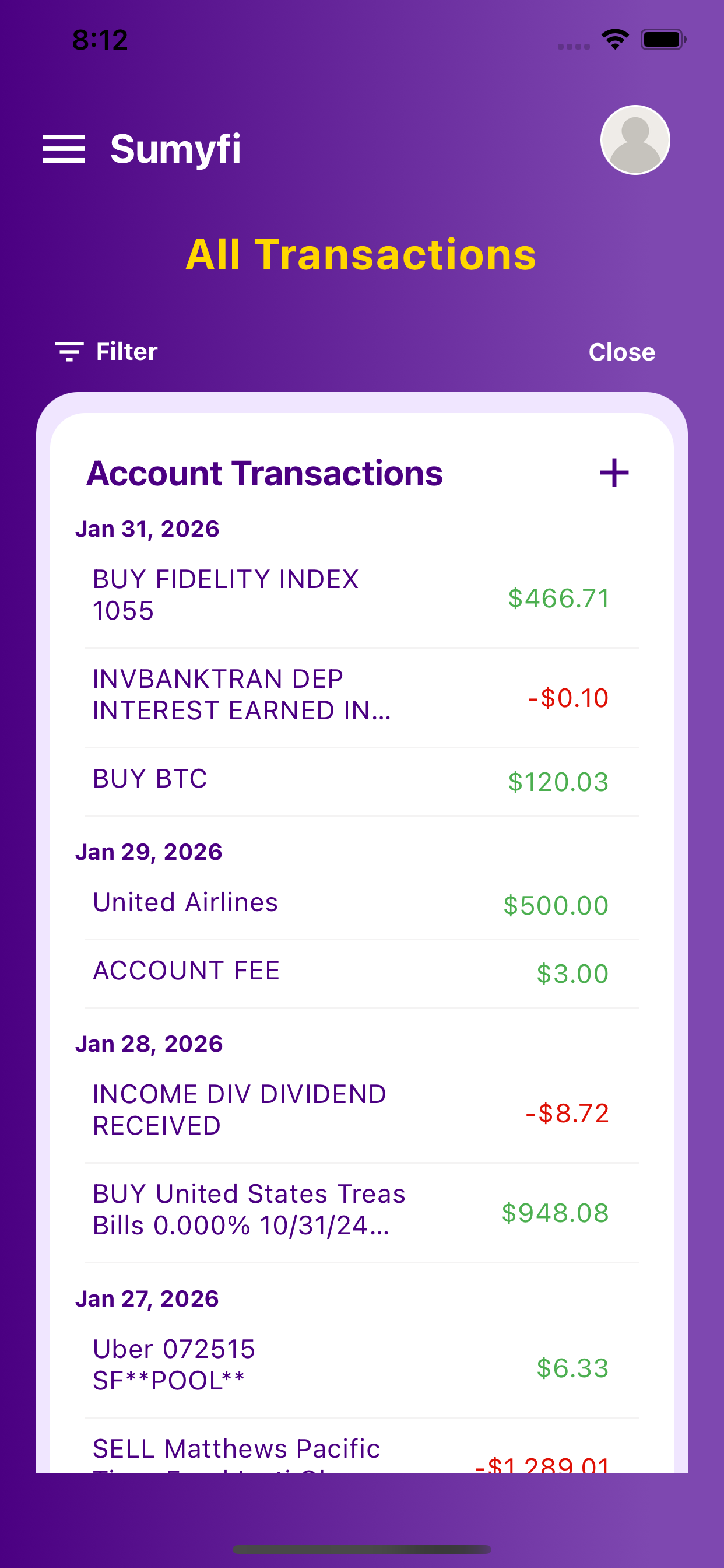
Beyond just balances, the app tracks individual transactions from connected accounts. Advanced apps use AI and machine learning to automatically categorize spending (e.g., groceries, utilities, entertainment). This forms the basis for budgeting, spending analysis, and identifying financial patterns. Sumyfi's intuitive interface allows for easy review and customization of categories, giving you granular control.
Performance Tracking & Visualization
For investment assets, a sophisticated personal asset tracker app tracks performance over time, showing gains, losses, and overall portfolio returns. It can visualize these trends through charts and graphs, making complex data easily digestible. This is crucial for making informed investment decisions and ensuring your portfolio aligns with your financial goals.
Liquid Assets: Cash, checking accounts, savings accounts.
Investment Assets: Stocks, bonds, mutual funds, ETFs, cryptocurrencies, precious metals, alternative investments.
Real Estate
Primary residence, investment properties (with estimated valuations).
Retirement Accounts
401(k), IRA, Roth IRA, RRSP, TFSA, LIRA.
Other Assets
Vehicles, collectibles, business equity, intellectual property (though some may require manual input for valuation).
Secured Debts
Mortgages, auto loans, secured lines of credit.
Unsecured Debts
Credit card balances, personal loans, student loans.
Other Liabilities
Medical debt, tax obligations.
The Sumyfi Advantage: Redefining Personal Asset Tracking for the Modern Investor
While many personal asset tracker apps exist, Sumyfi stands out as the ultimate modern solution, engineered from the ground up to address the complexities of contemporary personal finance.
Seamless, Secure, and Comprehensive Connectivity
Sumyfi's core strength lies in its ability to connect with thousands of financial institutions across both the US and Canada. This expansive reach ensures that whether you bank with a major national institution or a regional credit union, hold investments with diverse brokerages, or manage various debt accounts, Sumyfi can aggregate all your data. The connection process is lightning-fast and incredibly secure, utilizing bank-level encryption and read-only access protocols to safeguard your sensitive information.
Real-time, Dynamic Net Worth Tracking
Sumyfi provides a real-time, dynamically updated net worth calculation. As your assets appreciate, your debts decrease, or new transactions occur, your net worth figure instantly reflects these changes. This immediate feedback loop is incredibly powerful, transforming net worth from an abstract concept into an actionable metric that drives financial progress.
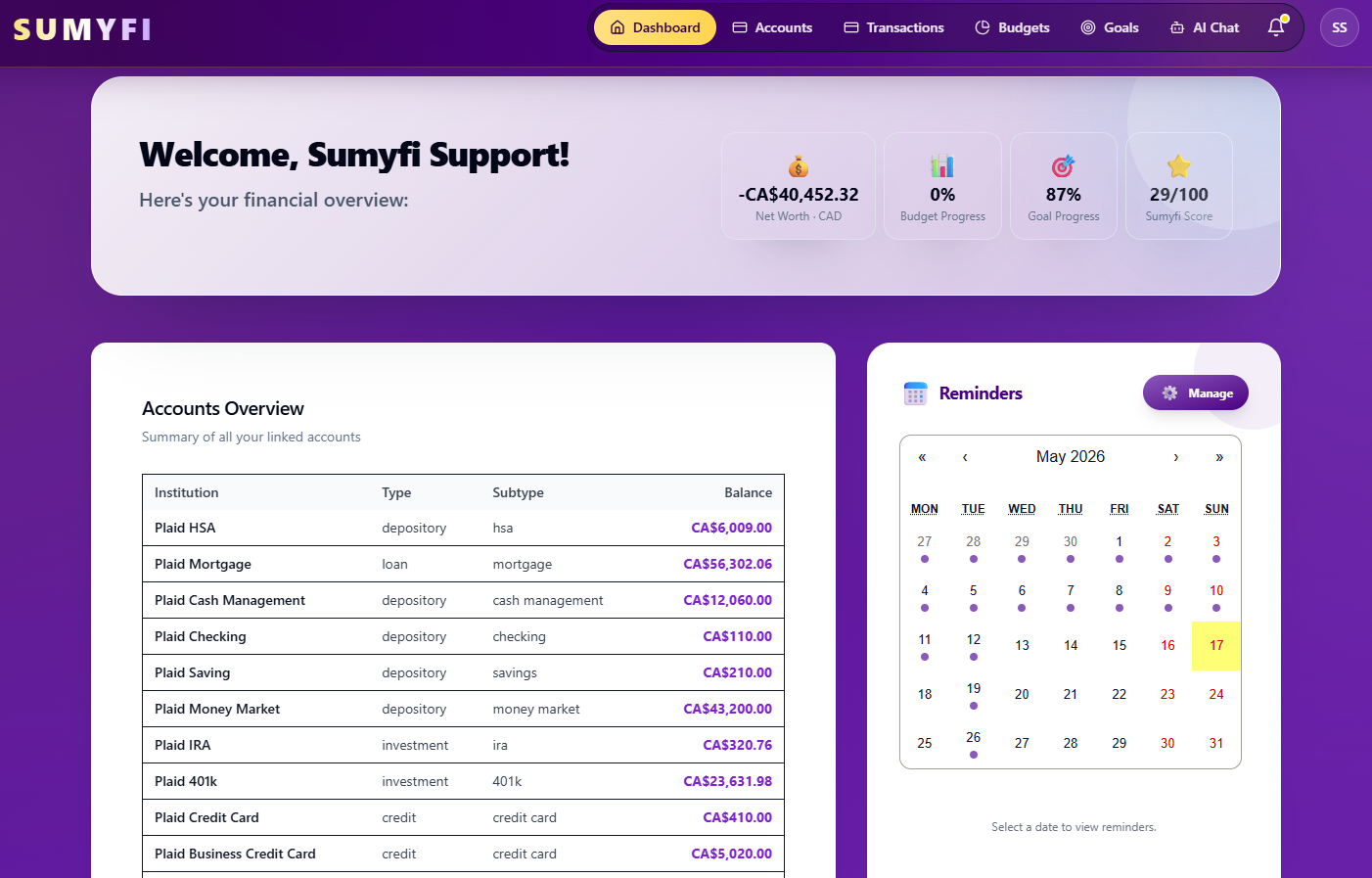
One of Sumyfi's most celebrated features is its beautifully designed, slick dashboard interface. Forget cluttered screens and confusing menus. Sumyfi presents your entire financial picture - assets, liabilities, spending, investments, and goals - in a clear, concise, and visually engaging manner.
This intuitive design, born from agile engineering principles, makes understanding your finances an empowering experience, not a chore.
Automated Transactions & Intelligent Categorization
Sumyfi automates the tedious process of transaction tracking. Once connected, it pulls in your transactions and uses advanced algorithms to intelligently categorize them. This dramatically reduces manual effort and provides accurate data for budgeting and spending analysis. Need to adjust a category or split a transaction? Sumyfi's interface makes it simple, allowing you to maintain granular control with minimal fuss.
Holistic Financial Ecosystem: Beyond Just Assets
While a powerful personal asset tracker app, Sumyfi's vision extends to a holistic financial ecosystem. It seamlessly integrates:
This all-in-one approach means you don't need multiple apps for different financial tasks. Sumyfi consolidates everything, offering a truly integrated experience.
Empowering Insights, Not Just Raw Data
Sumyfi goes beyond merely presenting data. It processes that data to provide actionable insights. It helps you:
Built for the Modern User: Agile Engineering & Continuous Innovation
Sumyfi is built on a foundation of agile engineering, meaning it's constantly evolving, improving, and adapting to the needs of its users and the ever-changing financial landscape. This commitment to innovation ensures that Sumyfi remains at the forefront of personal finance technology, offering cutting-edge features and a consistently superior user experience. Its lightning-fast setup and responsive interface are direct results of this engineering philosophy.
Comparison to Legacy Solutions
At-a-glance summaries: Quickly grasp your overall financial health.
Interactive charts and graphs: Visualize trends in spending, investments, and net worth over time.
Customizable views: Tailor the dashboard to highlight the metrics most important to you.
Robust Budgeting Tools: Create custom budgets, track spending against them in real-time, and receive alerts.
Bill Tracking & Reminders: Never miss a payment again, helping to maintain a healthy credit score.
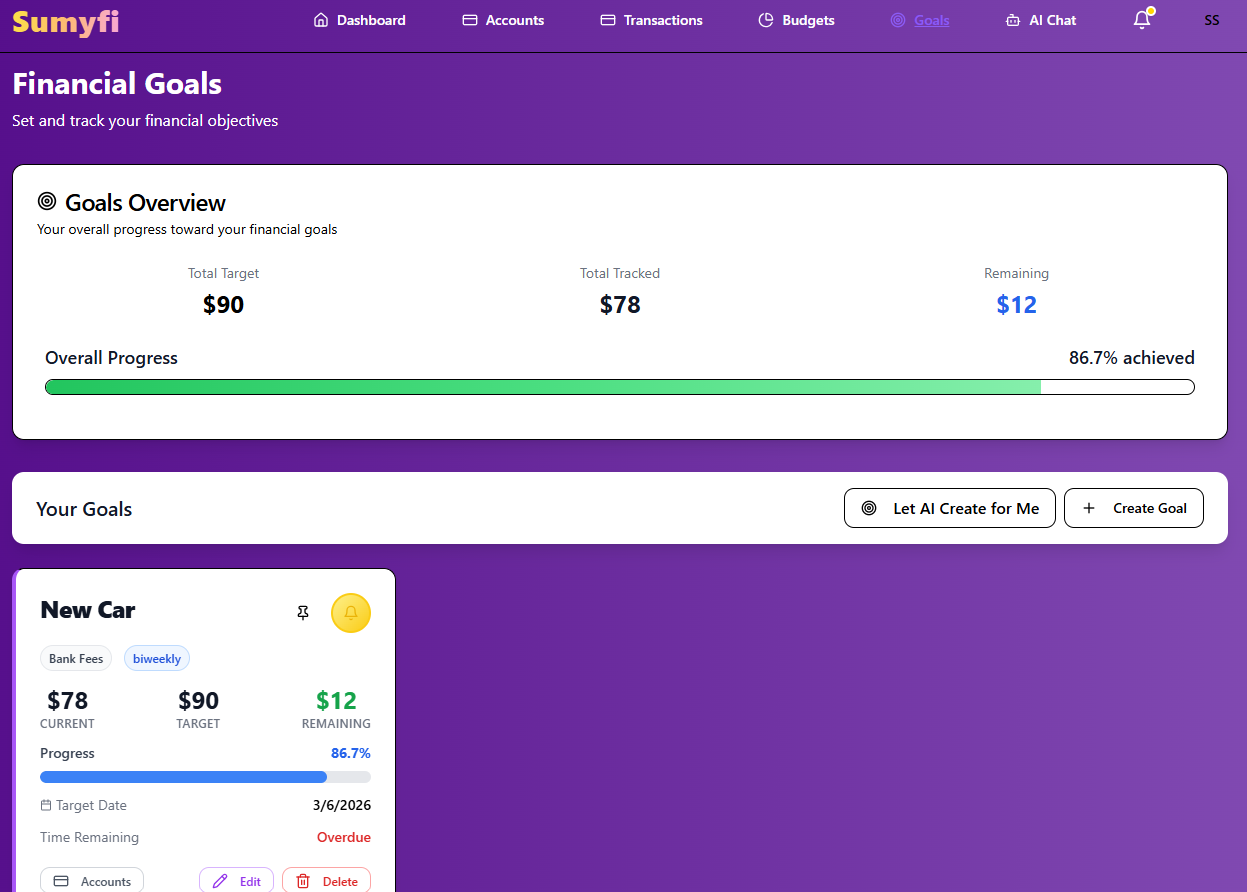
Goal Setting & Progress Monitoring: Visually track your journey towards financial milestones like retirement, a down payment, or debt freedom.
Identify spending patterns that might be hindering your goals.
Spot opportunities to optimize your investments.
Understand the impact of your financial decisions on your net worth trajectory.
Receive proactive alerts and recommendations tailored to your financial situation.
Spreadsheets: While free, spreadsheets are manual, error-prone, static, and lack real-time updates and security. Sumyfi automates everything, provides dynamic insights, and is inherently secure.
Older Personal Finance Software: Many legacy apps are clunky, have outdated interfaces, limited connectivity, and require significant manual intervention. Sumyfi offers a sleek, modern UI, extensive institution connectivity, and powerful automation.
Other Modern Apps: While competitors exist, Sumyfi distinguishes itself with its superior cross-border (US & Canada) connectivity, its focus on a truly holistic financial hub, and its commitment to an empowering, user-centric experience that converts complex data into crystal-clear insights.
How to Choose the Right Personal Asset Tracker App for You
With a growing number of options, selecting the ideal personal asset tracker app can seem daunting. Here's a structured approach to ensure you pick the one that best fits your unique financial needs and preferences.
- Identify Your Core Needs and Financial Complexity
Prioritize Security and Data Privacy
This is non-negotiable. Ensure the app adheres to:
- Evaluate Connectivity and Integration Capabilities
- Assess User Experience (UX) and User Interface (UI)
- Consider Features vs. Cost
- Check Customer Support and Community
By methodically evaluating these factors, you can confidently select a personal asset tracker app that will truly empower your financial journey.
Simple Tracking: Do you primarily need to see your net worth and basic spending?
Comprehensive Management: Are you looking for in-depth investment analysis, budgeting, debt management, and goal tracking across numerous accounts?
Cross-Border Needs: If you have accounts in both the US and Canada, like many Sumyfi users, then broad institutional connectivity is paramount.
Bank-level encryption (256-bit AES or higher).
Read-only access to your financial accounts.
Clear and transparent privacy policies.
Regular independent security audits.
Compliance with relevant data protection regulations (e.g., GDPR, CCPA).
Supported Institutions: Does the app connect to all your banks, credit unions, brokerages, and other financial accounts? Sumyfi's extensive US and Canadian coverage is a significant advantage here.
API Reliability: How frequently does the data sync? Is it prone to connection breaks? A robust app provides reliable, frequent updates.
Intuition: Is the app easy to navigate? Can you find what you need quickly?
Clarity: Is the financial data presented in an understandable and actionable way?
Aesthetics: Is the design clean, modern, and visually appealing? A slick interface like Sumyfi's makes engagement enjoyable.
Cross-Platform Availability: Does it work seamlessly on web, iOS, and Android?
Free vs. Paid: Free apps often come with limitations (e.g., fewer features, ads, less robust security, limited connectivity). Paid apps typically offer a more comprehensive, ad-free, and secure experience.
Value Proposition: Does the cost justify the features and benefits? Consider the time saved, insights gained, and potential financial improvements. A premium personal asset tracker app like Sumyfi offers immense value that often far outweighs its subscription cost.
Responsiveness: How quickly and effectively does their support team respond to inquiries?
Resources: Do they offer helpful FAQs, tutorials, or a community forum?
Setting Up Your Personal Asset Tracker App: A Step-by-Step Guide
Once you've chosen your ideal personal asset tracker app, like Sumyfi, getting started is a straightforward process designed for efficiency and ease.
Step 1: Sign Up and Create Your Secure Profile
Step 2: Connect Your Financial Accounts
Step 3: Review and Categorize Initial Transactions
Step 4: Set Up Your Budget and Financial Goals
Step 5: Explore the Dashboard and Reports
Step 6: Regular Review and Engagement
By following these steps, you'll quickly transform your fragmented financial picture into a unified, actionable masterpiece with Sumyfi.
Visit the Sumyfi website or download the app from your preferred app store.
Create an account using your email and a strong, unique password.
Enable Multi-Factor Authentication (MFA) immediately for enhanced security. This is often an optional but highly recommended step.
This is the core of any personal asset tracker app. Follow the prompts to add your various financial institutions.
You'll typically search for your bank, credit union, brokerage, or loan provider.
You'll then be securely redirected to your institution's login page (or an embedded secure portal) to enter your credentials.
Grant read-only access. Remember, Sumyfi never has access to move your money.
Repeat this process for all your checking, savings, credit cards, investments, retirement accounts, mortgages, student loans, and any other relevant financial accounts. Sumyfi's extensive US and Canadian connectivity makes this process incredibly comprehensive.
Once accounts are connected, the app will begin pulling in historical transaction data (typically 90 days or more).
Review the automatically categorized transactions. While AI is smart, it's not perfect. Correct any miscategorizations.
Create custom categories if needed to better reflect your spending habits. This initial cleanup ensures the accuracy of your financial data from the outset.
Based on your transaction history, establish a realistic budget for different spending categories.
Define your financial goals: saving for a down payment, paying off debt, retirement planning, etc.
Link specific accounts or contributions to these goals to track progress visually.
Familiarize yourself with the app's dashboard. On Sumyfi, you'll immediately appreciate the slick, intuitive layout.
Explore the various reports: net worth trends, spending breakdowns, investment performance, and more.
Understand how to interpret the visual data (charts, graphs) to gain insights.
Make it a habit to log in regularly (daily, weekly) to review your transactions, check your net worth, and monitor your progress towards goals.
The more you engage, the more valuable the personal asset tracker app becomes as a tool for proactive financial management.
Adjust your budget and goals as your financial situation evolves.
Leveraging Your Personal Asset Tracker App for Strategic Financial Growth
A personal asset tracker app is not merely a reporting tool; it's a powerful engine for strategic financial growth. By providing granular insights and a holistic view, it empowers you to make smarter decisions that accelerate your journey towards financial independence.
- Identifying Spending Patterns and Optimizing Cash Flow
- Strategic Investment Management
- Accelerated Debt Reduction Strategies
- Enhancing Financial Planning and Goal Achievement
- Simplified Tax Preparation
By actively engaging with the insights provided by your personal asset tracker app, you transform it from a passive data repository into an active partner in your journey towards sustained financial prosperity.
The trajectory of personal finance technology is exciting, with artificial intelligence (AI) and machine learning (ML) at its forefront. A leading personal asset tracker app like Sumyfi is already leveraging these technologies and will continue to evolve, offering even more sophisticated capabilities.
- Predictive Analytics
- Hyper-Personalized Recommendations
- Proactive Alerts and Anomaly Detection
- Enhanced Security and Fraud Detection
Sumyfi is committed to leading this charge, continuously integrating cutting-edge technology to serve its users better.
Addressing Common Concerns: Security, Data Privacy, and Trust
The idea of connecting all your financial accounts to a single app can naturally raise questions about security and privacy. It's crucial to understand how modern personal asset tracker apps, especially industry leaders like Sumyfi, prioritize and protect your sensitive financial data.
- Bank-Level Security Measures
- Read-Only Access
- Multi-Factor Authentication (MFA)
- Strict Privacy Policies and Data Usage
- Regulatory Compliance and Audits
Sumyfi's commitment to security and privacy is unwavering. We understand that trust is paramount when it comes to your financial data. Our agile engineering team prioritizes robust security measures, transparent data practices, and continuous vigilance to ensure your financial information is always protected, allowing you to manage your assets with complete peace of mind.
Conclusion: Empower Your Financial Future with the Ultimate Personal Asset Tracker App
In a world brimming with financial complexities, the need for clarity, control, and foresight has never been greater. The modern personal asset tracker app stands as an indispensable tool, transforming fragmented financial data into a unified, actionable intelligence hub. It moves you beyond mere record-keeping to proactive fiscal management, empowering you to understand your net worth, optimize your investments, master your spending, and achieve your financial aspirations with unprecedented confidence.
Sumyfi represents the pinnacle of this evolution. It's more than just a tracker; it's a holistic financial ecosystem that provides real-time insights, automates tedious tasks, and offers a crystal-clear view of your entire financial universe.
Stop relying on outdated spreadsheets or juggling multiple apps. Take control, gain clarity, and unlock your full financial potential.
[Experience Sumyfi today - Sign up for free and start tracking your assets with confidence!](https://www.sumyfi.com/signup)
Pinpoint Leakage: Detailed transaction categorization helps you identify "money leaks" - unnecessary or excessive spending in certain areas (e.g., subscriptions you don't use, frequent takeout).
Optimize Budgeting: With clear data, you can create more realistic and effective budgets, redirecting funds from discretionary spending to savings or debt repayment.
Boost Savings Rate: By understanding where your money goes, you can consciously increase your savings rate, a critical factor in wealth accumulation.
Portfolio Health Check: Regularly review your asset allocation to ensure it aligns with your risk tolerance and financial goals. A personal asset tracker app can highlight overconcentration or under-diversification.
Performance Benchmarking: Compare the performance of your investments against relevant benchmarks. Identify underperforming assets that might need re-evaluation.
Tax-Loss Harvesting Opportunities: While not tax advice, seeing your gains and losses across your portfolio can help you identify potential tax-loss harvesting opportunities to discuss with a financial advisor.
Dividend & Interest Tracking: Understand the passive income generated by your investments.
Visualize Debt Burden: Clearly see all your liabilities, interest rates, and minimum payments in one place.
Implement Payoff Strategies: Use the data to apply "debt snowball" or "debt avalanche" methods effectively, focusing on high-interest debts first.
Monitor Progress: Witnessing your debt balances decrease over time is a powerful motivator to stay on track.
Realistic Goal Setting: Base your financial goals on actual income, expenses, and savings capacity, rather than guesswork.
Progress Tracking: The visual representation of goal progress keeps you motivated and allows for timely adjustments if you're falling behind or exceeding expectations.
Retirement Readiness: Project your retirement savings trajectory and adjust contributions to ensure you're on track for a comfortable future.
Organized Data: All your income and expense data, particularly for self-employed individuals or those with complex investments, is neatly categorized and accessible.
Investment Reporting: Capital gains/losses, dividends, and interest income are easily exportable, simplifying the process of gathering information for tax season.
Deductible Expense Tracking: Categorize business expenses, charitable contributions, and other deductible items throughout the year.
Future Cash Flow Forecasting: AI can analyze your income and spending patterns to predict your future cash flow, identifying potential surpluses or deficits weeks or months in advance.
Goal Attainment Projections: Based on your current savings rate and investment performance, AI can provide more accurate projections for when you'll reach your financial goals.
Market Trend Analysis: While not a crystal ball, AI can analyze market data to provide insights into potential future trends impacting your investments.
Tailored Budget Adjustments: Instead of generic advice, AI can suggest highly personalized budget adjustments based on your unique spending habits, income, and financial goals.
Optimized Debt Strategies: ML algorithms can recommend the most efficient debt payoff strategy for your specific mix of liabilities and interest rates.
Investment Rebalancing Suggestions: AI can monitor your portfolio and suggest rebalancing actions to maintain your target asset allocation and risk profile.
Unusual Spending Alerts: The app can learn your normal spending patterns and flag unusual transactions or sudden spikes in spending, potentially indicating fraud or an unexpected expense.
Subscription Reminders: AI can identify recurring subscriptions and remind you before renewal, giving you the opportunity to cancel unwanted services.
Financial Health Warnings: Proactive alerts if you're veering off track from your budget or financial goals, allowing for timely corrective action.
ML algorithms can analyze transaction data in real-time to detect patterns indicative of fraudulent activity, providing an extra layer of security beyond traditional bank alerts.
Encryption: All data, both in transit (when it's being sent between your device and the app's servers) and at rest (when it's stored on the servers), is protected with robust, industry-standard encryption (e.g., 256-bit AES). This is the same level of security used by major financial institutions.
Secure Infrastructure: Apps operate on highly secure, regularly audited cloud infrastructure, often leveraging services from industry leaders that meet stringent security compliance standards.
No Transactional Authority: This is perhaps the most critical point. When you connect your accounts to a personal asset tracker app like Sumyfi, you grant it *read-only* access. This means the app can view your transaction history and account balances, but it cannot initiate any transfers, payments, or trades on your behalf. Your money remains securely within your financial institutions.
API-Based Connections: Modern apps use secure Application Programming Interfaces (APIs) provided by financial institutions (or secure third-party aggregators like Plaid or Flinks) to access your data. These APIs are designed with security and limited permissions in mind.
MFA adds an essential layer of security by requiring two or more verification factors to log in (e.g., password + a code sent to your phone). This significantly reduces the risk of unauthorized access, even if your password is compromised.
Transparency: Reputable apps have clear and transparent privacy policies that outline exactly what data is collected, how it's used, and who it might be shared with (e.g., for anonymized statistical analysis, never for direct marketing without consent).
No Selling of Personal Data: A premium personal asset tracker app like Sumyfi will explicitly state that it does not sell your personally identifiable financial data to third parties. Its business model relies on subscription fees, not data monetization.
Anonymized Data: Data may be aggregated and anonymized for research, product improvement, or industry trend analysis, but never in a way that can be traced back to you.
Leading apps adhere to relevant data protection regulations in the regions they operate (e.g., PIPEDA in Canada, various state and federal laws in the US).
They often undergo regular independent security audits to identify and address potential vulnerabilities proactively.