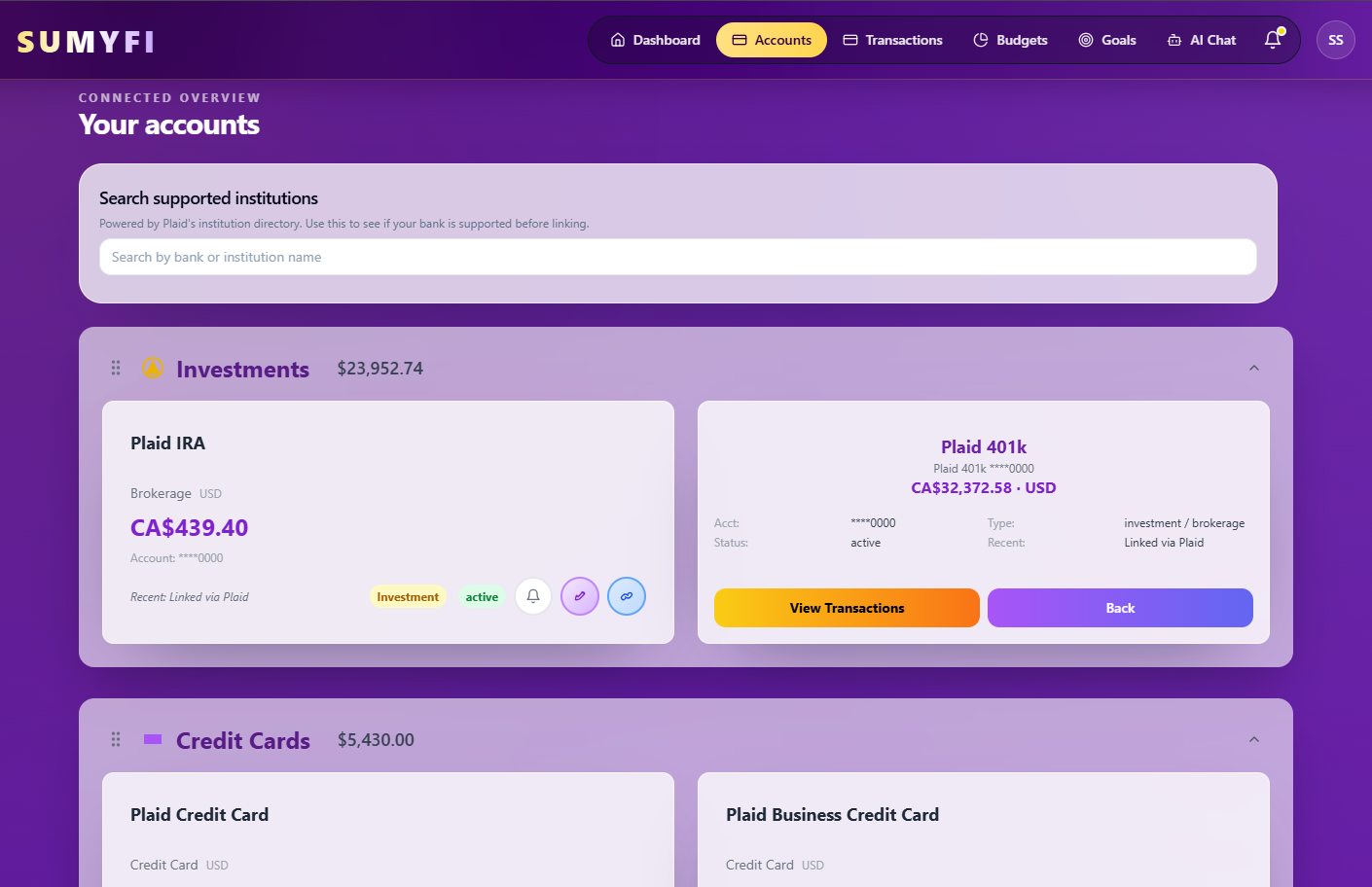
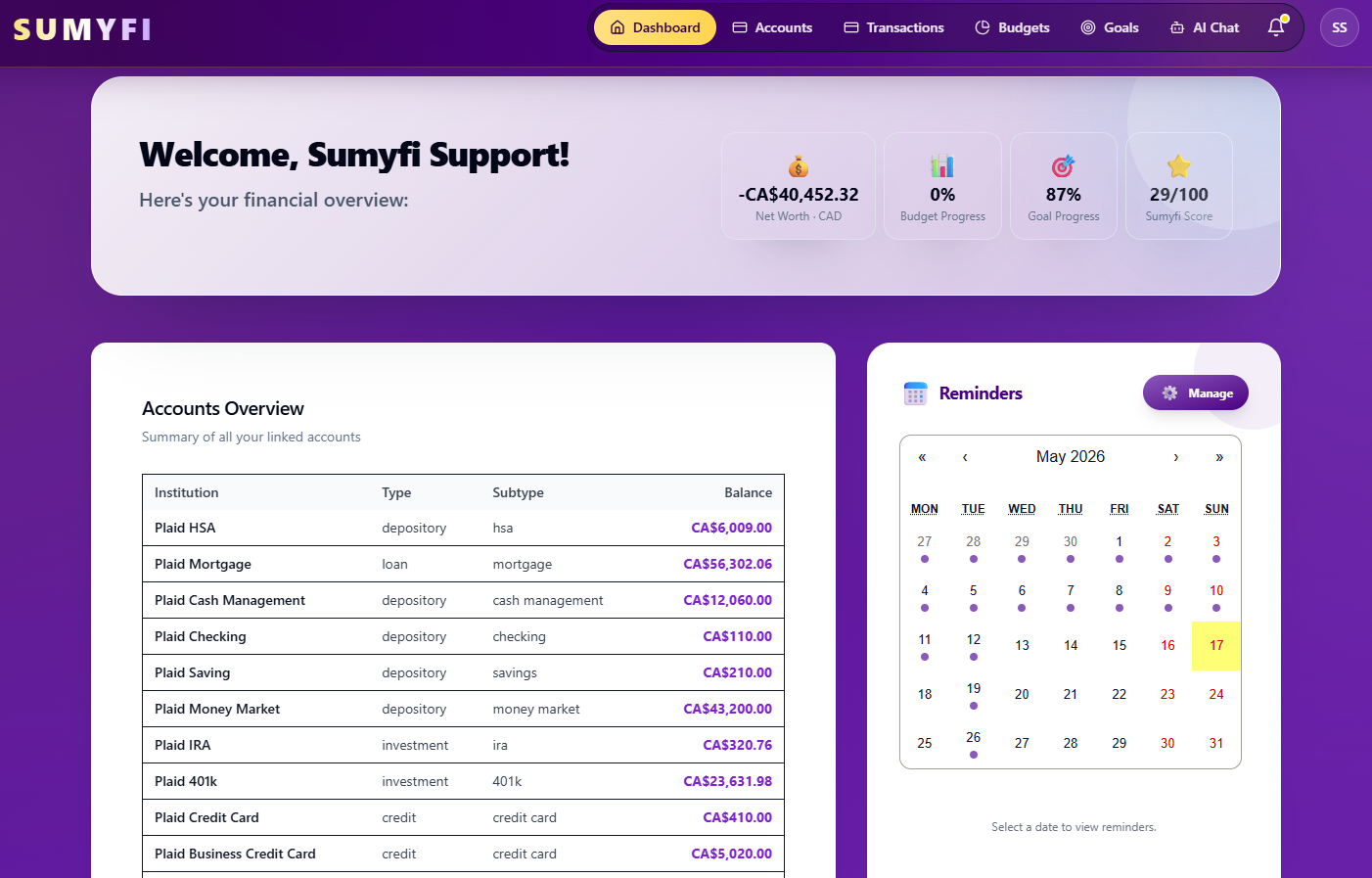
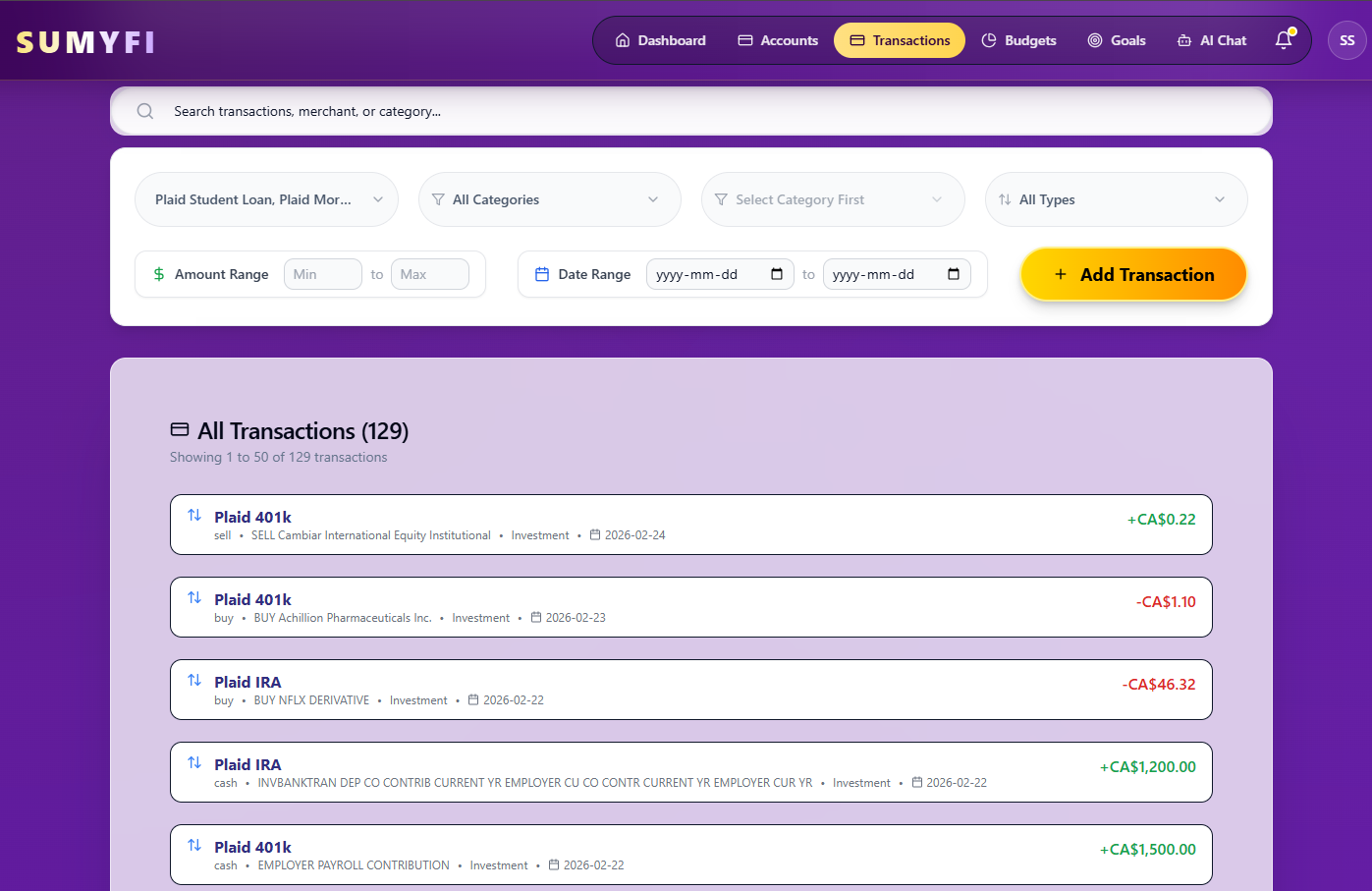
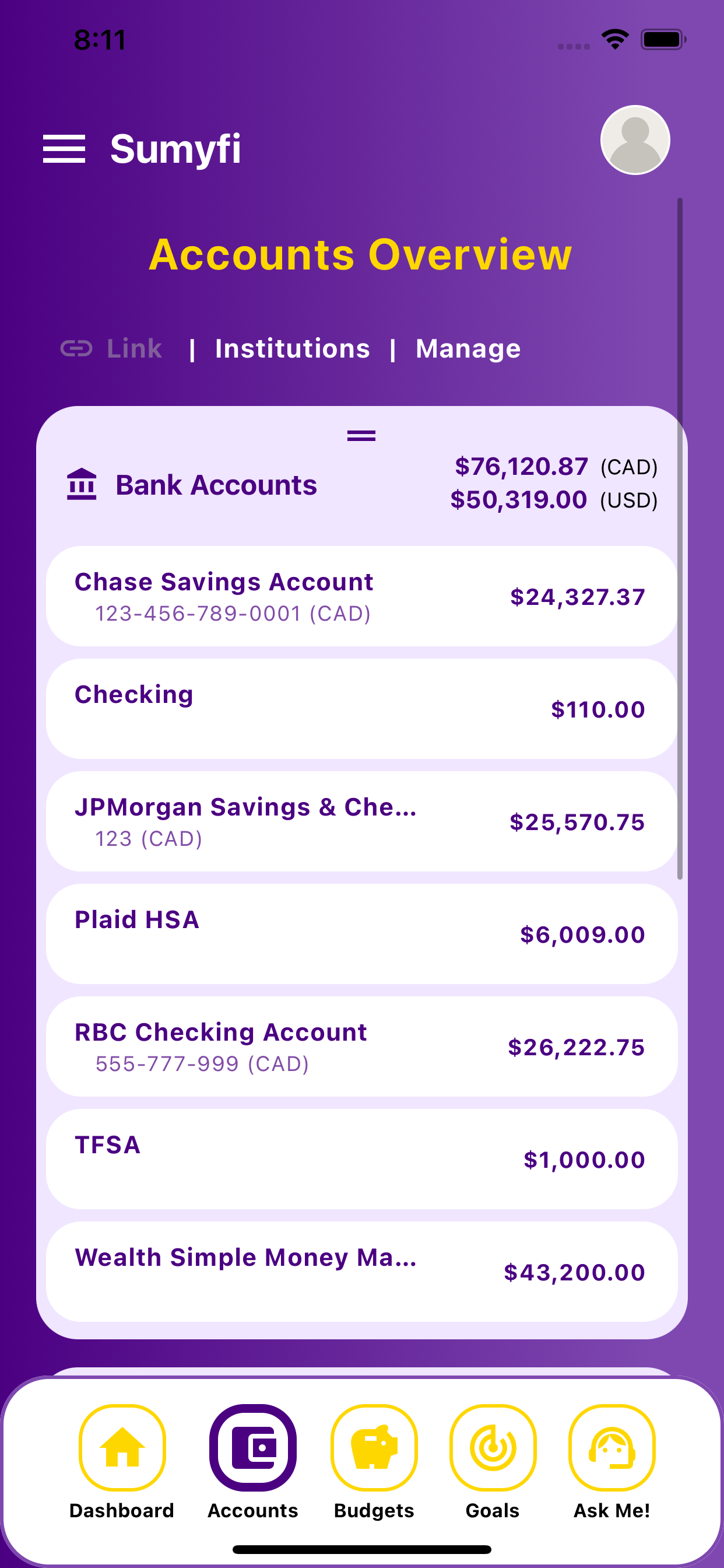
An app that connects 12,000+ institutions should promise more than breadth. It should turn broad connectivity into a dashboard that actually helps people make better financial decisions after the accounts are connected.
The modern individual often interacts with a dozen or more financial institutions, each holding a piece of their financial puzzle. The dream? A single, intelligent platform that can seamlessly aggregate all this disparate data, providing a holistic, real-time view of one's financial universe.
For too long, individuals have grappled with manual spreadsheets, clunky legacy software, or fragmented apps that only offer partial insights. These traditional methods are not just time-consuming; they often lead to incomplete data, missed opportunities, and a pervasive sense of financial disorganization. Sumyfi emerges as the quintessential modern solution, engineered from the ground up to eliminate these pain points.
The Fragmented Financial Landscape: Why a Unified Connection is Imperative
The average person's financial life is rarely confined to a single bank. Consider the typical scenario:
Each of these accounts lives in its own digital silo, requiring separate logins, statements, and mental calculations to understand your overall financial standing. The sheer cognitive load of tracking balances, monitoring transactions, identifying spending patterns, and calculating net worth across these diverse platforms is immense. This fragmentation is not merely an inconvenience; it's a significant barrier to effective financial planning, budgeting, and wealth building.
The Limitations of Traditional Approaches
Before the advent of advanced aggregation technologies, individuals relied on:
These methods inherently prevent a holistic view, making it difficult to:
This is precisely where an app that connects 12,000 institutions becomes not just a convenience, but a necessity for modern financial management.
A primary checking account with a large national bank.
A savings account with an online-only institution offering higher interest rates.
Two to three credit cards from different issuers, each with unique rewards programs.
A mortgage with a specialized lender.
Student loans or personal loans from another provider.
An employer-sponsored 401(k) or RRSP with a specific brokerage.
A personal investment account (e.g., Roth IRA, TFSA, individual brokerage) with a different platform.
Perhaps a local credit union for community banking.
Digital payment apps like PayPal or Venmo.
Manual Spreadsheets: While offering ultimate customization, they demand constant, tedious data entry, are prone to human error, and instantly become outdated the moment new transactions occur. They lack automation and real-time insights.
Paper Statements: An antiquated method that provides historical data, not actionable current information.
Limited Finance Apps: Many older or less sophisticated apps connect to a handful of major banks but fall short when it comes to niche credit unions, regional investment firms, or specific loan providers, leaving significant gaps in your financial picture.
Accurately track net worth in real-time.
Identify all recurring expenses and subscriptions.
Understand true spending habits across all accounts.
Spot fraudulent activity quickly.
Optimize cash flow and investment strategies.
Sumyfi's Unrivaled Connectivity: Bridging 12,000 Institutions
This isn't just a number; it represents a profound commitment to comprehensive coverage, ensuring that virtually every aspect of your financial life can be seamlessly integrated into a single, intuitive platform.
What Does "12,000 Institutions" Truly Mean?
The figure of 12,000 institutions encompasses a vast spectrum of financial entities across the United States and Canada, including:
This extensive reach ensures that whether you bank with a global giant or a hyper-local credit union, invest with a traditional broker or a modern robo-advisor, Sumyfi has you covered. This is the bedrock upon which true financial clarity is built.
The Engineering Behind Seamless Aggregation
Achieving such vast and reliable connectivity requires sophisticated engineering and robust partnerships. Sumyfi leverages cutting-edge API (Application Programming Interface) technology and secure data aggregation services.
- Direct API Integrations: Where possible, Sumyfi establishes direct, secure API connections with financial institutions. These APIs act as digital bridges, allowing for the real-time, encrypted exchange of data (with your explicit permission). This method offers the highest speed and reliability.
- Advanced Data Aggregators: For institutions without direct APIs or those with legacy systems, Sumyfi partners with industry-leading, secure data aggregators. These aggregators specialize in safely connecting to a multitude of financial systems, standardizing the data, and transmitting it securely to Sumyfi.
- Continuous Monitoring and Updates: The financial landscape is dynamic. Institutions update their security protocols, change their online banking interfaces, and introduce new products. Sumyfi's engineering team continuously monitors these changes, updating its connection infrastructure to ensure uninterrupted service and data accuracy. This agile approach is critical for maintaining robust connectivity across 12,000 institutions.
The result is a lightning-fast setup process. In minutes, you can link all your accounts, watching as your financial data populates a slick, intuitive dashboard. This agile engineering is a stark contrast to the bulky, often unreliable connection methods of legacy financial tools.
The Transformative Benefits of a Unified Financial Hub
When an app that connects 12,000 institutions like Sumyfi brings all your financial data into one place, the benefits are profound and far-reaching, fundamentally changing your relationship with your money.
Real-Time Net Worth Tracking: Your True Financial Snapshot
One of the most powerful features of Sumyfi is its ability to calculate and display your net worth in real-time. Net worth-the total value of your assets minus your liabilities-is the ultimate barometer of your financial health.
No more manual calculations, no more guessing. Sumyfi provides the definitive answer to "What am I really worth?" at any given moment.
Automated Transaction Tracking & Categorization: Effortless Spending Insights
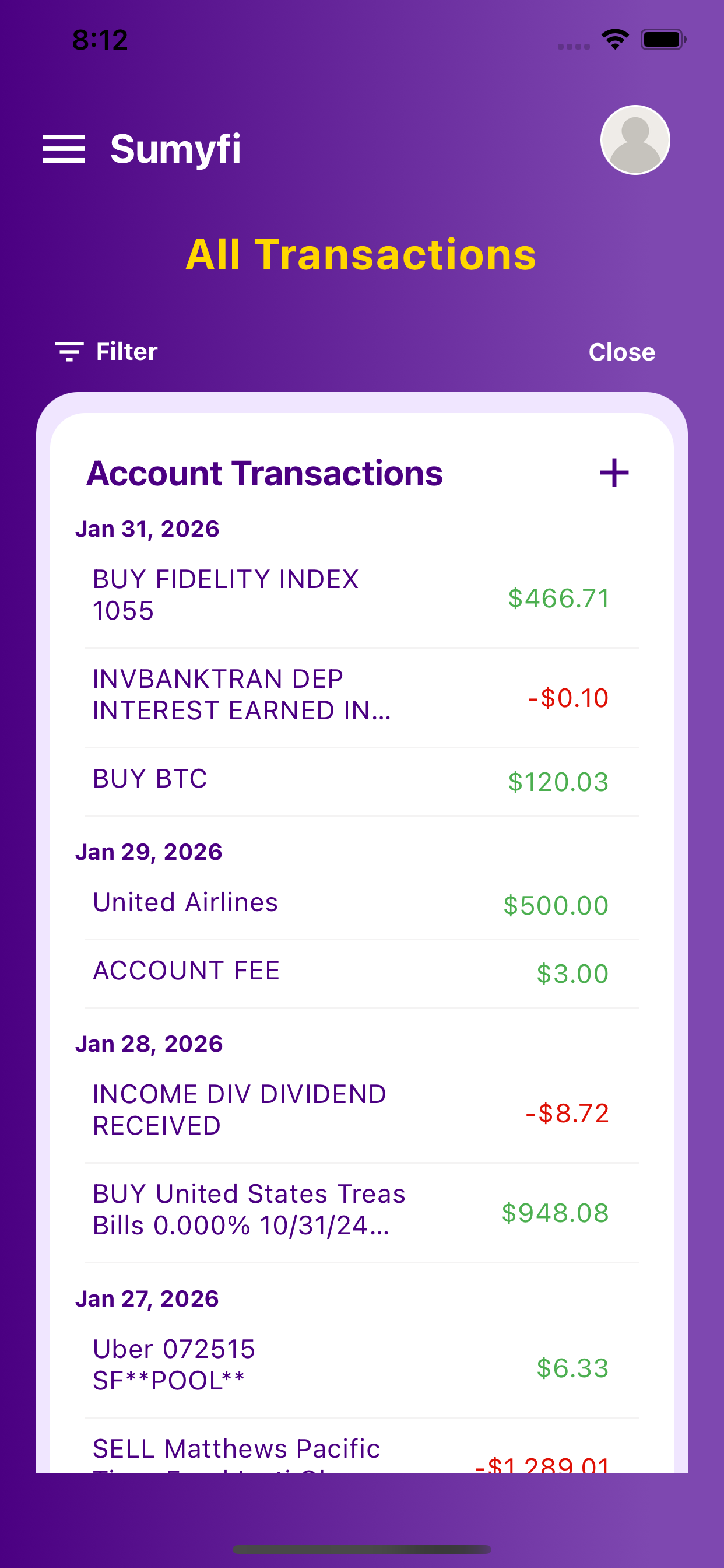
Manual transaction entry is a relic of the past. Sumyfi automatically imports and categorizes transactions from all your connected accounts.
This automation forms the backbone of effective budgeting and spending analysis, providing crystal-clear insights without any manual effort.
Smarter Budgeting & Spending Analysis: Take Control of Your Cash Flow
With all your transactions aggregated and categorized, Sumyfi transforms budgeting from a chore into an empowering experience.
Sumyfi doesn't just show you your budget; it helps you actively manage and optimize your spending habits across all your financial accounts.
Major Banks: National and international retail banks (e.g., Chase, Wells Fargo, TD Bank, RBC, Scotiabank).
Credit Unions: Thousands of local and regional credit unions, often overlooked by less comprehensive apps.
Investment Brokerages: From full-service firms to discount brokers and robo-advisors (e.g., Fidelity, Schwab, Vanguard, Questrade, Wealthsimple).
Investment Portfolio Tracking: A Unified View of Your Wealth
For investors, managing multiple brokerage accounts, retirement funds, and even alternative investments can be a logistical nightmare.
Sumyfi provides the clarity needed to make informed investment decisions, free from the hassle of logging into multiple platforms.
Debt Management & Optimization: A Clear Path to Financial Freedom
Debt can be a significant burden, but understanding and managing it effectively is the first step towards financial freedom.
Sumyfi transforms debt management from a daunting task into a structured, achievable journey.
Goal Setting & Progress Monitoring: Turn Aspirations into Achievements
Whether it's saving for a down payment, a dream vacation, or retirement, Sumyfi helps you define, track, and achieve your financial goals.
With Sumyfi, your financial goals are no longer abstract ideas but concrete objectives with a clear path to realization.
Consolidated Portfolio: Sumyfi aggregates all your investment accounts, displaying your total portfolio value, asset allocation, and performance metrics in one dashboard.
Performance Monitoring: Track the performance of individual holdings and your overall portfolio across different time horizons.
Diversification Analysis: Gain insights into your asset allocation, helping you ensure your portfolio is diversified according to your risk tolerance and financial goals.
Loan Providers
Mortgage lenders, student loan servicers, auto loan companies, and personal loan providers.
Credit Card Issuers
All major credit card companies and their various card products.
Fintech Platforms
Emerging digital banks, payment apps, and specialized financial services.
Retirement Account Providers
401(k), 403(b), RRSP, RRIF administrators.
Alternative Investment Platforms
Certain peer-to-peer lending platforms, real estate crowdfunding, etc.
Automated Asset Aggregation
Sumyfi pulls in balances from all your checking, savings, investment, retirement, and even certain property valuation data (if linked).
Comprehensive Liability Tracking
All your loans (mortgage, student, auto, personal) and credit card balances are automatically factored in.
Dynamic Updates
As balances change, investments fluctuate, or debts are paid down, your net worth updates automatically, giving you an accurate, up-to-the-minute understanding of your financial standing.
Historical Trends
Visualize your net worth growth over time with clear charts, celebrating progress and identifying areas for improvement.
Intelligent Categorization
Advanced algorithms analyze transaction descriptions and assign them to relevant categories (e.g., Groceries, Utilities, Entertainment, Transportation).
Customization
Easily re-categorize transactions or create custom categories to match your unique budgeting system. Sumyfi learns your preferences over time.
Search & Filter
Quickly find specific transactions across all accounts, making reconciliation and expense tracking incredibly simple.
Eliminate Manual Entry
Say goodbye to logging into multiple bank portals or painstakingly typing out every purchase. Every swipe, every bill payment, every deposit is automatically captured.
Dynamic Budget Creation
Set budgets for various spending categories based on your actual historical spending, not just arbitrary estimates.
Real-Time Progress Tracking
See exactly how much you've spent in each category relative to your budget throughout the month. Get alerts when you're approaching limits.
Visual Spending Reports
Intuitive charts and graphs illustrate where your money is going, highlighting trends, identifying overspending areas, and revealing opportunities for savings.
Cash Flow Projections
Understand your incoming and outgoing funds to anticipate future balances and avoid overdrafts or liquidity issues.
Tax-Advantaged Account Tracking
Easily monitor your 401(k), RRSP, IRA, TFSA, and other tax-advantaged accounts alongside your taxable investments.
Consolidated Debt Overview
View all your loans (mortgage, student, auto, personal) and credit card debts in one place.
Interest Rate & Payment Tracking
Monitor interest rates, minimum payments, and total outstanding balances for each debt.
Debt Payoff Strategies
Use Sumyfi's insights to implement strategies like the debt snowball or debt avalanche, visualizing your progress and motivating you to accelerate payoff.
Impact on Net Worth
See how reducing debt directly contributes to increasing your net worth.
Link Goals to Accounts
Assign specific savings or investment accounts to your goals.
Automated Progress Tracking
See how your contributions and account growth are bringing you closer to your targets.
Motivational Visualizations
Watch your progress bar fill up, providing tangible encouragement.
Adjust & Optimize
Based on real-time data, adjust your contributions or spending to stay on track.
Sumyfi vs. The Alternatives: A New Paradigm in Personal Finance
While the market offers various personal finance tools, Sumyfi distinguishes itself through its comprehensive connectivity, modern design, and empowering feature set.
Beyond Spreadsheets: The Power of Automation
Manual spreadsheets, while flexible, are inherently static and labor-intensive. Sumyfi transcends this by automating data aggregation, transaction categorization, and net worth calculations. This means less time spent on data entry and more time on analysis and strategic financial planning. The real-time nature of Sumyfi's data provides a living, breathing financial picture, unlike a spreadsheet that is outdated moments after it's updated.
Outpacing Legacy Apps: The "App That Connects 12,000 Institutions" Advantage
Older personal finance apps, while pioneering in their time, often suffer from several limitations that Sumyfi elegantly overcomes:
A Modern Alternative to Modern Contenders
Even newer contenders in the personal finance space often don't match Sumyfi's robust connectivity and integrated approach. Its focus on agile engineering ensures a responsive, reliable, and secure experience that continuously evolves with user needs and technological advancements.
Limited Connectivity
Many legacy apps struggle to connect with the sheer breadth of institutions that Sumyfi effortlessly manages. This leaves users with incomplete financial pictures, forcing them to revert to manual tracking for certain accounts. Sumyfi's app that connects 12,000 institutions capability is a game-changer here, ensuring no account is left behind.
Outdated Interfaces
Clunky, unintuitive user interfaces can make financial management a chore. Sumyfi boasts a sleek, modern, and highly responsive dashboard designed for clarity and ease of use.
Slower Data Syncs
Older systems can be slow to update, leading to delays in seeing your most current financial information. Sumyfi's agile engineering prioritizes lightning-fast data synchronization.
Lack of Integrated Features
Many apps excel at one or two features (e.g., just budgeting or just net worth) but lack a truly integrated, all-in-one approach. Sumyfi combines net worth tracking, automated transactions, budgeting, bill management, investment tracking, and goal setting into one cohesive experience.
The Sumyfi Experience: Slick, Intuitive, Empowering
Beyond its powerful backend, Sumyfi is meticulously designed to offer an exceptional user experience.
Lightning-Fast Setup
Getting started with Sumyfi is remarkably quick. The intuitive onboarding process guides you through securely linking your financial institutions. Thanks to its robust connectivity engine, most users can link all their primary accounts within minutes, watching their financial data populate the dashboard almost instantly. There's no lengthy manual input or complex configuration required.
A Dashboard Designed for Clarity and Action
Sumyfi's dashboard is the command center for your financial life. It's clean, uncluttered, and designed to provide actionable insights at a glance.
The slick interface ensures that managing your finances is not just effective, but also enjoyable.
Intelligent Automation and Personalization
Sumyfi learns from your habits. Its intelligent categorization adapts to your preferences, and its insights become more refined over time. You can personalize alerts, customize categories, and tailor reports to fit your unique financial goals and lifestyle. This level of personalization makes Sumyfi feel like a bespoke financial assistant, not just a generic tool.
Dedicated Support and Continuous Innovation
Sumyfi is committed to providing outstanding customer support, ensuring that any questions or issues are addressed promptly and effectively. Furthermore, the platform is continuously evolving, with regular updates introducing new features, enhancing existing ones, and expanding its impressive network of connected institutions. This dedication to innovation means Sumyfi remains at the cutting edge of personal finance technology.
- Customizable Widgets: Arrange widgets to prioritize the information most important to you-be it net worth, budget progress, upcoming bills, or investment performance.
- Visual Data Representation: Complex financial data is transformed into easy-to-understand charts and graphs, making trends and insights immediately apparent.
- Seamless Navigation: Effortlessly drill down into specific accounts, transactions, or reports with just a few taps or clicks.
Security and Privacy: Sumyfi's Unwavering Commitment
For an app that connects 12,000 institutions and handles sensitive financial data, security and privacy are paramount. Sumyfi employs industry-leading protocols to protect your information, giving you complete peace of mind.
Multi-Factor Authentication (MFA)
To further safeguard your account, Sumyfi supports and encourages the use of multi-factor authentication, adding an extra layer of security beyond just your password.
Data Anonymization and Privacy Policy
Sumyfi adheres to a strict privacy policy. Your personal financial data is never sold to third parties. When aggregate data is used for analytical purposes (e.g., market trends), it is always anonymized and de-identified, ensuring your individual financial details remain private. Sumyfi is committed to transparency in its data handling practices.
Regular Security Audits
The platform undergoes regular security audits and penetration testing by independent experts to identify and address any potential vulnerabilities, ensuring the highest standards of data protection are consistently maintained.
With Sumyfi, you can trust that your financial information is handled with the utmost care and protected by robust security measures, allowing you to focus on achieving your financial goals without worry.
The era of fragmented financial management is over. With Sumyfi, the app that connects 12,000 institutions, you gain an unprecedented level of clarity, control, and confidence over your financial life. Imagine making financial decisions not based on partial information or guesswork, but on a complete, real-time understanding of your entire financial universe.
Sumyfi isn't just a tool; it's a partner in your journey towards financial empowerment. It simplifies the complex, automates the tedious, and illuminates the path to your financial aspirations. Whether you're aiming to pay off debt, save for a major purchase, invest wisely, or simply achieve a better understanding of your money, Sumyfi provides the foundation you need to succeed.
Its agile engineering ensures a platform that is not only powerful today but continuously evolves to meet the demands of tomorrow's financial landscape. Its slick dashboard and intuitive interface make managing your money an empowering and even enjoyable experience. And its unwavering commitment to security and privacy ensures your data is always protected.
Experience the power of an app that connects 12,000 institutions and unlock your full financial potential.