Canadian net worth tracking has its own quirks: registered accounts with different tax treatment, US-dollar holdings, HELOCs tied to mortgages, and credit unions some apps can't reach. Here's what a Canadian tracker needs to handle and how the options compare.
Most net worth trackers are designed in the US and adapted for Canada later, if at all. That's why the best net worth tracker in Canada isn't necessarily the one with the best reviews. It's the one that connects to your Desjardins or Vancity account, shows your TFSA and RRSP as different things, converts the US-dollar side of your portfolio properly, and doesn't fall apart when your mortgage and HELOC live inside one combined product.
Below we go through the Canadian accounts that need special handling, how to deal with CAD and USD, what to do with your home and mortgage, which banks and providers tend to connect, and the realistic options. Sumyfi is one of them, and we'll be specific about what it does and doesn't do.
Canadian accounts a net worth tracker has to handle
A typical Canadian household might have chequing at RBC, a TFSA at Wealthsimple, a group RRSP through work at Sun Life or Manulife, an FHSA opened in the last couple of years, and an RESP for the kids. Each has different rules, and a good tracker at least labels them clearly so you can see where your money sits.
The big one is pre-tax versus after-tax. A $100,000 RRSP and a $100,000 TFSA look identical in a total, but the RRSP will be taxed as income when you withdraw it and the TFSA won't. Most people track both at face value, which is fine for watching progress. Just keep in mind that a net worth heavy on RRSP money is worth less in spending terms than the same number in a TFSA.
RRSP and spousal RRSP
pre-tax money, taxed on withdrawal
TFSA
after-tax money, withdrawals are tax-free
FHSA
contributions are deductible and qualifying withdrawals for a first home are tax-free
RESP
includes government grants that can have to be returned if the money isn't used for education, so many parents list it separately
LIRA or locked-in RRSP
money from an old employer pension, real but hard to access before retirement
Defined benefit pension
hard to value as a single number, so most people note it separately rather than adding it in
Leave out
CPP and OAS, which are income streams, not assets you own
Tracking US-dollar money as a Canadian
Lots of Canadians hold some US dollars without thinking of it as a currency question: US stocks bought in USD inside an RRSP at Questrade, a US-dollar savings account at TD for trips, a USD credit card, or a bank account left over from a job or condo in the States.
A tracker needs to convert those to CAD for the total and still show you the original amount. Otherwise you'll either see a wrong total or a total that changes for reasons you can't explain. Exchange rates move your net worth even when you do nothing. $50,000 USD is $68,000 CAD at 1.36 and $70,000 CAD at 1.40. That $2,000 swing isn't progress or a setback, it's just the loonie moving.
When you review your number each month, note roughly how much of the change came from the exchange rate if you hold a meaningful amount in USD. It stops you from feeling great after a weak-loonie month or discouraged after a strong one.
Your home, your mortgage and the HELOC problem
For many Canadian households, the home is the biggest asset and the mortgage the biggest debt, so how you value them matters more than anything else in the tracker.
Use a conservative value for the house. Recent sold prices on your street are the best guide. Municipal assessments are a weak one: in Ontario, MPAC assessments are still based on 2016 values, so they can be far from today's market. Whatever figure you use, update it once or twice a year rather than every month, and consider knocking off around 5% for real estate commissions and legal costs if you want a number closer to what you'd walk away with.
Readvanceable mortgages are the uniquely Canadian headache. Products like RBC Homeline, Scotia STEP and TD FlexLine bundle a mortgage and a HELOC under one limit, and the HELOC room grows as you pay the mortgage down. Make sure your tracker shows each piece as its own debt. If you borrow $15,000 from the HELOC for a renovation, the mortgage keeps shrinking on schedule while your total debt has gone up, and you want to see that clearly.
Which Canadian banks and providers tend to connect
Connection coverage is where Canadian trackers differ the most. The Big Six (RBC, TD, Scotiabank, BMO, CIBC and National Bank) are usually supported. Online banks like Tangerine, Simplii and EQ Bank, brokerages like Questrade and Wealthsimple, and Desjardins and the larger credit unions vary by app. Smaller credit unions are often missing.
Group retirement plans are the weak spot almost everywhere. Group RRSPs and pensions at Sun Life, Manulife and Canada Life frequently don't connect at all, which matters because for a lot of people that's one of the largest balances they have. Plan on entering it manually from your quarterly statement.
Before paying for anything, connect your least common account first. If the tracker can't see your credit union chequing or your group RRSP, everything else is a nice-looking guess.
The realistic net worth tracker options for Canadians
Mint used to fill this role for a lot of Canadians and it shut down in early 2024. Here's how the remaining options shake out.
A spreadsheet
free and fully under your control, and it handles RESPs, pensions and HELOCs exactly how you want, but every balance is typed by hand
Wealthica
a Canadian aggregator focused on investment accounts, a good fit if your main goal is seeing your portfolios together
Kubera
paid, built for net worth, handles many currencies and unusual assets well
US apps open to Canadians
several accept Canadian users, but coverage for Canadian banks and credit unions varies, so test before paying
Sumyfi
net worth alongside budgets and goals, with CAD and USD handled together
What Sumyfi does for Canadian net worth tracking
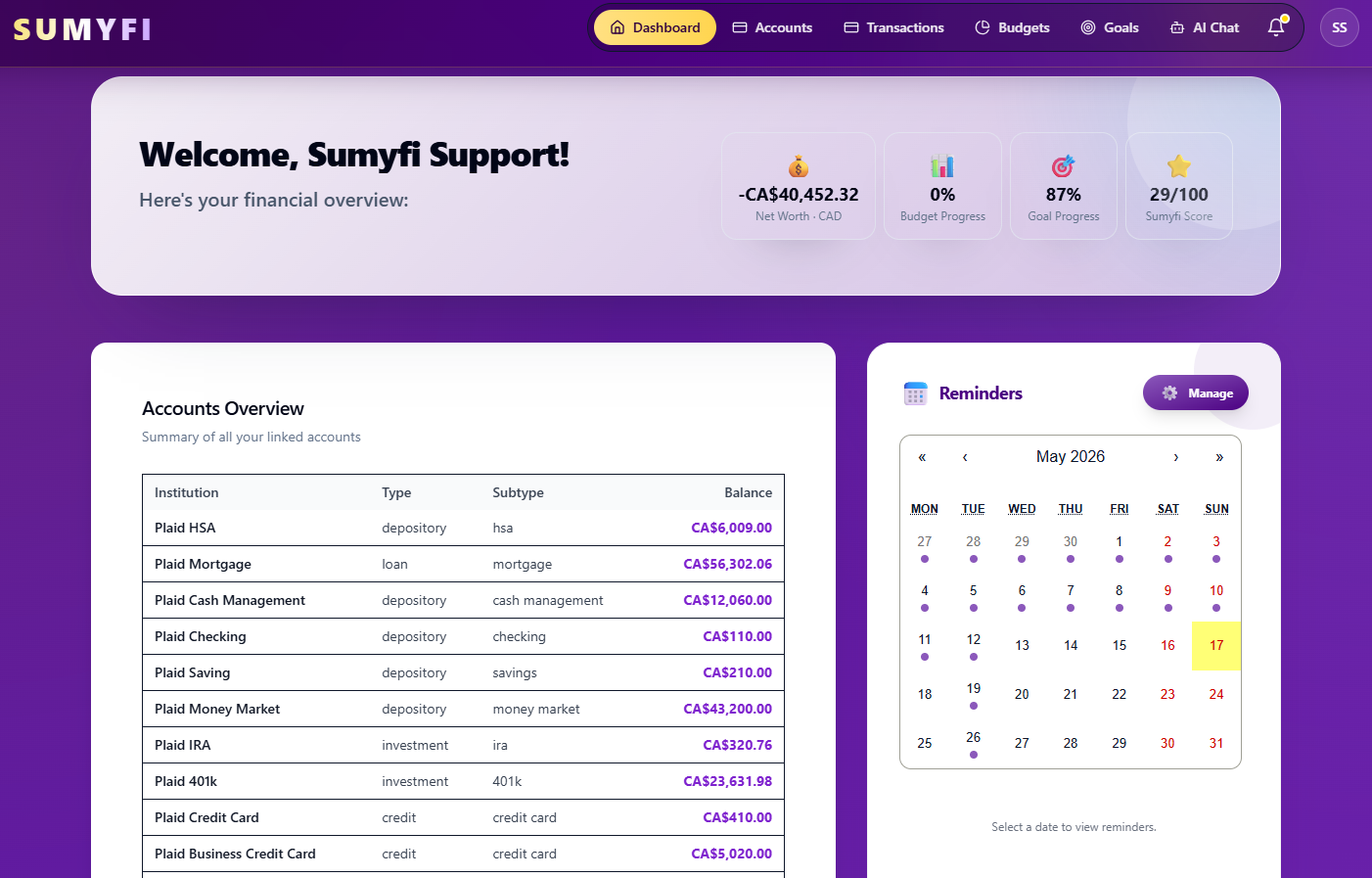
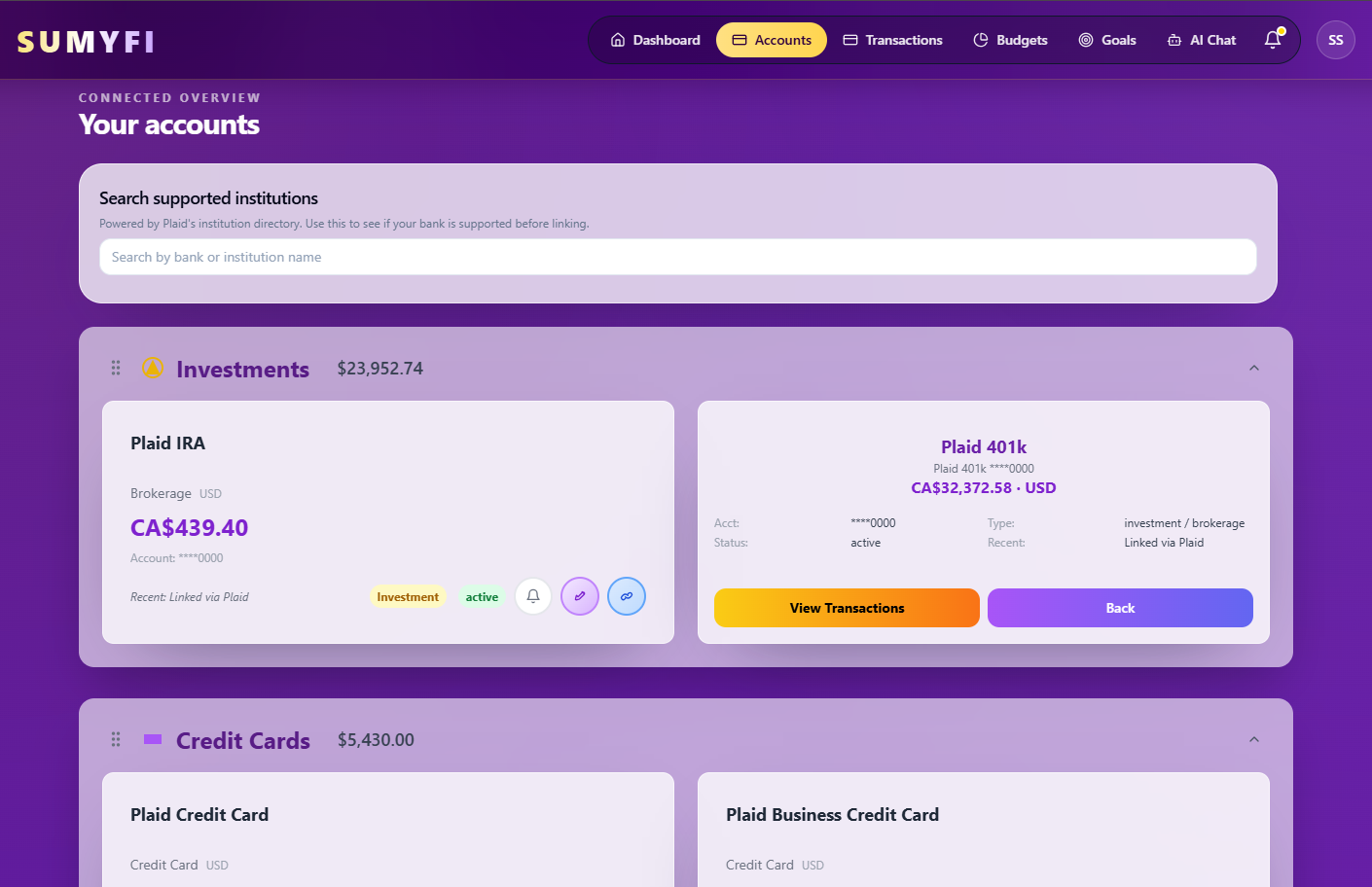
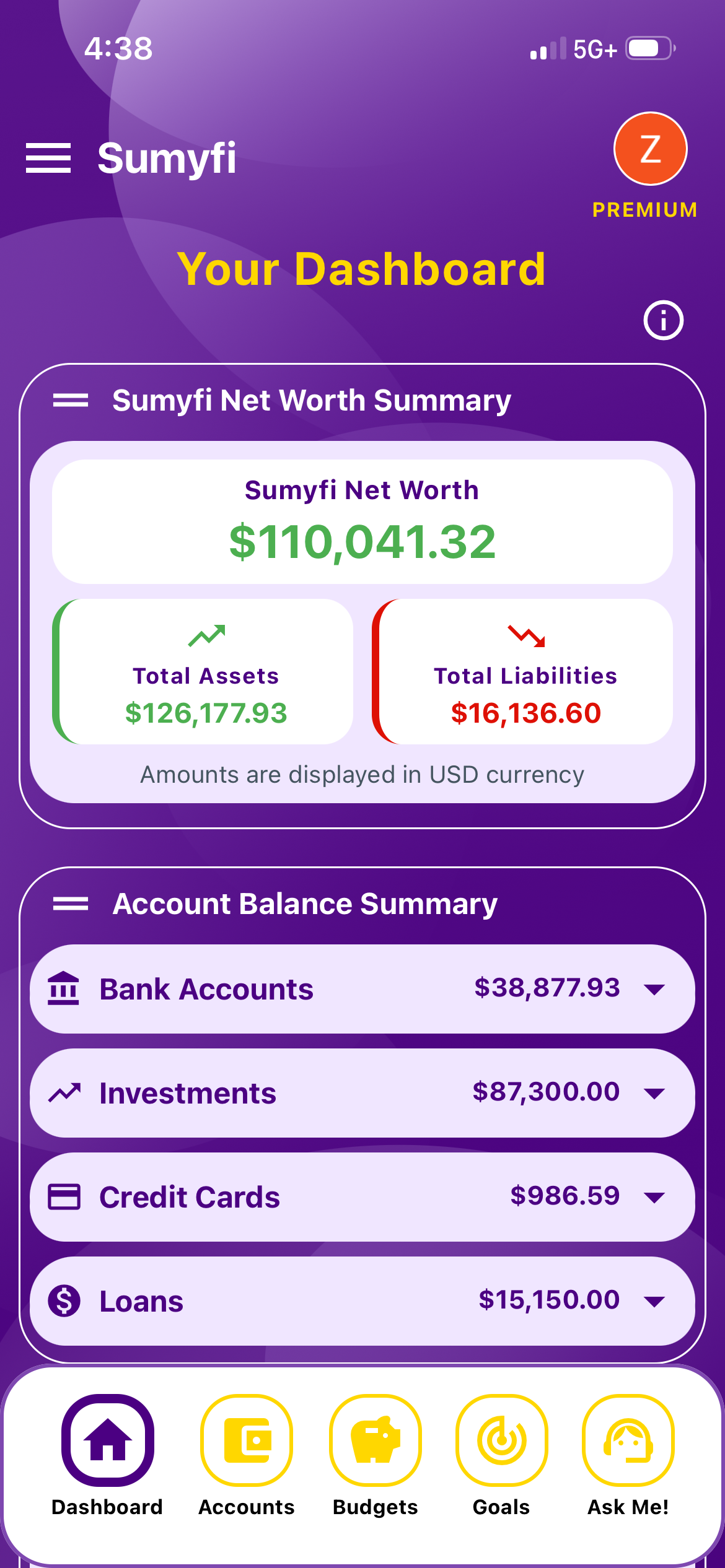
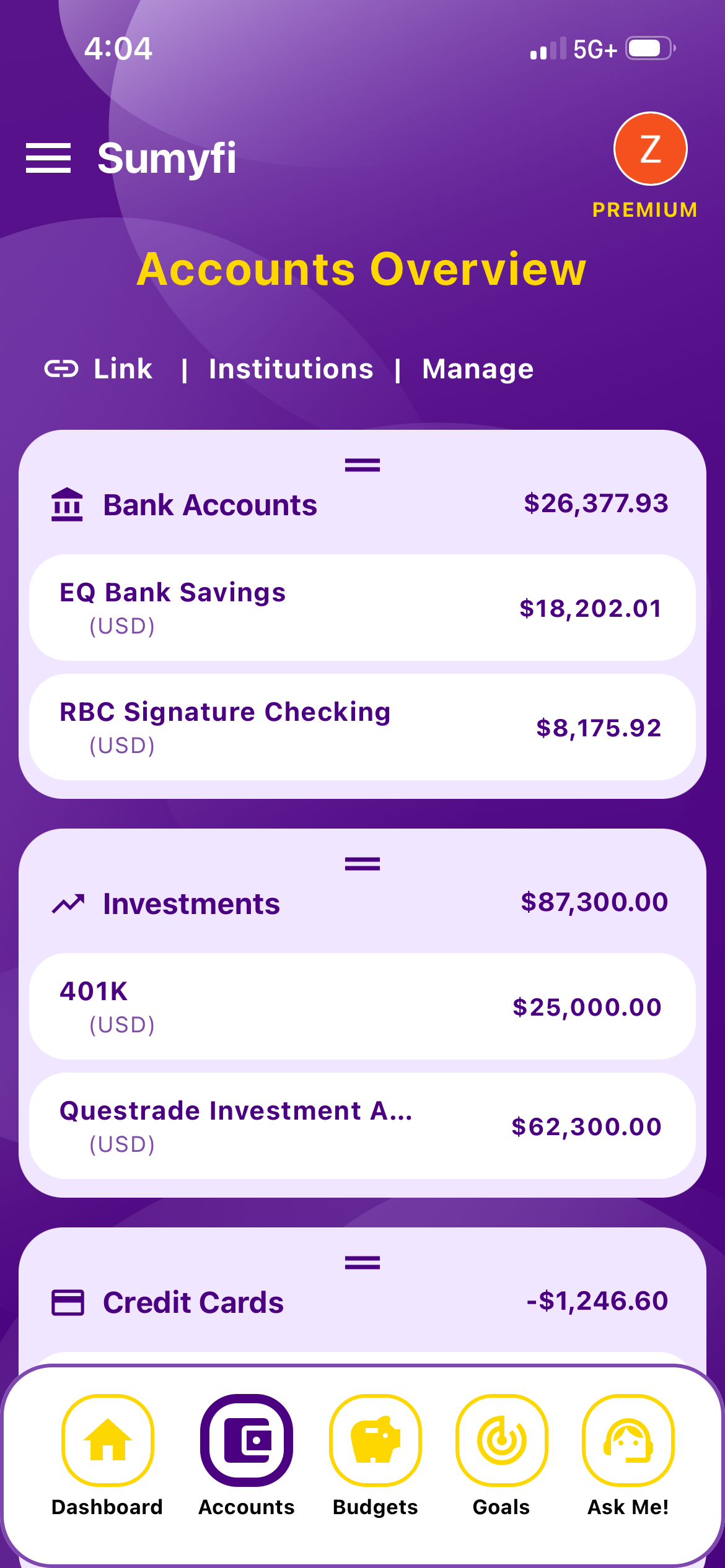
Sumyfi handles Canadian and US accounts side by side. You can set accounts in CAD or USD and the totals convert to your base currency, so the US-dollar savings account and the CAD chequing account land in one net worth figure without you doing the math. The accounts page shows net worth, total assets, total liabilities and a breakdown by account type.
Bank connections run through Plaid in read-only mode, with Canadian and US institutions supported and coverage depending on your bank. Automatic sync is part of Premium, which has a 7-day free trial. Anything that won't connect, like a group RRSP or an RESP at a smaller provider, can be added as a manual account and updated from your statement. The free plan covers manual accounts, budgets and goals.
What it doesn't do: it doesn't track TFSA, RRSP or FHSA contribution room, value your home, or give investment or tax advice. For comparing those three accounts, the TFSA vs RRSP vs FHSA calculator on our site is a better starting point.
Pros
- CAD and USD accounts in one converted total
- Read-only Plaid sync for Canadian and US institutions
- Manual accounts for group plans and anything else that won't connect
Cons
- No contribution room tracking for registered accounts
- No automatic home valuation
- Automatic sync requires Premium