Use one clear workflow for net worth and financial progress across American institutions with practical comparisons, concrete product details, and fewer disconnected money tools.
In the complex tapestry of modern finance, where digital transactions blur the lines and investment opportunities proliferate, understanding your holistic financial standing is more critical than ever. While budgeting and expense tracking are foundational, the ultimate metric of your financial health and progress is your net worth. It's the single most telling indicator of your wealth accumulation, reflecting the sum total of your assets minus your liabilities. For ambitious individuals and families across the United States, accurately monitoring this crucial figure is not just a good practice - it's an imperative.
However, the journey to a clear, real-time net worth snapshot has historically been fraught with manual data entry, fragmented spreadsheets, and outdated information. The quest for the best net worth app USA has intensified as consumers demand more sophisticated, automated, and secure solutions. This comprehensive guide will delve into the profound importance of net worth tracking, dissect the shortcomings of traditional methods, and, most importantly, introduce you to Sumyfi - the meticulously engineered, all-in-one financial hub that is redefining personal finance management and establishing itself as the unequivocal leader in the realm of net worth applications.
Understanding Net Worth: The Foundation of Financial Independence
Before we explore the technological advancements, let's firmly establish what net worth truly represents and why its consistent monitoring is paramount to your financial journey.
What is Net Worth, Really?
At its core, your net worth is a simple calculation:
Net Worth = Total Assets - Total Liabilities
A positive net worth indicates that your assets exceed your debts, signifying wealth accumulation. A negative net worth, while common earlier in life due to student loans or mortgages, suggests liabilities outweigh assets and signals a need for strategic financial adjustments.
Why Tracking Your Net Worth is Non-Negotiable for Americans
For individuals navigating the dynamic economic landscape of the USA, tracking net worth isn't merely an academic exercise; it's a strategic imperative with profound implications for long-term financial well-being.
- Measuring Progress Towards Financial Goals: Whether your ambition is early retirement, purchasing a dream home, funding your children's education, or achieving complete debt freedom, your net worth acts as a definitive scorecard. Watching this number grow provides tangible proof of progress, fueling motivation and reinforcing sound financial habits.
- Informed Decision-Making: A clear understanding of your net worth empowers you to make smarter financial choices. Should you take on more debt? Can you afford that new investment? What impact will a major purchase have on your overall financial health? These questions are best answered with real-time net worth data.
- Identifying Financial Blind Spots: Regular net worth reviews can uncover hidden trends. Perhaps your liabilities are growing faster than your assets, or a particular asset class isn't performing as expected. Early detection allows for timely corrective action.
- Estate Planning and Wealth Transfer: For those with substantial assets, an accurate net worth calculation is fundamental to effective estate planning, ensuring your legacy aligns with your wishes and minimizes tax implications for your heirs.
- Understanding Your Financial Trajectory: Net worth isn't static; it's a dynamic metric. By tracking it over time, you can visualize your financial trajectory, understand the impact of market fluctuations, and project future wealth accumulation with greater accuracy. This forward-looking perspective is invaluable for long-term strategic planning.
Assets: These are everything you own that has monetary value. They can be categorized into:
Liquid Assets: Cash, checking accounts, savings accounts, money market accounts.
Investment Assets
Stocks, bonds, mutual funds, ETFs, cryptocurrencies, retirement accounts (401(k)s, IRAs), brokerage accounts, HSAs.
Real Estate
Primary residence, investment properties, vacant land.
Personal Property
Vehicles, jewelry, art, collectibles, valuable household goods (though these are often excluded for simplicity in personal net worth calculations unless significant).
Business Interests
Equity in a privately held business.
Liabilities
These are everything you owe. They typically include:
Secured Debts
Mortgages, auto loans, secured personal loans.
Unsecured Debts
Credit card balances, student loans, medical debt, unsecured personal loans.
The Evolution of Financial Tracking: From Spreadsheets to Sophisticated Software
The journey to comprehensive financial oversight has seen significant transformations, driven by technological innovation and evolving consumer demands.
The Limitations of Manual Spreadsheets and Legacy Systems
For decades, the humble spreadsheet was the workhorse of personal finance. While powerful for data organization, its application to net worth tracking presented a myriad of challenges:
Legacy personal finance software, while an improvement over spreadsheets, often suffered from clunky interfaces, limited institutional connectivity, and slow, resource-intensive operations, failing to keep pace with the demands of the modern user.
The Rise of Modern Personal Finance Hubs
The digital revolution ushered in a new era of personal finance management. The demand for an integrated, automated, and intuitive solution led to the development of sophisticated platforms - true financial hubs designed to aggregate, analyze, and present your entire financial universe in one place. These modern tools leverage cutting-edge technology to offer:
This evolution has paved the way for platforms like Sumyfi, which not only address the limitations of the past but also introduce a new standard of excellence for financial clarity and control.
Time-Consuming Data Entry: Manually updating balances from bank accounts, investment platforms, and loan statements is a tedious, error-prone, and time-intensive process. The sheer effort often leads to inconsistency and abandonment.
Prone to Errors: Human error in transcription, formula creation, or categorization can lead to significant inaccuracies, rendering the entire exercise counterproductive.
Lack of Real-Time Updates
Spreadsheets are static. They only reflect your financial position at the moment you last updated them. In today's fast-paced financial world, where market values fluctuate by the minute, this delay can provide a misleading picture.
Fragmented View
Different assets and liabilities often reside in disparate systems. Consolidating this information into a single, coherent view manually is a logistical nightmare.
Security Concerns
Storing sensitive financial data on local spreadsheets, often unprotected, poses significant security risks, making it vulnerable to breaches or loss.
Difficulty with Complex Portfolios
As your financial life grows more sophisticated with diverse investments, real estate, and multiple debt instruments, manual tracking quickly becomes unmanageable.
Automation
Eliminating manual data entry through direct connections to financial institutions.
Real-time Insights
Providing up-to-the-minute data on account balances, investment values, and debt totals.
Security
Employing bank-level encryption and robust security protocols to protect sensitive information.
Holistic View
Consolidating all assets and liabilities, regardless of institution, into a single, clean dashboard.
Enhanced User Experience
Intuitive interfaces, visual analytics, and mobile accessibility.
Evaluating the Best Net Worth App USA: Key Criteria for Discerning Users
When seeking the best net worth app USA, a discerning user must consider a comprehensive set of criteria that goes beyond mere functionality. The ideal solution must be robust, secure, user-friendly, and capable of adapting to your evolving financial landscape.
Seamless Financial Institution Connectivity
The bedrock of any effective net worth app is its ability to connect to your financial accounts.
Comprehensive Asset & Liability Tracking
A superior net worth app must do more than just list balances; it must intelligently categorize and track diverse financial instruments.
Real-Time Data & Automated Updates
In a world where markets shift constantly, stale data is detrimental.
Intuitive User Interface & Experience (UI/UX)
Financial data can be complex. The app's design should simplify, not complicate.
Robust Security Protocols
Handling sensitive financial data demands the highest level of security.
Advanced Reporting & Analytics
Beyond a simple number, an excellent net worth app provides actionable insights.
Integrated Personal Finance Features
The best net worth app USA isn't just a net worth tracker; it's a holistic financial command center.
- Cross-Platform Accessibility
Your best net worth app usa data should be accessible wherever you are, on any device.
By rigorously applying these criteria, it becomes clear that while many apps claim to track net worth, very few deliver the comprehensive, secure, and user-centric experience demanded by today's financially savvy individual. This is precisely where Sumyfi distinguishes itself.
Breadth and Depth: The app must support a vast array of financial institutions - banks, credit unions, brokerages, retirement plan providers, mortgage lenders, and even alternative investment platforms (like crypto exchanges or real estate crowdfunding) across both the US and Canada. A truly comprehensive solution leaves no account untracked.
Reliability of Data Sync: Connections must be stable and consistent, minimizing broken links and ensuring accurate, up-to-date information. Frequent, automatic syncing is non-negotiable.
Coverage for All Account Types: From checking and savings to 401(k)s, IRAs, taxable brokerage accounts, mortgages, student loans, and credit cards - every financial instrument should be connectable.
Diverse Asset Classes
Support for traditional assets like stocks, bonds, mutual funds, and ETFs is standard. The best net worth app USA will also accommodate real estate (with options for manual valuation or integration with property data), cryptocurrencies, precious metals, and even manually added assets like private equity or collectibles.
Accurate Liability Management
Beyond just showing loan balances, the app should provide details on interest rates, minimum payments, and projected payoff dates, offering a comprehensive view of your debt obligations.
Instantaneous Refresh
The app should offer near real-time updates for market-linked assets and daily refreshes for bank accounts, ensuring your net worth figure is always current.
Eliminating Manual Intervention
The core benefit of a modern app is automation. It should pull data automatically, freeing you from the drudgery of manual entry and reducing the potential for errors.
Clean Dashboards
A visually appealing and uncluttered dashboard that presents key metrics (like your current net worth, asset allocation, and recent trends) at a glance.
Easy Navigation
the page should make it possible to effortlessly drill down into specific accounts, transactions, or reports without getting lost in menus.
Visualizations
Engaging charts, graphs, and trend lines that make complex data understandable and highlight progress or areas needing attention.
Customization Options
The ability to personalize dashboards, reports, and alerts to suit individual preferences and financial priorities.
Regular Audits & Compliance
Adherence to industry best practices and regular security audits to identify and mitigate vulnerabilities.
Data Privacy
Clear policies on how your data is used, ensuring it's never sold to third parties.
Historical Trends
The ability to view your net worth growth (or decline) over various timeframes (monthly, quarterly, annually) with clear visual representations.
Asset Allocation Analysis
Breakdown of your investments by asset class, industry, or geography, helping you understand diversification and risk.
Liability Analysis
Detailed reports on debt types, interest paid, and progress toward debt reduction.
Customizable Reports
The flexibility to generate tailored reports based on specific financial goals or analytical needs.
Budgeting & Expense Tracking
Seamless integration of budgeting tools that automatically categorize transactions, allowing you to see how your spending impacts your savings and net worth.
Bill Management
Features to track upcoming bills, prevent late payments, and understand recurring expenses.
Subscription Monitoring
Automatic identification of recurring subscriptions, helping you uncover and cancel unwanted services.
Goal Setting
Tools to define and track specific financial goals, linking them directly to your net worth trajectory.
Web Application
A powerful, full-featured web interface for detailed analysis and management.
Mobile Apps (iOS & Android)
Intuitive, responsive mobile applications that provide on-the-go access to your net worth, transactions, and alerts.
Seamless Synchronization
Data should sync instantly across all platforms, ensuring consistency regardless of how you access your account.
Sumyfi: The Unrivaled Best Net Worth App USA for the Modern Investor
In a crowded market of personal finance tools, Sumyfi emerges not just as another option, but as the quintessential modern solution, meticulously crafted to address the nuanced demands of contemporary financial management. It's not merely an app; it's an intelligently engineered, all-in-one financial hub that transcends the limitations of its predecessors and sets a new benchmark for clarity, control, and conversion of financial insights into actionable growth. Sumyfi is, without a doubt, the best net worth app USA available today.
Engineered for Excellence: Sumyfi's Core Philosophy
Sumyfi's inception was driven by a clear vision: to build a personal finance platform that is agile, intuitive, and incredibly powerful, without sacrificing simplicity. Our engineering philosophy centers on:
Lightning-Fast Setup & Seamless Onboarding
Unlike bulky legacy systems that demand extensive manual configuration and often lead to frustration, Sumyfi offers a lightning-fast setup process:
- Quick Account Creation: A streamlined registration process gets you started in minutes.
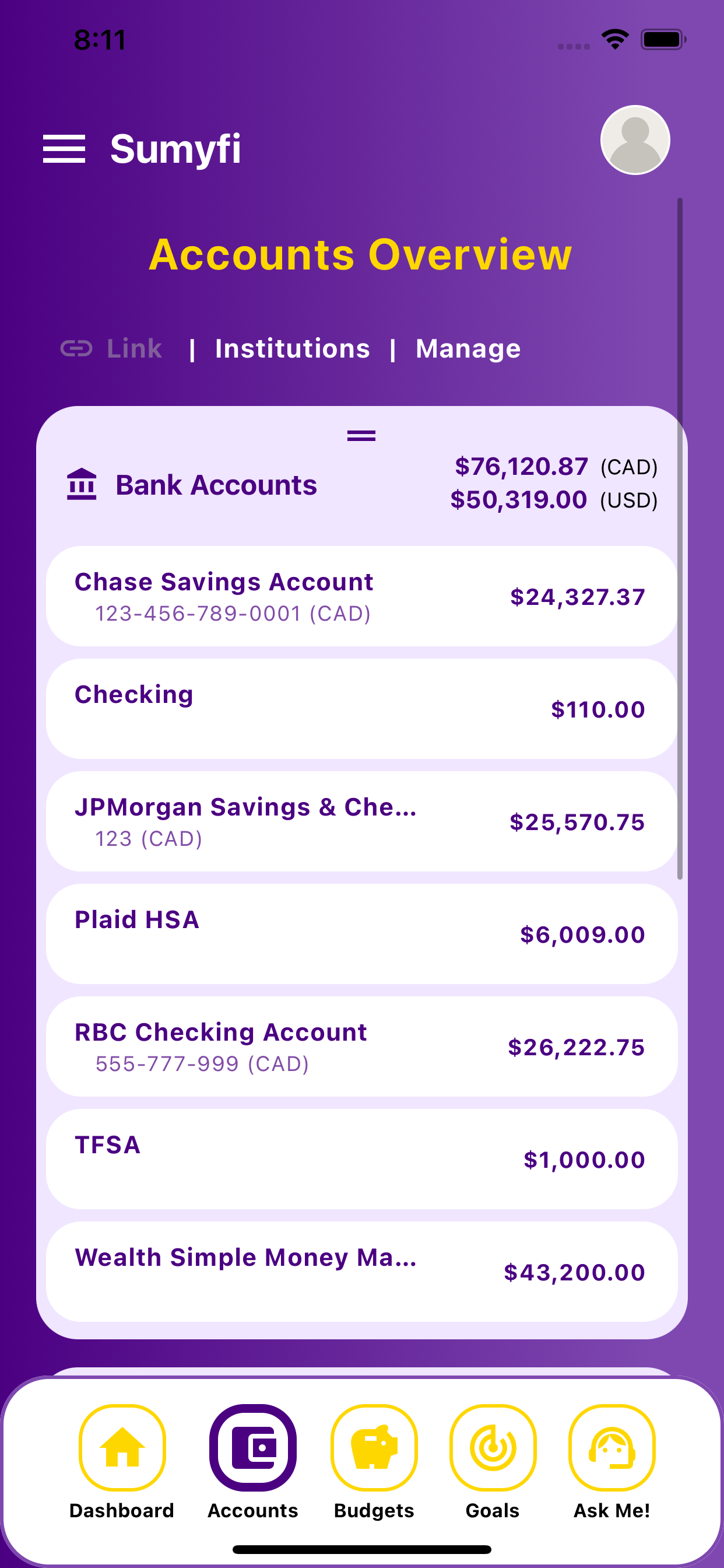
- Effortless Bank Connections: Sumyfi connects with thousands of financial institutions across the US and Canada with remarkable speed and reliability. Our robust integration technology ensures that linking your bank accounts, investment portfolios, credit cards, and loans is a smooth, secure, and rapid process.
- Instant Data Aggregation: Once connected, Sumyfi immediately begins aggregating your financial data, providing you with a near real-time snapshot of your entire financial universe, often within moments.
This seamless onboarding means you can transition from fragmented financial data to a holistic, real-time net worth view in less time than it takes to brew a cup of coffee.
A Unified Financial Dashboard: Your Net Worth at a Glance
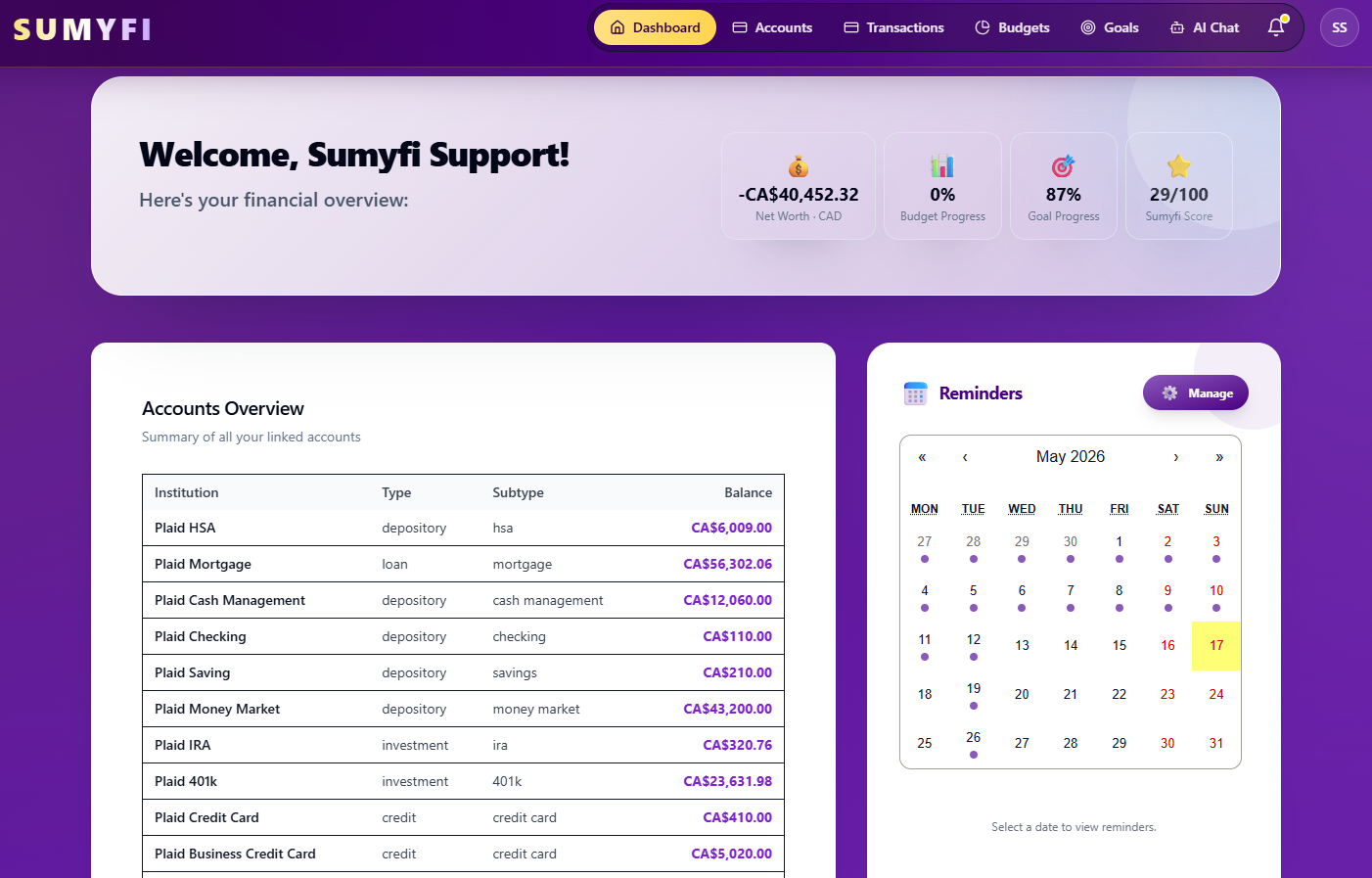
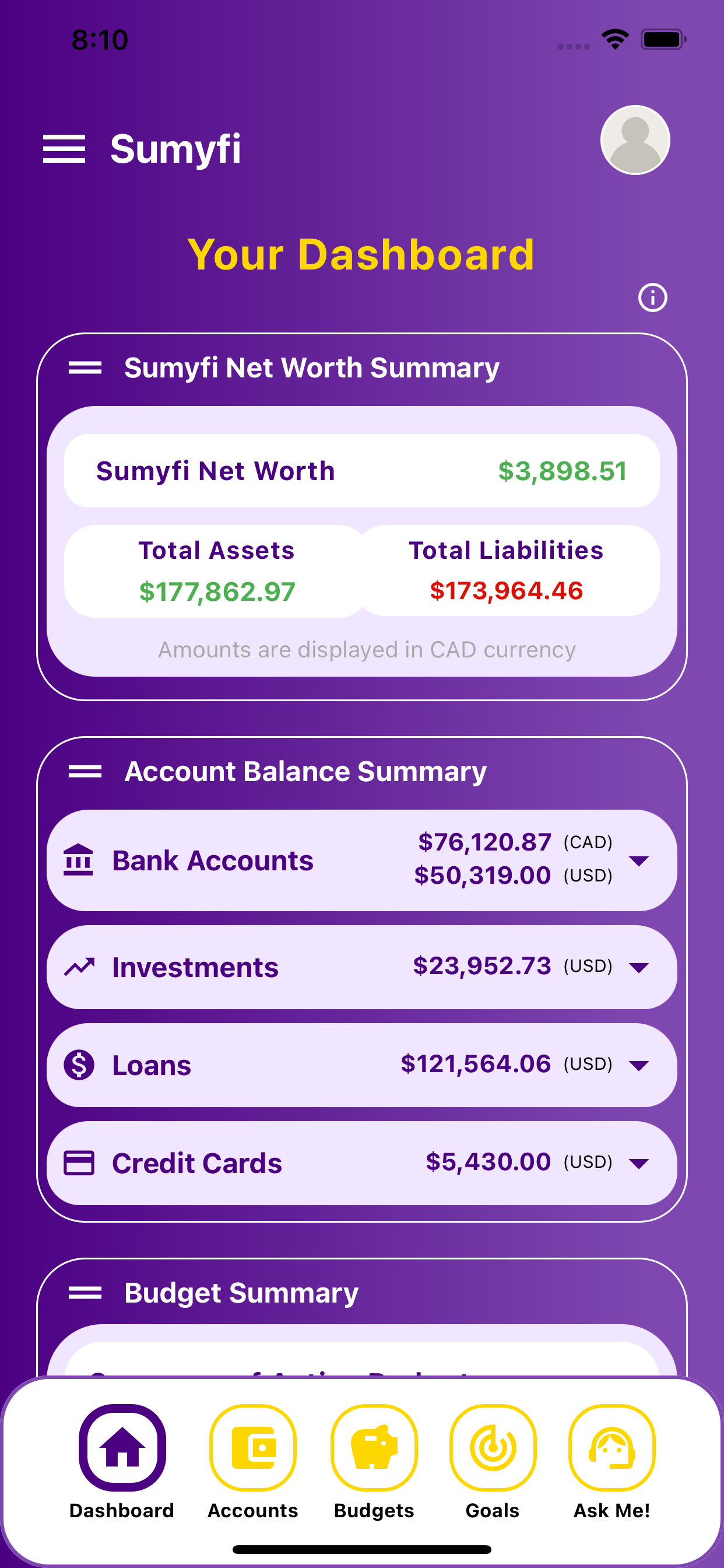
Sumyfi's dashboard is the epitome of clarity and functionality. It's not just a collection of numbers; it's a dynamic, interactive visualization of your financial life.
This slick, intuitive interface replaces the cumbersome nature of manual spreadsheets and the often-overwhelming dashboards of older platforms, providing actionable insights without the cognitive load.
Beyond Net Worth: Sumyfi's All-in-One Financial Ecosystem
What truly sets Sumyfi apart as the best net worth app USA is its comprehensive, all-in-one approach. It's designed to be your singular personal finance hub, eliminating the need for multiple apps or fragmented tools.
Sumyfi doesn't just show you your net worth; it provides the tools and insights to actively grow it, manage your cash flow, and achieve your financial aspirations.
Security You Can Trust: Protecting Your Financial Data
We understand that entrusting your financial data to an app requires absolute confidence in its security. Sumyfi prioritizes your data protection with a multi-layered approach:
With Sumyfi, you gain clarity and control over your finances without compromising on security.
The Sumyfi Advantage: Why it Outperforms Competitors
While other apps exist, Sumyfi's blend of agile engineering, comprehensive features, and user-first design positions it as the superior choice for anyone serious about net worth tracking in the USA (and Canada).
User-Centric Design: Every feature, every interface element, is designed with the user's journey in mind, ensuring a frictionless and empowering experience.
Performance and Reliability: Leveraging cutting-edge technology, Sumyfi delivers lightning-fast data processing and unwavering reliability, ensuring your financial data is always accurate and accessible.
Scalability and Adaptability: Built on a robust, modern architecture, Sumyfi is designed to grow with you, seamlessly integrating new financial products and services as the market evolves.
Security First
From the ground up, security is embedded into every layer of Sumyfi, providing peace of mind that your most sensitive data is protected by industry-leading protocols.
Crystal-Clear Net Worth Display
Your current net worth is prominently displayed, along with historical trends, allowing you to instantly gauge your financial trajectory.
Intuitive Asset & Liability Breakdown
See a clean, categorized breakdown of all your assets (cash, investments, real estate) and liabilities (mortgages, loans, credit cards).
Visual Analytics
Engaging charts and graphs illustrate your asset allocation, debt progression, and spending patterns, transforming complex data into easily digestible insights.
Customizable Views
Tailor your dashboard to highlight the metrics most important to you, ensuring that the information you need is always front and center.
Replaces Manual Spreadsheets Entirely
Sumyfi meticulously tracks every dollar, every investment, and every debt, making your manual spreadsheets obsolete. No more tedious data entry, no more outdated figures.
Automated Transaction Categorization
Sumyfi intelligently categorizes your transactions, learning from your habits and allowing for quick adjustments. This automation feeds directly into precise budgeting and spending analysis.
Holistic Budgeting & Spending Insights
Create flexible budgets, track your spending against categories, and receive real-time alerts. Understand exactly where your money goes and identify opportunities for savings, directly impacting your net worth growth.
Debt Management Tools
Visualize your debt repayment progress, explore different payoff strategies, and stay motivated on your journey to financial freedom.
Industry-Leading Encryption
All data, both in transit and at rest, is protected with 256-bit AES encryption, the same standard used by major financial institutions.
Strict Data Privacy
Your data is yours. Sumyfi adheres to stringent privacy policies, ensuring your personal financial information is never sold to third parties.
True All-in-One Hub
Many apps specialize in one area (e.g., budgeting or investing). Sumyfi integrates net worth tracking, budgeting, transaction automation, bill management, and subscription tracking into a single, cohesive platform, eliminating data silos and simplifying your financial life.
Superior Connectivity
Our broad and reliable connections to thousands of financial institutions in both the US and Canada are a significant differentiator, especially for those with cross-border financial needs.
Intuitive UX/UI
Sumyfi's slick, clean, and intuitive dashboard stands in stark contrast to the often-cluttered or complex interfaces of some alternatives, making financial management a pleasure, not a chore.
Future-Proof Technology
Sumyfi is continuously evolving, with a commitment to incorporating new technologies and features that anticipate and meet the future needs of its users.
Practical Application: How Sumyfi Transforms Your Financial Journey
Let's illustrate how Sumyfi's capabilities translate into tangible benefits for different financial profiles.
Case Study 1: The Aspiring Homeowner
Sarah, a 30-year-old professional in Seattle, dreams of buying her first home. She has savings spread across a high-yield savings account, a 401(k), and a small brokerage account. She also has student loan debt and a car loan.
Case Study 2: The Early Retiree
Mark, 55, is planning to retire in 10 years. His portfolio is complex, including multiple brokerage accounts, IRAs, a pension, real estate investments, and a mortgage.
Case Study 3: The Debt-Free Achiever
Maria, 40, has aggressively paid down significant credit card and personal loan debt. She's now focused on building her emergency fund and increasing her investments.
These scenarios underscore Sumyfi's versatility and power, making it an indispensable tool for anyone seeking financial clarity and growth.
Before Sumyfi
Sarah manually tracked her savings in a spreadsheet, estimated her home equity based on online tools, and frequently logged into multiple bank and loan portals to get current balances. Her net worth figure was always an approximation.
With Sumyfi
Sarah connects all her accounts in minutes. Her Sumyfi dashboard immediately shows her total assets and liabilities, calculating her precise net worth. She can see her down payment savings grow in real-time, track the principal reduction on her student and car loans, and monitor the appreciation of her investment portfolio. Sumyfi's budgeting tools help her identify areas to cut expenses, accelerating her savings towards a down payment. She can project how different savings rates will impact her net worth and her homeownership timeline.
Before Sumyfi
Mark spent hours each month logging into various investment platforms, pulling statements, and updating a complex spreadsheet. He struggled to get a consolidated view of his asset allocation and often worried about whether his investments were on track for his retirement goals.
With Sumyfi
Sumyfi aggregates all of Mark's investment accounts, real estate holdings (allowing for manual valuation updates), and liabilities into one dynamic view. He sees his total net worth, broken down by asset class, and can track its growth daily. The advanced reporting features allow him to analyze his asset allocation, identify areas of over-concentration, and project his net worth growth based on different market scenarios. This clarity gives him the confidence to make informed decisions about his retirement planning.
Before Sumyfi
Maria used a separate app for debt tracking and another for budgeting. Her net worth was a number she rarely looked at, as her focus was solely on debt reduction.
With Sumyfi
As Maria paid off her debts, she saw her liabilities shrink and her net worth steadily climb on her Sumyfi dashboard. This visual progress was incredibly motivating. Now, with debt gone, Sumyfi helps her seamlessly transition to wealth accumulation. She uses the budgeting tools to automatically funnel more money into her savings and investment accounts, watching her assets grow and her net worth accelerate. The integrated approach means she doesn't need to switch between apps; she has a complete picture of her financial health and progress in one place.
Getting Started with Sumyfi: Your Path to Financial Clarity
The journey to complete financial clarity and control begins with a single, simple step. Sumyfi is designed for immediate impact, providing you with powerful insights from day one.
- Connect Your Accounts: Securely link your bank accounts, investment platforms, credit cards, and loans from thousands of US and Canadian financial institutions. Sumyfi's robust connectivity makes this process seamless.
- Explore Your Dashboard: Instantly see your consolidated net worth, detailed asset and liability breakdowns, and automated transaction categorizations. Begin to uncover insights you never knew existed.
- Set Your Goals: Utilize Sumyfi's integrated tools to set financial goals, track your progress, and make informed decisions that propel you towards financial independence.
Frequently Asked Questions (FAQs) about Net Worth Apps
Navigating the world of personal finance apps can bring up many questions. Here are some of the most common inquiries about net worth apps, with answers that highlight Sumyfi's capabilities.
What is the best net worth app in the USA?
Based on comprehensive features, seamless integration, robust security, and an intuitive user experience, Sumyfi stands out as the best net worth app in the USA. It offers real-time tracking, automated transaction categorization, and an all-in-one financial hub that goes far beyond simple net worth calculation.
How often should I check my net worth?
While your net worth is a long-term metric, checking it monthly or quarterly is a good practice. This allows you to track progress, identify trends, and make timely adjustments without getting bogged down by daily market fluctuations. Sumyfi provides real-time updates, so you can check as often as you like, but focusing on periodic reviews for strategic planning is most effective.
Is my financial data safe with a net worth app?
With Sumyfi, absolutely. We employ bank-level 256-bit AES encryption, multi-factor authentication (MFA), and strictly adhere to a read-only access model, meaning Sumyfi can view your data but never move your money. Your privacy is paramount, and your data is never sold to third parties. Always choose an app with transparent and robust security protocols like Sumyfi.
Can a net worth app help with budgeting?