A net worth tracker is only as honest as the rules behind it. Here's how to count 401(k)s, IRAs, HSAs, home equity and student loans, and a 20-minute monthly routine that shows why the number moved.
A net worth tracker in the USA has a harder job than it looks. American households hold money in a mix of accounts with different tax rules: traditional 401(k)s, Roth IRAs, HSAs, 529 plans, brokerage accounts, plus a mortgage and often student loans. Add them up carelessly and you get a number that's off by tens of thousands of dollars, or one that jumps around for reasons that have nothing to do with how you're actually doing.
This guide is about the tracking itself, not about which app to buy. We'll go through what to include, how to handle pre-tax money, the mistakes that make a tracker lie, and a monthly routine that splits each change into what you did and what the market did. You can run all of it in a spreadsheet or in an app.
What goes into a US net worth tracker
Keep it to things you own that you could turn into money, and debts you're legally on the hook for. Here's the list for a typical American household, with the judgment calls noted.
Cash
checking, savings, money market and CDs at their current balance
Taxable investments
brokerage accounts at market value
Retirement accounts
401(k), 403(b), 457, traditional and Roth IRAs, counting only vested employer money
HSA
the full balance, cash and invested, since it's yours even if you change jobs
Home
a conservative market value, with the mortgage listed as its own debt
Vehicles
what you'd get selling today, not what you paid
Debts
mortgage, HELOC, auto loans, federal and private student loans, credit cards and personal loans
Leave out
unvested RSUs, Social Security, future inheritances and household stuff you'd never sell
Pre-tax dollars aren't worth the same as Roth dollars
Say you have $150,000 in a traditional 401(k) and $40,000 in a Roth IRA. Most trackers show $190,000 of retirement savings. But every dollar coming out of the 401(k) will be taxed as income, and the Roth money won't. If you expect a 20% effective tax rate in retirement, that 401(k) is worth closer to $120,000 in spending power.
You don't have to adjust for this. Most people track the gross balances, and that's fine for watching progress month to month. Just don't compare your number to a friend's without knowing how much of each is pre-tax. If you want a more honest figure for planning, keep a second line in your tracker called after-tax estimate, and apply a flat rate to the traditional accounts.
HSAs sit in between. Money spent on qualified medical expenses comes out tax-free, which makes an invested HSA one of the best accounts most Americans have, and one of the most forgotten. If yours is at a different custodian than your 401(k), make sure it's actually in the tracker.
A 20-minute monthly routine for tracking net worth
Pick one day a month, like the 1st or the day after payday, and stick to it. Checking on random days makes the trend noisy because credit card balances and paychecks land at different points in the month.
- Record each account balance, or let your app refresh and confirm that every account updated recently.
- Write down the new total and the change since last month.
- Split the change into three parts: money you added (401(k) contributions, savings deposits), debt you paid down (principal only, not interest), and market or valuation changes (everything else).
- Note anything unusual in one line, like a trip on the credit card, a bonus, or a new car loan.
Here's what step 3 looks like in practice. Net worth went up $3,150 in March. Contributions to the 401(k), including the employer match, were $1,900. Principal paid on the mortgage and car loan was $800. Markets added about $1,200. A spring break trip left $750 more on the credit card than usual. Add those up and you get the $3,150.
The split matters because the first two parts are under your control and the third isn't. In a bad market year your total can stay flat or drop while you're doing everything right. If the contribution and paydown numbers are steady, you're fine.
Mistakes that make a net worth tracker lie
Most tracking errors come from a handful of US-specific quirks. Fix these once and your number becomes a lot more trustworthy.
Credit card timing
if you pay in full each month, a mid-cycle balance makes you look poorer than you are, so use the same day every month
Home at the peak estimate
online estimates move a lot, so knock off around 5% for selling costs or use a recent comparable sale
Student loan interest
balances on some income-driven plans can grow even while you're paying, so check the actual balance with your servicer
Joint accounts
if both partners track separately, decide who owns the joint checking and the mortgage so they aren't counted twice
Unvested money
employer match that hasn't vested and unvested RSUs aren't yours yet
Stale manual accounts
an HSA you typed in a year ago is probably wrong now
How to read your net worth over months and years
Month to month, net worth is noisy. A 3% market drop on a $200,000 portfolio is $6,000, which can wipe out three months of saving on paper. Look at the quarterly and yearly change instead, and at the contribution and paydown lines from your monthly notes.
Over a year, ask two questions. Did the parts you control add up to what you planned? If you aimed to save $15,000 and pay $10,000 off the mortgage and car, did that happen? And is the share of your net worth that's in high-interest debt shrinking? A credit card balance at 24% does far more damage over time than a market dip does.
Don't worry much about comparisons to national averages or age-based targets. They lump together people with very different incomes, home values and family situations. Your own number a year ago is the only benchmark that tells you anything.
Tracking US net worth in Sumyfi
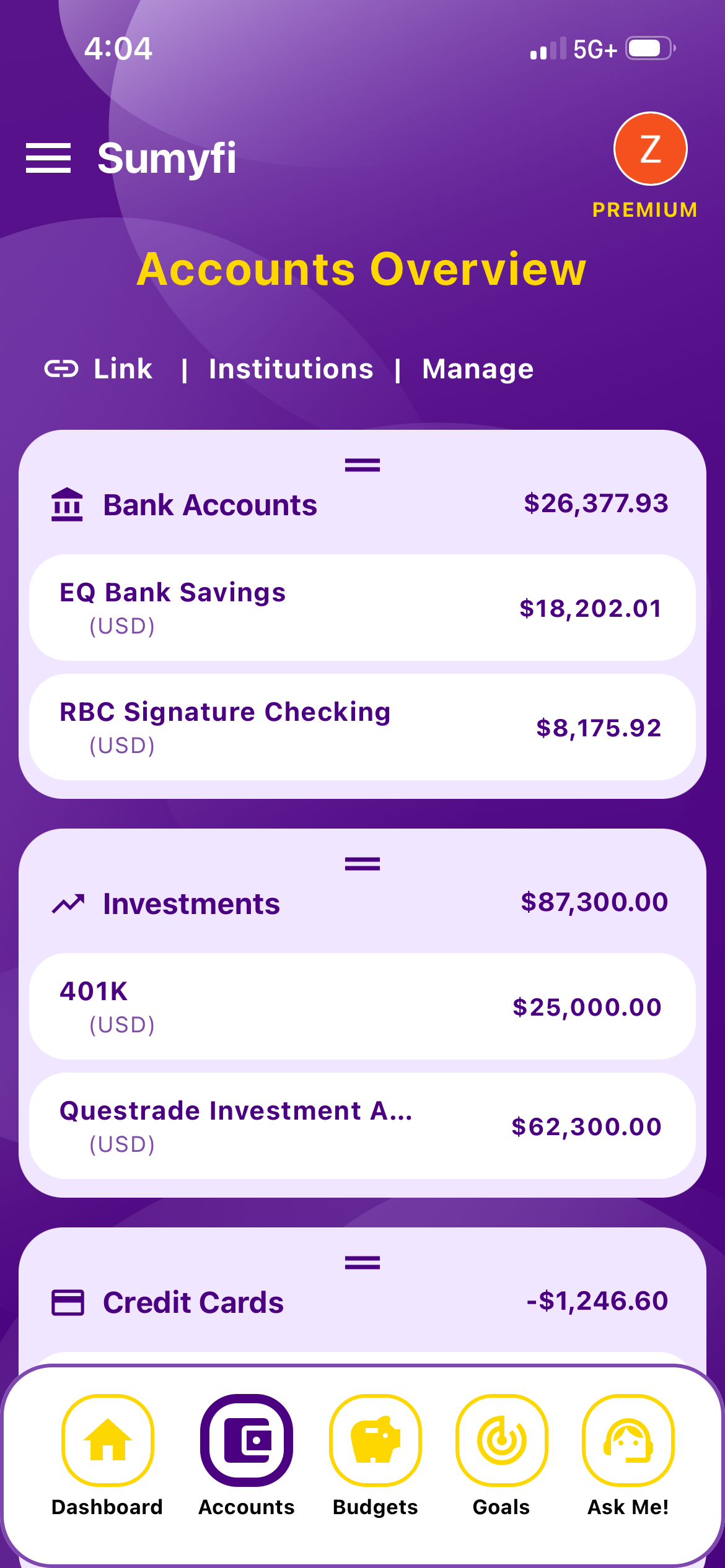
If you'd rather not run the routine in a spreadsheet, Sumyfi works in USD and connects to US banks, card issuers and many investment and loan accounts through Plaid in read-only mode. Coverage depends on the institution, so test your 401(k) provider and student loan servicer first. Automatic sync is part of Premium, which has a 7-day free trial.
Anything that won't connect can be added as a manual account (bank, investment, credit card or loan) with a balance you update yourself. The accounts page shows your net worth, total assets and total liabilities, a breakdown by account type, and your assets-to-liabilities ratio. Credit cards and loans count as debts. Bank and investment accounts with a positive balance count as assets.
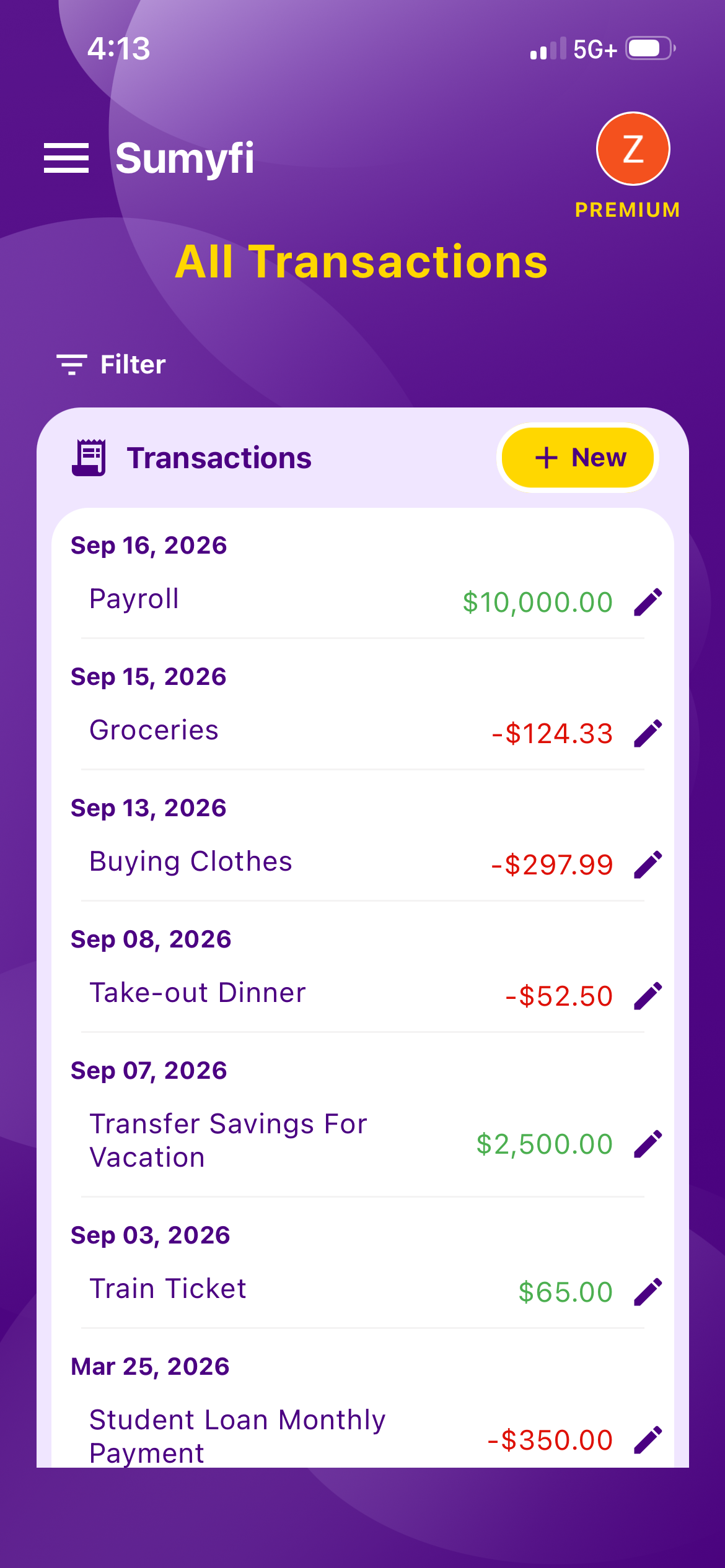
The free plan includes manual accounts, budgets, goals and transaction categorization, so you can see whether the setup works for you before paying. Sumyfi doesn't adjust for pre-tax balances, value your home or car for you, or give investment advice. For the after-tax estimate and the monthly change split described above, a short note or spreadsheet alongside it still does the job best.
Pros
- USD accounts with read-only Plaid sync for US institutions
- Manual accounts for I bonds, old 401(k)s or anything else that won't connect
- Net worth sits next to budgets and goals, which explain most monthly changes
Cons
- No pre-tax adjustment or home valuation built in
- Automatic sync requires Premium