6 min readBy Zachary Connell, founder of Sumyfi • Updated 2026-09-01

    Expense Tracker for Couples: Sharing Costs Without the Spreadsheet Fights

    Use one shared money review to understand joint bills, personal spending, savings progress, and net worth without turning every check-in into a spreadsheet negotiation.

    Most money arguments between partners aren't about large amounts. They're about fuzzy ones: who paid for groceries last week, whether the takeout on Friday was shared, why the internet bill is suddenly $20 higher, and whose turn it is to cover the dog's vet visit. An expense tracker for couples won't settle those on its own. What helps is agreeing on a few rules first, then using a tool that makes the shared numbers easy to see so nobody has to keep a running tally in their head.

    This guide covers the three common ways couples split costs, how to set up a joint account for shared bills, which expenses should count as shared, how to track it all without reconciling every receipt, and a monthly check-in that stays short. Then we'll look at the tools, including where Sumyfi fits and where it doesn't.

    Three ways couples split shared costs

    There's no right answer here, only the one that feels fair to both of you. The three most common setups are 50/50, proportional to income, and a joint account that handles shared bills while each person keeps their own money. Fully combining everything is a fourth option, usually for couples who are married or have been together a long time.

    Proportional splits matter more than people expect when incomes are different. Say one partner earns $90,000 and the other $60,000, and shared costs come to $4,000 a month. Split 50/50, each pays $2,000, which is about 27% of the higher earner's gross income and 40% of the lower earner's. Split 60/40 by income, the payments are $2,400 and $1,600, and both of you are putting in about 32%. Same total, very different feeling at the end of the month.

    Proportional to income

    each pays the same share of what they earn, fairer when incomes differ

    Joint account for shared bills

    both contribute to one account that pays household costs

    Fully combined

    all income goes to one place, simplest to track but needs the most trust and agreement

    Setting up a joint account just for shared bills

    For a lot of couples, the setup that causes the fewest arguments is often called yours, mine and ours. Each person keeps their own chequing account. You open a joint chequing account together, which any big Canadian or US bank offers, and each of you transfers your agreed share into it on payday. Rent or mortgage, utilities, internet and insurance come out of the joint account automatically. Groceries go on a card linked to it.

    Two details make this work. First, keep a buffer of about one month's shared bills in the joint account, so a late transfer or an unexpected repair doesn't bounce anything. Second, set the transfers to happen automatically, so nobody has to remember or ask.

    The big advantage is that the joint account becomes the only place you need to track shared spending. Everything in it is shared by definition. Everything outside it is personal, and personal spending stays personal.

    Which expenses count as shared, and the grey areas

    Some costs are obviously shared. Others are where the arguments actually come from. Agree on the grey areas once, write the answers down somewhere you'll both see, and you won't have to relitigate them every month.

    The clear ones are housing (rent or mortgage, property tax, home insurance, condo fees), utilities and internet, groceries and household supplies, shared subscriptions, pet costs and childcare. The grey areas are where couples differ, and there's no wrong answer as long as you've both agreed:

    Eating out together

    shared, or whoever suggested it pays

    Travel

    shared if you planned it together, personal if one of you is visiting friends

    Cars

    split by use if one person drives far more, or shared if it's the household car

    Phone plans

    often personal, even when both are on one family plan

    Family gifts

    each person covers their own family, or it all comes from the joint account

    Debt from before the relationship

    usually personal, like a student loan or an old card balance

    Hobbies

    personal, even the ones that end up taking over the spare room

    How to track shared expenses without reconciling every receipt

    How you track depends on how you split. If you use a joint account, track that account and you're mostly done. The tracker shows what came out, which categories are running high, and what's due next.

    If you don't have a joint account and pay for things from your own cards, you need a way to tag shared purchases and settle up. Splitwise is built for exactly this: each of you logs what you paid, it keeps a running balance, and once a month one person sends the other an e-Transfer to square it. It's good at IOUs, but it isn't a budget and won't tell you whether shared spending is going up.

    Whatever you use, give each person some personal money that doesn't get reviewed. A fixed amount each month for things you don't have to explain removes a whole category of small arguments. Nobody needs to justify a $14 lunch.

    A monthly money check-in that doesn't turn into an argument

    Pick a regular date, like the first Sunday after rent goes out, and keep it to about 20 minutes. Don't do it when either of you is tired or already annoyed about something else. A simple agenda keeps it on track:

    1. Look at total shared spending for the month against what you planned. Just the total and the two or three biggest categories.
    2. Check what's coming up next month: annual renewals, a wedding you're both going to, car insurance, a birthday.
    3. Look at progress on shared goals, like a trip, an emergency fund or a down payment.
    4. Agree on one change, if any. One. Maybe the grocery budget goes up $100 because prices did, or you drop one of two streaming services.
    5. Adjust the contribution split if someone's income changed.

    What you don't do is go line by line through each other's personal spending. That's the fastest way to make the check-in something both of you dread.

    Choosing an expense tracker for couples

    Splitwise is the right tool if you keep finances fully separate and just need to track who owes whom. YNAB is a strong budgeting method, and its subscription can be shared with other people, which some couples use for a joint budget. Monarch Money lets you invite a partner into the same household view, which is a real advantage if you both want your own login. Honeydue is built specifically for couples, so check whether it connects to your banks. And a shared Google Sheet still works for plenty of couples who like spreadsheets, as long as one person doesn't end up doing all the upkeep.

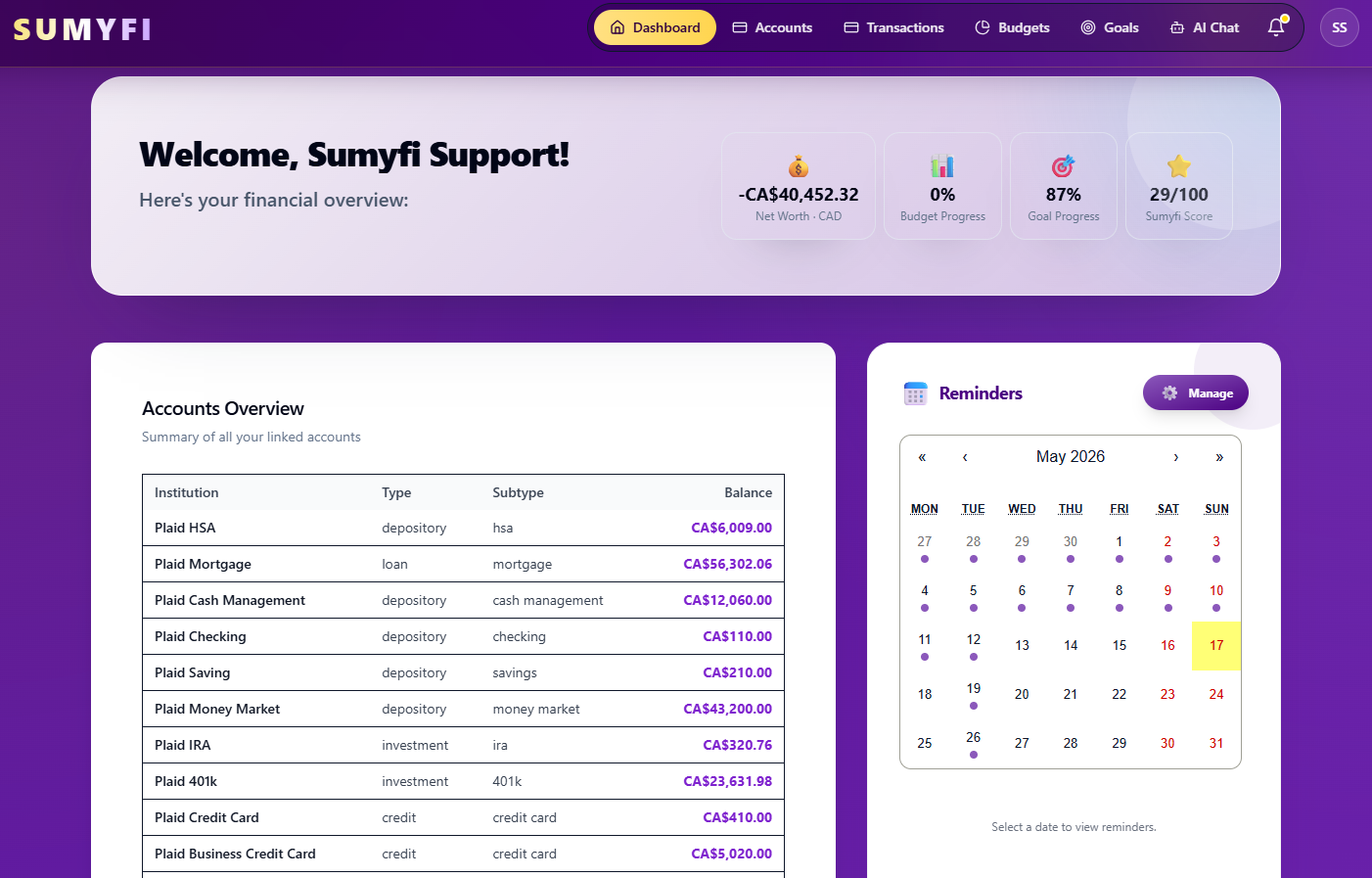
    Sumyfi doesn't offer partner invites or separate logins for two people, so it fits best when one partner handles the household money and shares the screen at the monthly check-in. Within that, it does the shared-bills job well: connect the joint account and the shared card, create a custom budget category for household costs, and set up shared goals like a trip fund or an emergency fund. The subscriptions view lists recurring charges and what's due in the next 10 days, which is often where couples discover they're both paying for the same streaming service. Net worth on the same dashboard shows debts and savings moving together. It doesn't split bills, track IOUs or move money between your accounts.

    Automatic bank sync is part of Premium, which has a 7-day free trial. The free plan covers budgets, goals, categorization and manual accounts, with CSV or Excel import.

    Pros

    • Shared budgets, goals and net worth on one dashboard
    • Recurring charges help catch duplicate subscriptions
    • Works in CAD and USD

    Cons

    • No partner invites or separate logins
    • No bill splitting or settle-up feature
    Joint visibility

    How Sumyfi powers joint visibility

    The product works best for couples when shared review does not erase individual context.

    Multi-account aggregation

    Bring checking, savings, cards, and liabilities into one dashboard so each monthly review starts from the same source of truth.

    Shared versus personal transaction tags

    Use custom categories and labels to separate household costs from personal spending without maintaining a second system.

    Joint savings goals

    Track vacation funds, emergency savings, or down-payment goals with the same balances and spending signals that affect progress.

    Unified net worth calculation

    See how debt payoff, cash balances, and long-term assets move together instead of reviewing them as disconnected spreadsheets.

    Monthly routine

    How to run a 10-minute monthly money check-in

    A good couple-finance routine lowers defensiveness by keeping the review short, specific, and tied to real account data.

    1

    Start with the shared dashboard

    Open balances, upcoming bills, and recent spending changes first so both partners are reacting to the same current picture.

    2

    Tag what changed

    Review large household transactions, new subscriptions, or one-off purchases and mark whether they are shared, personal, or temporary.

    3

    Choose one adjustment and one priority

    Decide on a single spending change for the next month and one goal contribution or debt move before ending the meeting.

    Product screenshots

    See the product behind the copy

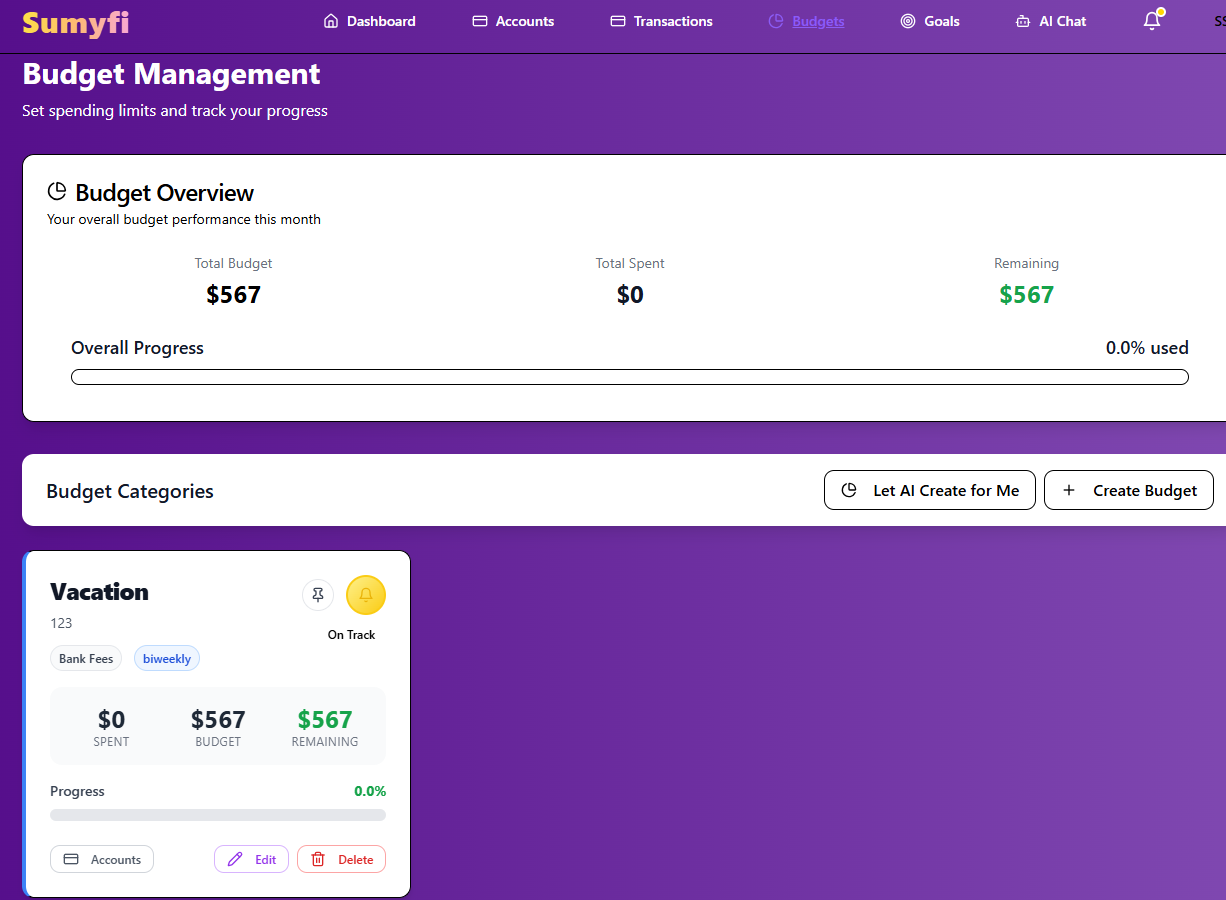
    Screenshots shown: Budgets, Accounts.

    Budgeting screen in Sumyfi

    Budgets shows spending by category alongside the amounts assigned to each category.

    Dashboard showing budgets and balances

    Accounts keeps connected and manual accounts in one place for budget review.

    Goals tracking in Sumyfi

    Budgets shows spending by category alongside the amounts assigned to each category.

    Mobile view

    The same workflow stays usable during faster phone check-ins

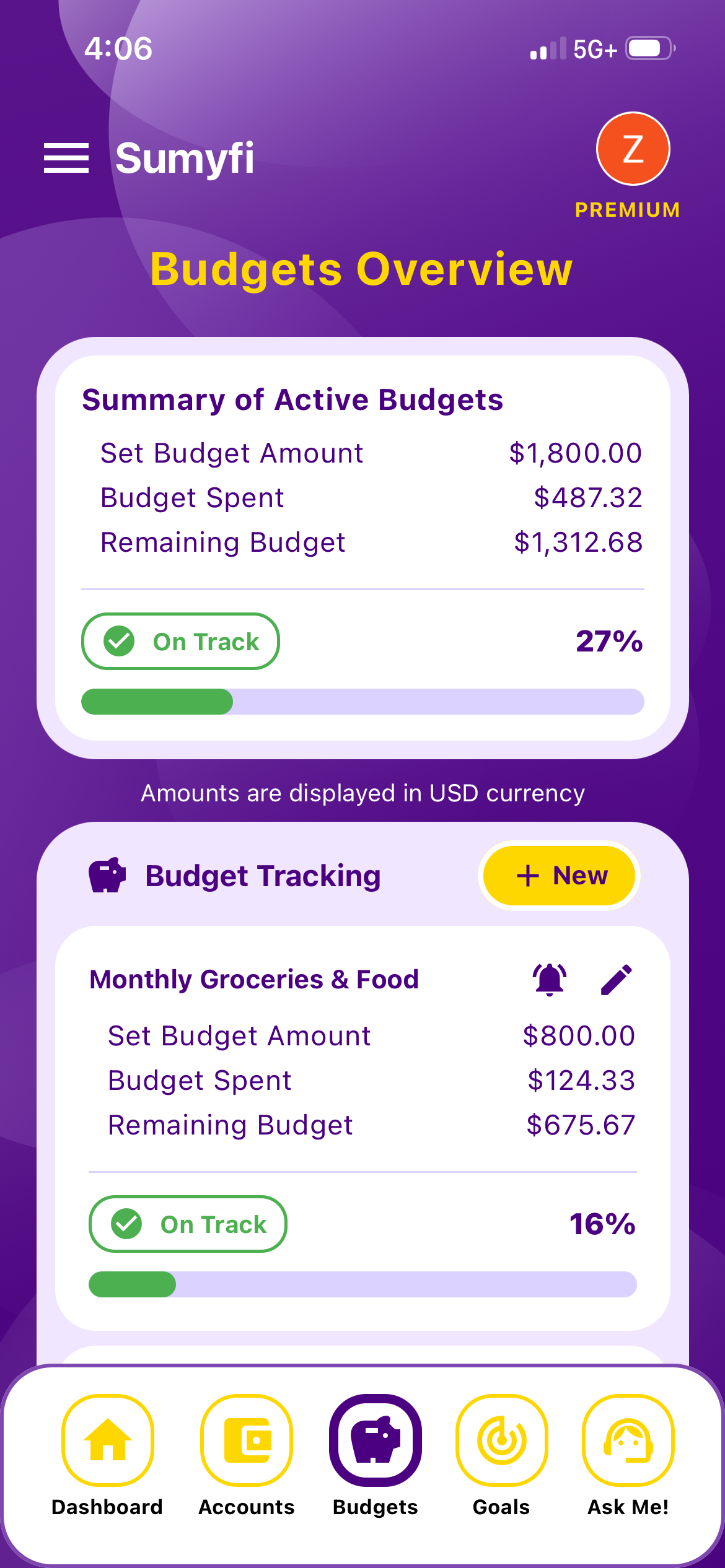
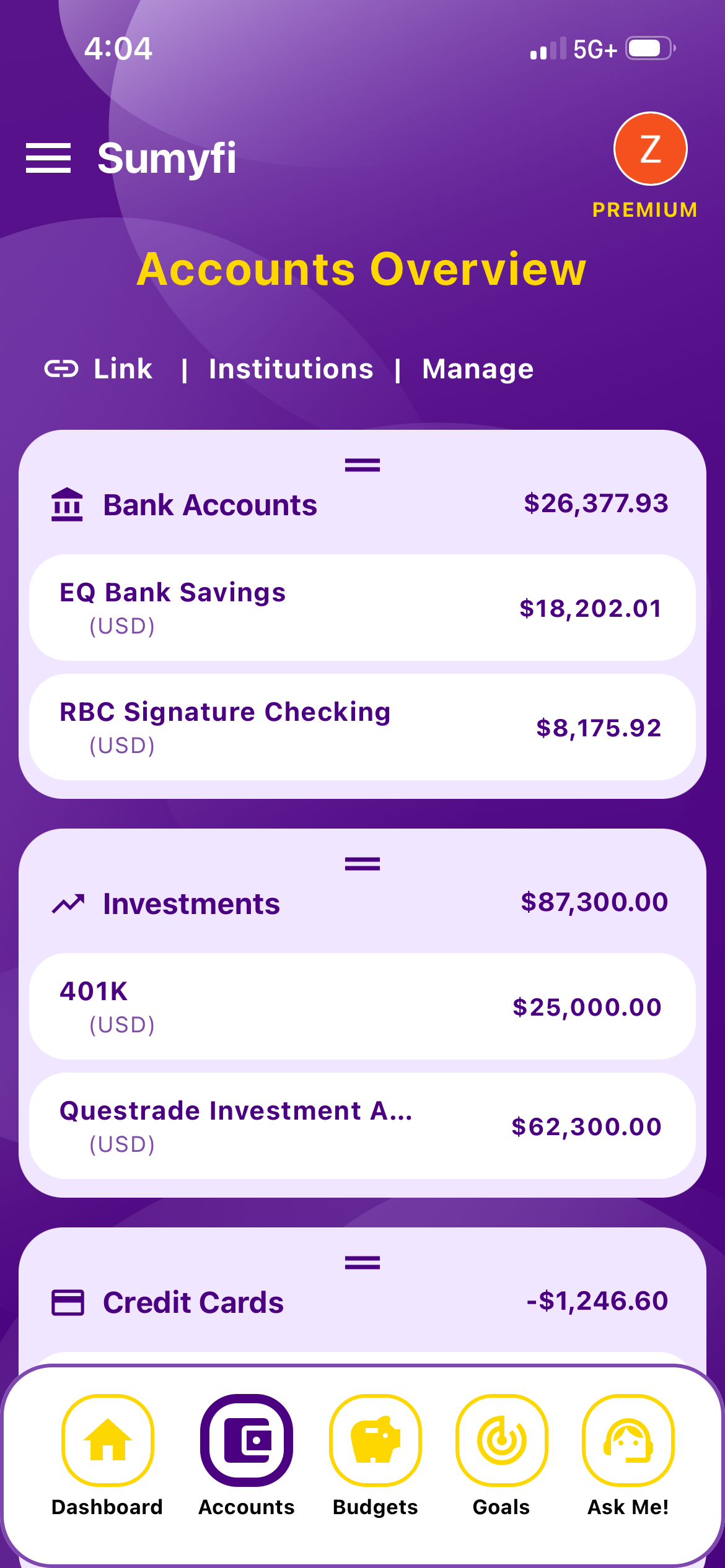
    These iPhone screenshots help show that the desktop workflow for expense tracker for couples carries into a lighter mobile review without splitting into a separate product experience.

    Expense Tracker for Couples mobile joint budget categories

    Mobile budgeting

    Review joint spending categories and monthly limits on mobile.

    Expense Tracker for Couples mobile shared account balances

    Shared account check-in

    Track upcoming shared bills and recent account balances in seconds.

    Comparison table

    Sumyfi vs traditional couple-finance methods

    This matrix focuses on the capabilities that matter once shared finances become a recurring routine instead of a one-time conversation.

    Decision areaSumyfiManual SpreadsheetsSingle-User Budget Apps
    Seeing both partners' accountsBoth partners' accounts can be added to one Sumyfi login, so balances, recurring charges and debts sit in one view you review together. There are no separate partner logins.Possible, but every account update depends on someone remembering to refresh the sheet manually.Often designed around one primary user, which can leave the second partner relying on screenshots or summaries.
    Shared-expense organizationCustom categories make it easier to separate household costs from personal spending during the same review.Highly customizable, but categorization and cleanup can become its own recurring argument.Can track spending, but shared-versus-personal context is often bolted on instead of central to the workflow.
    Privacy and context balanceWorks best when you agree which accounts go in. Personal accounts can stay out entirely and be discussed as a single number.Privacy depends entirely on how much detail each partner decides to enter and expose in the sheet.The app may be polished, but it usually centers a single-user workflow more than a household review conversation.
    Bank connectivity and net worthSupported institutions can be linked through read-only aggregation so spending, bills, debt, and net worth stay connected.Possible only with imports, manual copying, or a stack of connected add-ons that still require maintenance.Connectivity may exist, but joint net-worth context often sits outside the core couple-finance workflow.

    FAQs

    Frequently asked questions

    Should couples fully combine finances to use Sumyfi well?

    No. The product is useful for fully blended finances, proportional-contribution setups, or a yours-mine-ours model. What matters is having one review system that makes shared obligations visible without forcing every dollar into the same bucket.

    Can we keep some spending separate?

    Yes. Couples can use custom categories and labels to separate shared bills from personal spending, which keeps the monthly conversation focused on household priorities instead of turning every purchase into a negotiation.

    How does it help with shared savings goals?

    Goals stay tied to the same balances, recurring bills, and spending patterns that influence whether the couple is actually moving forward. That makes savings progress easier to interpret and protect.

    Does it support long-term net worth tracking too?

    Yes. Sumyfi can roll assets, debts, and cash accounts into one broader view so couples can connect day-to-day expense management with debt payoff and long-term net worth progress.

    Keep exploring

    Related guides for couples and households

    These guides stay close to the same household-finance decisions: subscriptions, budgeting by region, and tracking long-term progress.