The best account aggregation app in Canada should do more than sync balances. It should help Canadians understand how chequing, credit cards, savings, investments, and recurring bills fit together in one reviewable picture.
For Canadians, navigating a landscape of diverse financial institutions, investment platforms, and cross-border accounts can feel like a labyrinth. The traditional approach of logging into multiple portals, updating spreadsheets, and manually reconciling transactions is not just inefficient; it's a significant barrier to achieving true financial clarity and empowerment. This is precisely where the concept of account aggregation emerges as a game-changer, and where Sumyfi positions itself as the undisputed best account aggregation app Canada has to offer.
This comprehensive guide will delve deep into the critical importance of account aggregation, explore the unique challenges and opportunities within the Canadian financial ecosystem, and meticulously detail why Sumyfi stands head and shoulders above the rest as the ultimate modern solution for personal finance management. Prepare to transform your financial perspective from scattered data points to a unified, intelligent, and actionable financial hub.
What is Account Aggregation, and Why is it Indispensable for Canadians?
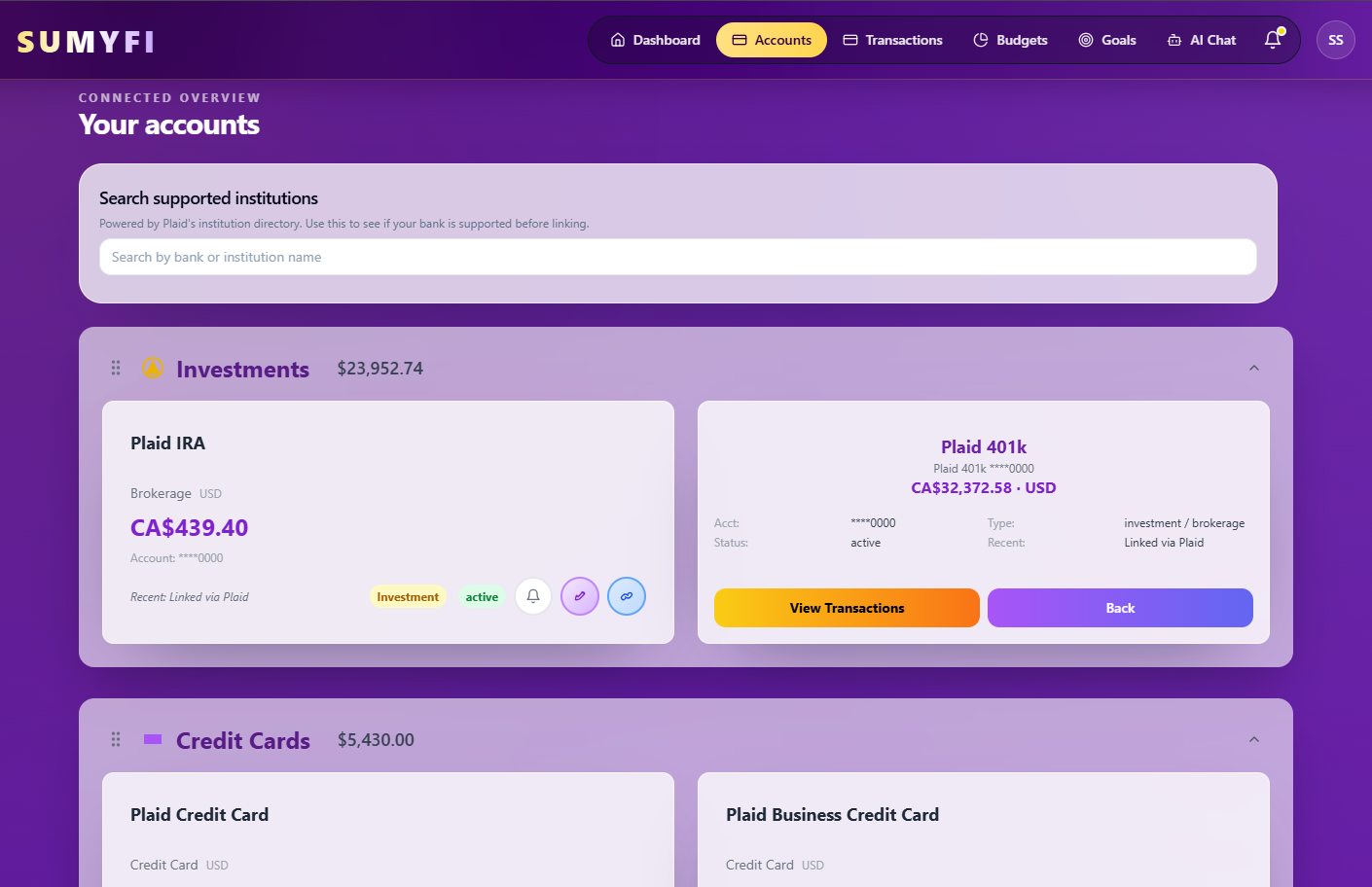
At its core, account aggregation is the process of consolidating information from all your financial accounts-bank accounts, credit cards, investments, loans, mortgages, and even cryptocurrency holdings-into a single, unified interface. Imagine a dashboard where every dollar you own, owe, earn, or spend is visible at a glance, updated in real-time, and intelligently categorized. That's the power of account aggregation.
For Canadians, this capability is not merely convenient; it's indispensable. The typical Canadian household often juggles accounts across multiple institutions: a primary bank for chequing/savings, another for a high-interest savings account, a credit card from a different provider, an investment portfolio with a brokerage, a mortgage with a lender, and perhaps even US dollar accounts for cross-border transactions. Without a robust aggregation tool, gaining a holistic view of one's financial health becomes an arduous, time-consuming, and often inaccurate task.
The benefits extend far beyond mere convenience:
In a country where financial literacy is increasingly emphasized, and economic conditions demand agile financial management, an effective account aggregation app is no longer a luxury but a fundamental tool for every financially conscious Canadian.
Holistic Financial Overview: See your entire financial picture, updated automatically. No more guessing your net worth or scrambling to find account balances.
Enhanced Budgeting and Spending Analysis: With all transactions categorized and visualized, understanding where your money goes becomes effortless, paving the way for smarter spending habits.
Improved Net Worth Tracking
Accurately monitor your assets and liabilities to understand your true financial standing and progress towards wealth accumulation.
Early Fraud Detection
Quickly spot unusual or unauthorized transactions across all accounts from a single dashboard.
Streamlined Financial Planning
Make informed decisions about savings, investments, and debt reduction with real-time data at your fingertips.
Time Savings
Eliminate the tedious manual process of logging into multiple portals and updating spreadsheets.
Reduced Stress
Gain peace of mind knowing you have complete control and visibility over your financial life.
Why Canadians Urgently Need a Superior Account Aggregation App
The Canadian financial landscape presents unique characteristics that amplify the need for a truly superior account aggregation solution.
The Fragmented Canadian Banking Ecosystem
Unlike some markets, Canada is dominated by a handful of large financial institutions ("The Big Five": RBC, TD, Scotiabank, BMO, CIBC), alongside numerous credit unions, smaller banks, and specialized wealth management firms. Canadians often spread their financial activities across several of these entities to optimize for interest rates, loyalty programs, or specialized services. This fragmentation necessitates an aggregation tool capable of connecting seamlessly and reliably with a vast array of Canadian financial providers, from major banks to regional credit unions and online brokerages.
Cross-Border Financial Management
Many Canadians have financial ties to the United States, whether through employment, property ownership, or frequent travel. Managing both CAD and USD accounts across different institutions (Canadian and American) adds another layer of complexity. An ideal account aggregation app for Canada must offer robust multi-currency support and seamless integration with both Canadian and US financial institutions to provide a truly comprehensive view.
Tax Season Simplification
Canada's tax system, while robust, can be intricate. Having all income, expense, and investment data aggregated and categorized simplifies tax preparation immensely. The ability to export transaction data or generate summary reports from an aggregation app can save countless hours and reduce the potential for errors during tax season.
The Rise of Digital-First Banking
Canadians are increasingly embracing digital banking, mobile payments, and online investment platforms. This shift demands a personal finance solution that is equally modern, intuitive, and mobile-friendly, capable of keeping pace with evolving digital financial habits. Legacy systems and manual methods simply cannot provide the agility and real-time insights required in this environment.
The Slow March Towards Open Banking
While Canada has been slower than some other nations to fully embrace Open Banking, the conversation is gaining momentum. A truly forward-thinking account aggregation app will be built on agile engineering principles, ready to adapt and integrate with future Open Banking frameworks, ensuring continued, secure, and enhanced data connectivity for its users. This readiness for future financial infrastructure changes is a hallmark of the best account aggregation app Canada can adopt today.
Choosing the Best Account Aggregation App Canada-Wide: A Feature Checklist
When evaluating potential solutions for personal finance management and account aggregation in Canada, a discerning user must look beyond superficial aesthetics. The true value lies in a robust feature set, unwavering security, and a user experience designed for empowerment. Here's a detailed checklist of what defines the best account aggregation app Canada can offer:
1. Unrivaled Financial Institution Connectivity (Canada & US)
2. Ironclad Security and Data Privacy
3. Comprehensive Net Worth Tracking
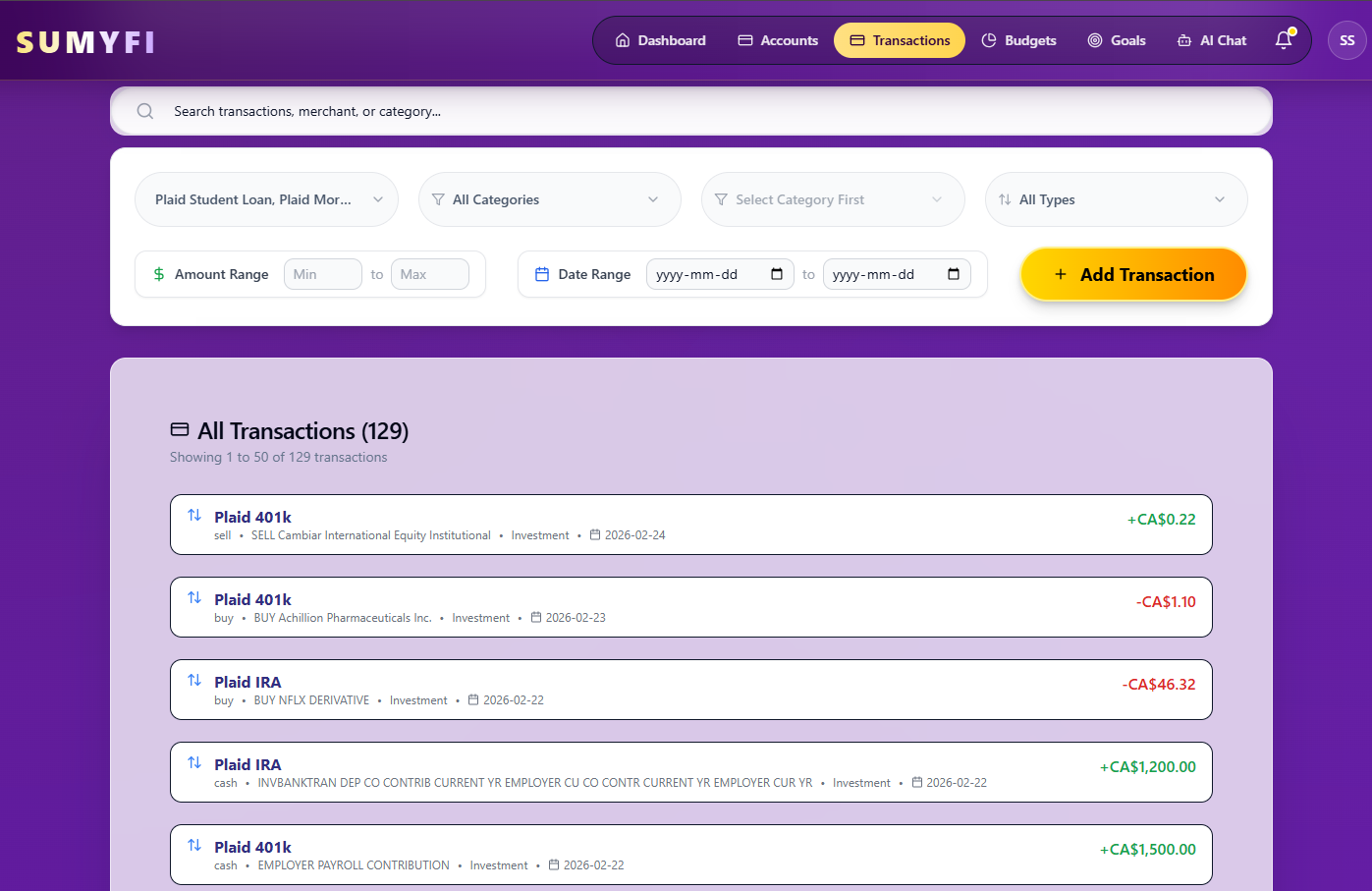
4. Intelligent Transaction Management & Categorization
5. Robust Budgeting and Goal Setting Tools
- Intuitive User Interface (UI) and User Experience (UX)
- Advanced Financial Insights and Reporting
- Multi-Currency Support
- Customer Support
- Agility and Innovation
Any app claiming to be the best account aggregation app Canada can rely on must meet these stringent criteria, offering a blend of powerful functionality, uncompromised security, and an exceptional user experience.
Breadth and Depth: The app must connect to thousands of financial institutions across Canada (Big Five banks, credit unions, online brokerages like Questrade/Wealthsimple, mutual fund companies) and the United States (major banks, investment platforms).
Reliability: Connections must be stable, with minimal downtime or re-authentication requirements.
Real-time Updates: Data should refresh frequently (daily, or even multiple times a day) to provide the most current financial picture.
Encryption
Bank-level encryption (e.g., 256-bit AES) for data in transit and at rest.
Data Anonymization
How user data is handled, anonymized, and never sold to third parties.
Compliance
Adherence to Canadian privacy laws (PIPEDA) and international best practices.
Automated Asset & Liability Tracking
Automatically pull balances from all connected accounts (chequing, savings, investments, credit cards, loans, mortgages).
Manual Asset Addition
Ability to add manual assets (real estate, vehicles, valuables) and liabilities (private loans) for a truly complete picture.
Historical Trends
Visualize net worth changes over time with clear graphs and data points.
Automatic Categorization
AI-powered categorization of transactions to save time and provide insights.
Customizable Rules
Ability to create custom rules for recurring transactions or specific vendors.
Splitting Transactions
Option to split a single transaction into multiple categories.
Rich Transaction Details
Display merchant names, dates, amounts, and account origins clearly.
Search & Filtering
Powerful search and filtering capabilities to quickly find specific transactions.
Flexible Budget Creation
Ability to create custom budgets based on income and spending habits.
Real-time Progress Tracking
Monitor budget adherence throughout the month.
Goal Setting
Set and track financial goals (e.g., saving for a down payment, retirement, debt repayment) with clear progress indicators.
Spending Alerts
Notifications for overspending or approaching budget limits.
Clean & Modern Design
A visually appealing, clutter-free dashboard.
Ease of Navigation
Simple and logical pathways to access different features.
Mobile-First Approach
Fully functional and optimized mobile app for iOS and Android.
Customizable Dashboard
Ability to personalize the view to prioritize key information.
Spending Trends
Graphs and reports showing spending patterns over time.
Income Analysis
Track income sources and consistency.
Cash Flow Analysis
Understand money in vs. money out.
Custom Reports
Generate and export reports for budgeting, tax purposes, or personal review.
CAD and USD Integration
Seamlessly handle accounts in both Canadian and US dollars, with accurate conversion rates where applicable.
Display Options
Ability to view consolidated net worth in a single currency or broken down by currency.
Responsive & Knowledgeable
Access to helpful support channels (email, in-app chat, knowledge base).
Canadian Specifics
Support staff familiar with Canadian financial institutions and common user queries.
Regular Updates
Evidence of continuous development, new features, and improvements.
Future-Proofing
An architecture designed to adapt to evolving financial technologies and regulatory changes (e.g., Open Banking).
Sumyfi: Redefining Account Aggregation for Canadians
In a market saturated with legacy financial software and fragmented apps, Sumyfi emerges as the quintessential modern solution, engineered from the ground up to address the specific needs of Canadian users while setting a new global standard for personal finance management. It is not merely an account aggregator; it is a comprehensive, all-in-one financial hub designed for clarity, control, and ultimate financial empowerment.
Unrivaled Connectivity: Your Entire Financial World, Unified
We understand that a truly effective account aggregation app must integrate seamlessly with *all* your financial touchpoints. Sumyfi connects with thousands of financial institutions across both Canada and the United States. This means whether you bank with RBC, TD, Scotiabank, BMO, CIBC, a local credit union, or have investment accounts with Questrade, Wealthsimple, or even US-based brokerages, Sumyfi brings it all together.
Automated Transaction Management: Intelligence at Your Fingertips
The days of manually categorizing every transaction are over. Sumyfi employs advanced AI and machine learning to automatically categorize your spending and income.
Dynamic Net Worth Tracking: See Your Wealth Grow in Real-Time
Understanding your net worth is the cornerstone of financial progress. Sumyfi provides a dynamic, real-time net worth tracker that automatically updates as your assets and liabilities fluctuate.
Intuitive Interface & User Experience: Financial Clarity, Effortlessly Achieved
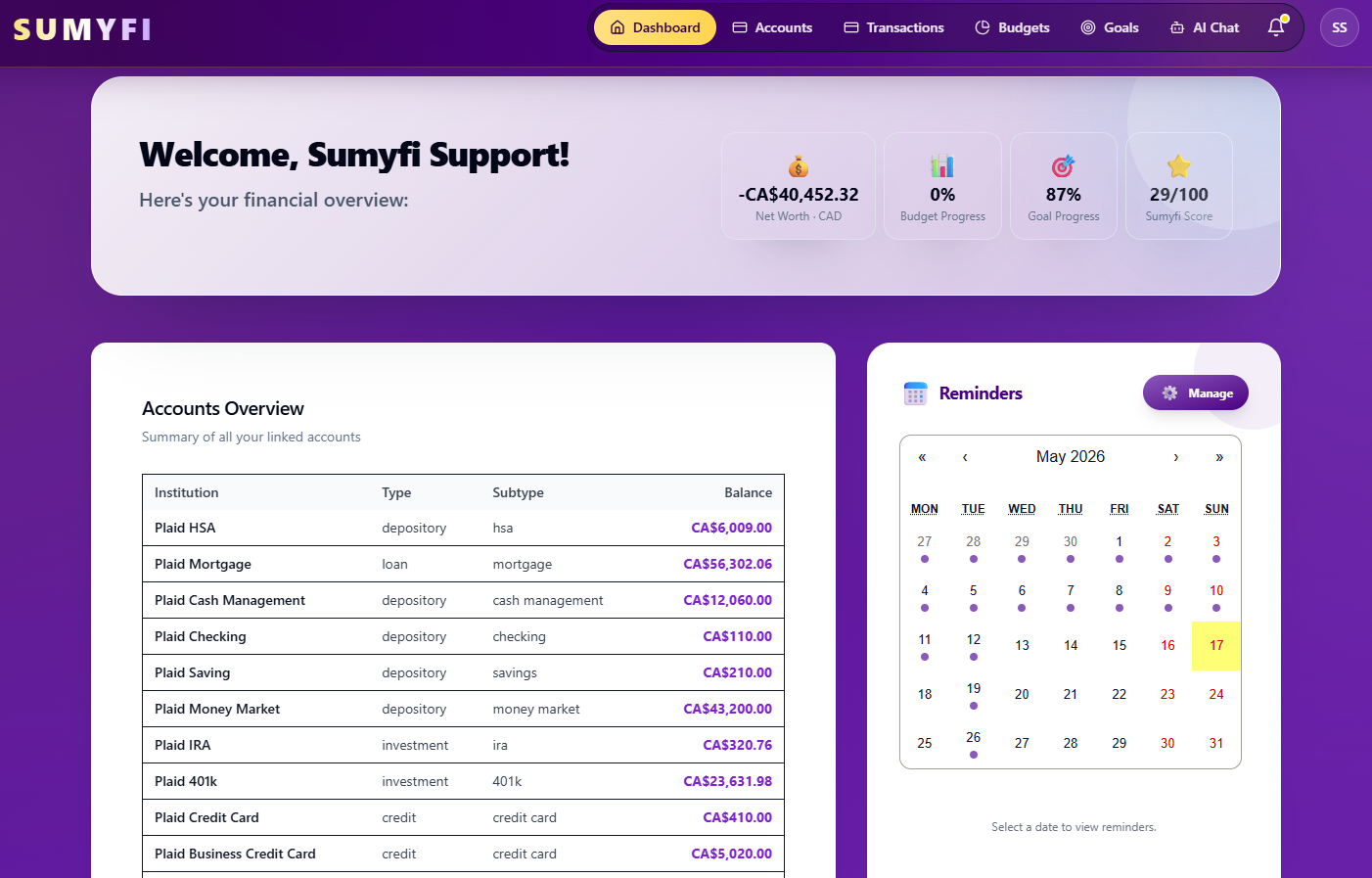
Sumyfi is built with the modern user in mind. Its slick, crystal-clear dashboard interface is designed for effortless navigation and instant comprehension.
Ironclad Security: Your Financial Data, Absolutely Protected
Beyond Aggregation: Your Complete Financial Management Hub
While account aggregation is our foundation, Sumyfi extends far beyond, offering a suite of powerful tools to manage every facet of your financial life:
Sumyfi is engineered to be the ultimate best account aggregation app Canada can embrace, providing a singular, powerful platform that replaces manual spreadsheets, outdated software, and the stress of fragmented financial oversight.
Lightning-Fast Setup: Forget tedious manual entries. Connect your institutions in minutes with a secure, streamlined process.
Robust & Reliable Links: Our agile engineering ensures stable connections and frequent, often real-time, data refreshes, giving you the most accurate financial picture at any moment.
Comprehensive Coverage: From chequing and savings accounts to credit cards, mortgages, loans, investment portfolios (stocks, ETFs, mutual funds), and even niche financial products, Sumyfi aggregates it all.
Smart Categorization
Our system learns your habits, ensuring transactions are accurately classified, reducing your manual effort.
Customizable Rules
Take control by creating your own rules for specific merchants or types of transactions, ensuring perfect categorization every time.
Detailed Insights
Dive into your spending with granular detail, identify trends, and uncover areas for potential savings.
Bill Tracking & Subscription Management
Beyond simple transactions, Sumyfi intelligently identifies recurring bills and subscriptions, helping you track upcoming payments and manage your recurring expenses with ease.
Holistic View
Consolidate all your assets (bank balances, investments, real estate, vehicles) and liabilities (mortgages, loans, credit card debt) into one powerful metric.
Visual Trends
Observe your net worth trajectory over time with intuitive graphs and charts, celebrating your progress and identifying areas for improvement.
Empowered Decision-Making
With a clear picture of your wealth, you can make more informed decisions about investments, debt repayment, and future financial planning.
Clean & Modern Design
Say goodbye to cluttered screens and confusing menus. Sumyfi's aesthetic prioritizes clarity and ease of use.
Customizable Dashboard
Arrange your financial view to highlight what matters most to you, whether it's your net worth, budget progress, or recent transactions.
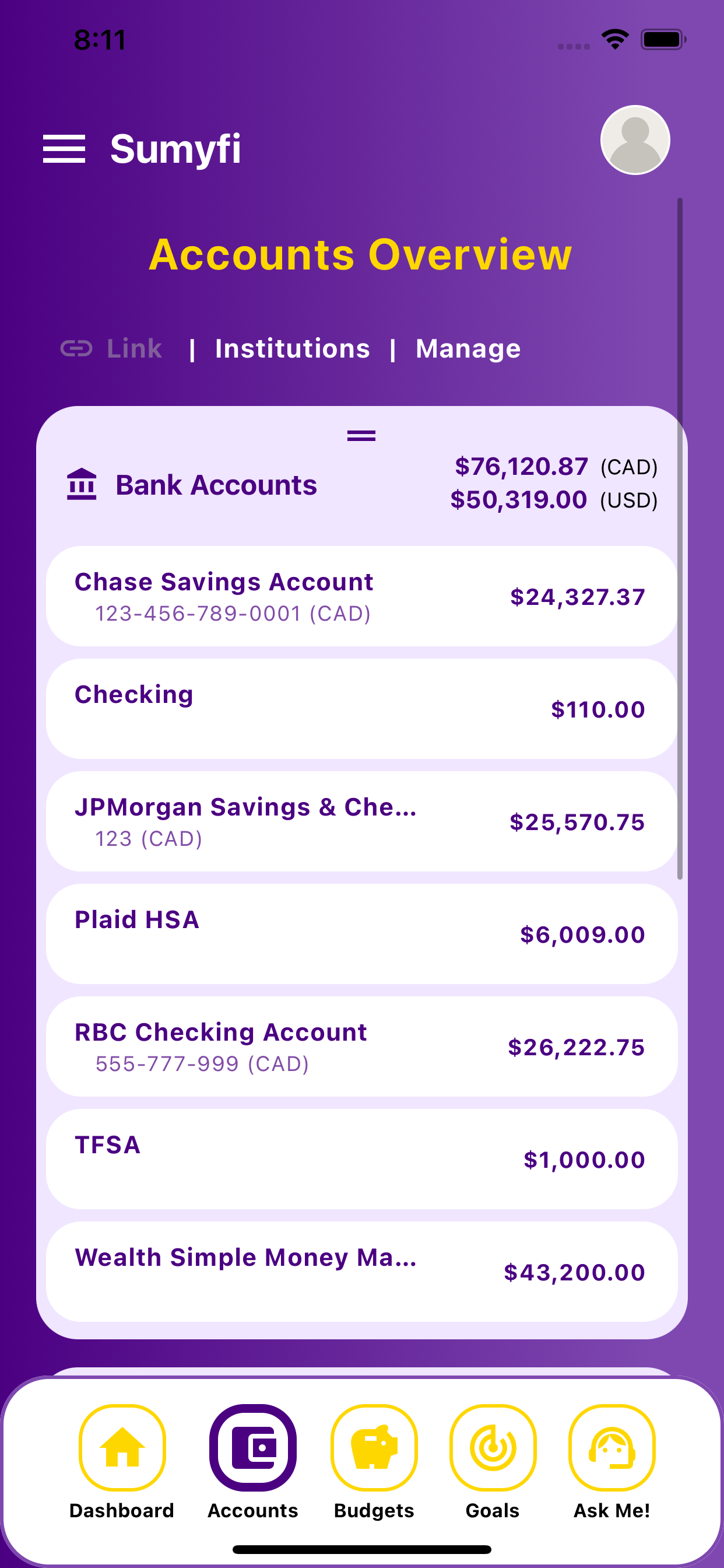
Seamless Mobile Experience
Access your complete financial hub on the go with our fully optimized mobile app for iOS and Android, ensuring your finances are always just a tap away.
Privacy-First Philosophy
We are committed to protecting your privacy. Your data is never sold to third parties, and we adhere strictly to Canadian privacy regulations (PIPEDA) and global best practices.
Advanced Budgeting
Create flexible budgets, track spending against categories in real-time, and receive alerts to stay on track.
Goal Setting
Define and monitor your financial goals, from saving for a down payment to planning for retirement, with clear progress indicators.
Financial Insights
Gain deep understanding into your spending habits, income trends, and cash flow with intuitive reports and visualizations.
How Sumyfi Transforms Your Financial Life: From Chaos to Clarity
Adopting Sumyfi isn't just about downloading an app; it's about fundamentally changing your relationship with your money.
From Fragmented Data to Holistic Oversight
Before Sumyfi, your financial life was scattered across multiple bank logins, investment portals, and perhaps a few error-prone spreadsheets. With Sumyfi, every single financial account-Canadian or American, banking or investing, asset or liability-converges into one intuitive dashboard. This holistic oversight eliminates blind spots, reveals hidden trends, and provides an immediate, accurate snapshot of your financial health. No more guessing; just pure, actionable clarity.
- Empowered Decision-Making Through Real-Time Insights
Imagine making financial decisions not based on outdated information or gut feelings, but on real-time, intelligently categorized data.
This data-driven approach empowers you to make smarter choices, whether it's optimizing your spending, rebalancing your investments, or accelerating debt repayment.
- Unprecedented Time Savings and Efficiency
The time spent logging into multiple accounts, downloading statements, and manually updating spreadsheets is time you could be spending on what truly matters. Sumyfi automates these tedious tasks, freeing up hours each month.
Sumyfi is designed for efficiency, streamlining your financial management process so you can focus on achieving your goals, not on administrative overhead.
- Achieving Financial Goals with Confidence
Whether your goal is to save for a down payment, pay off debt, build an emergency fund, or plan for retirement, Sumyfi provides the tools and visibility to turn aspirations into reality.
Sumyfi transforms abstract financial goals into concrete, actionable steps, providing the roadmap and the real-time feedback you need to succeed.
By integrating all these capabilities into one seamless platform, Sumyfi transcends the capabilities of a mere account aggregation tool.
Budgeting with Precision: Understand exactly where your money is going and adjust your budget with confidence.
Investment Tracking: See the real-time performance of your entire investment portfolio, consolidated from various brokerages.
Debt Management
Track your progress in paying down loans and credit cards, motivating you to stay on track.
Instant Updates
Your accounts refresh automatically, providing current balances and transactions without any manual intervention.
Automated Categorization
Our AI learns your spending, drastically reducing the need for manual categorization.
Centralized Management
Manage all your bills, subscriptions, and financial goals from a single platform.
Goal Tracking
Set specific financial goals within Sumyfi and watch your progress unfold in real-time.
Budget Alignment
Align your spending with your savings goals, ensuring every dollar works towards your objectives.
Motivation & Accountability
The visual feedback and clear progress indicators keep you motivated and accountable to your financial plan.
Getting Started with Sumyfi: Your Journey to Financial Empowerment
Embracing Sumyfi, the best account aggregation app Canada has to offer, is a straightforward and rewarding process. We've engineered the onboarding experience to be as agile and user-friendly as our platform itself.
Step 1: Create Your Secure Sumyfi Account
Visit [https://www.sumyfi.com](https://www.sumyfi.com) or download the Sumyfi app from your preferred app store (iOS or Android). Our registration process is quick, requiring just a few essential details to set up your secure profile. Remember, your security is our top priority, and we employ robust encryption and multi-factor authentication from the very first step.
Step 2: Connect Your Financial Institutions
This is where the magic of aggregation begins. Sumyfi will guide you through connecting your bank accounts, credit cards, investment portfolios, loans, and mortgages from various Canadian and US financial institutions. Our intuitive interface makes this process seamless and secure. Simply select your institutions and provide your login credentials-Sumyfi does the rest, establishing read-only connections to pull in your financial data.
Step 3: Watch Your Financial World Unify
Within moments of connecting your accounts, Sumyfi's slick dashboard will come to life. You'll instantly see:
Step 4: Explore, Customize, and Take Control
Now that your financial data is unified, the power is truly in your hands:
[Download the Sumyfi App on iOS](https://apps.apple.com/app/sumyfi) | [Download the Sumyfi App on Android](https://play.google.com/store/apps/details/sumyfi)
Your Consolidated Net Worth: A real-time calculation of your total assets minus your total liabilities.
All Your Account Balances: Every account, clearly displayed, from chequing to investments.
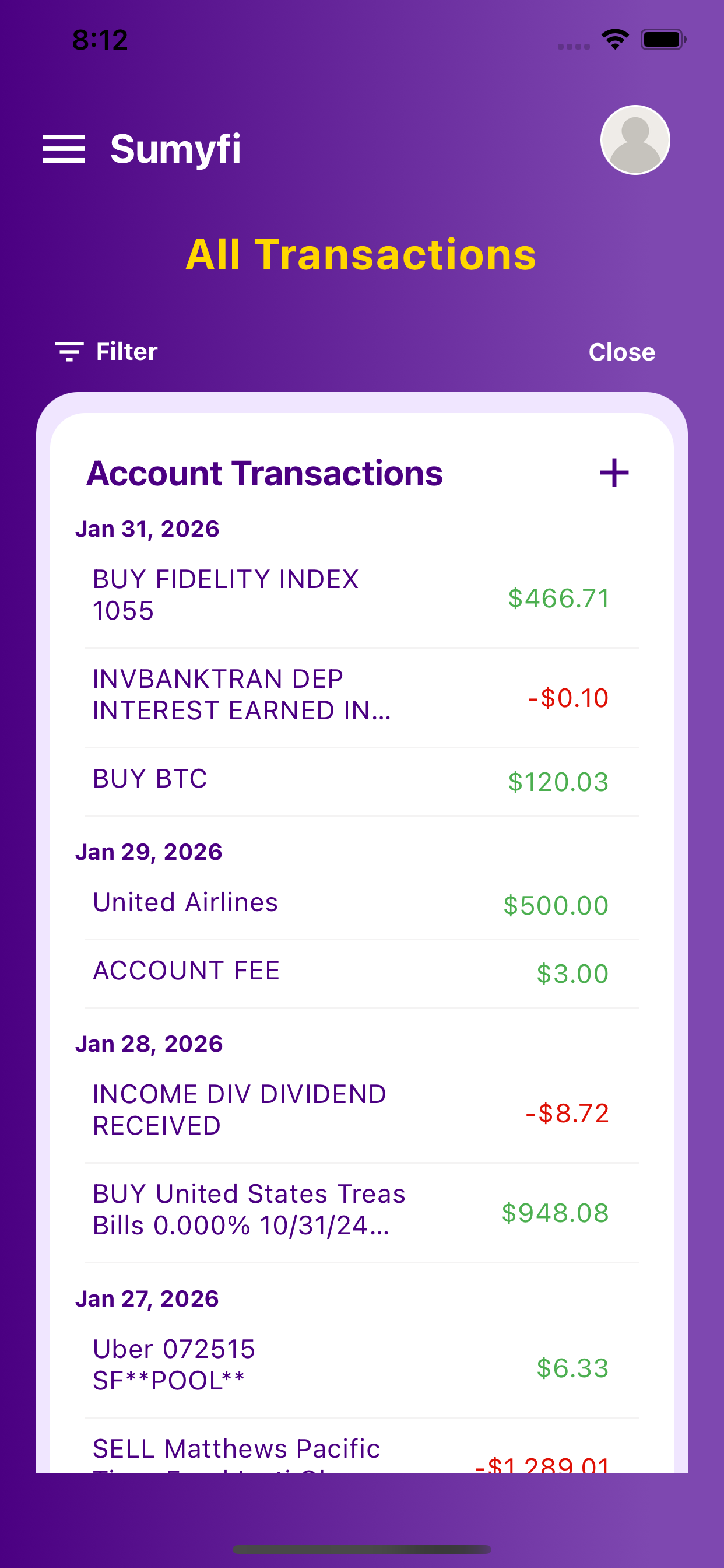
Automated Transaction Feed
Your transactions will begin populating, intelligently categorized by Sumyfi's powerful AI.
Review and Refine Categories
Sumyfi's AI is smart, but you can always fine-tune transaction categories or create custom rules to perfectly match your spending habits.
Set Up Budgets
Create personalized budgets for different spending categories and track your progress in real-time.
Define Financial Goals
Whether it's saving for a down payment, paying off debt, or planning for retirement, set your goals and monitor your journey.
Discover Insights
Explore detailed reports on your spending trends, income analysis, and cash flow to make informed financial decisions.
The Future of Financial Management: Sumyfi as Your Premier Account Aggregation App Canada Solution
The financial world is constantly evolving, driven by technological advancements and shifting consumer expectations. Sumyfi is not just built for today; it's engineered for tomorrow. Our commitment to agile development and continuous innovation ensures that Sumyfi remains at the forefront of personal finance technology.
As Canada moves closer to a full Open Banking framework, Sumyfi is perfectly positioned to leverage these advancements, offering even more seamless, secure, and enriched data connectivity for its users. We are actively monitoring regulatory changes and technological shifts to ensure Sumyfi consistently delivers the most robust and future-proof financial management experience.
We believe that every Canadian deserves access to powerful, intuitive tools that empower them to achieve their financial aspirations. Sumyfi is more than an app; it's a partner in your financial journey, providing the clarity, control, and confidence you need to thrive in any economic climate.
Conclusion: Sumyfi - The Undisputed Best Account Aggregation App Canada Has to Offer
In a financial landscape that demands precision, security, and clarity, the need for a truly superior account aggregation app in Canada has never been more pressing. From navigating the intricacies of multiple Canadian institutions to managing cross-border finances and simplifying tax preparation, Canadians require a solution that is both powerful and intuitive.
By replacing manual spreadsheets and outdated software with a modern, all-in-one personal finance hub, Sumyfi empowers you to gain complete control over your money, make informed decisions, and accelerate your journey towards financial freedom. Stop juggling accounts and start living your financial best life.
[Start your free trial now!](https://www.sumyfi.com/signup)