Connect All Bank Accounts in One App
In an increasingly digitized world, our financial lives have become paradoxically fragmented. Checking accounts at one bank, savings at another, credit cards from multiple issuers, investment portfolios with various brokerages, and perhaps a mortgage or loan with yet another institution. The sheer logistical burden of tracking these disparate financial threads can be overwhelming, leading to a hazy understanding of one's true financial standing. The solution? To connect all bank accounts in one app - a singular, powerful hub that consolidates your entire financial universe, offering unparalleled clarity and control.
Built for buyers tired of jumping across institutions just to rebuild the money picture.
Aggregation only wins when the dashboard helps users understand the combined picture faster.
Strongest for users who want accounts, recurring charges, and planning context to live together.
Aggregation buyer intent
The real question is not whether all accounts connect. It is whether the combined view finally becomes usable.
People searching for one app to connect all bank accounts are usually done with tab-hopping. They want one place that gives them a reliable answer to what changed, what looks off, and what deserves attention right now across checking, savings, debt, and investing.
A lot of dashboards win the sync step and still lose the review step. They centralize data without reducing mental reconciliation. This search is trying to separate those two jobs so buyers can judge whether the product actually shortens decision time after the accounts are connected.
If you want account aggregation to lead to clearer decisions rather than one more overview to babysit, Sumyfi is the more complete answer this search is looking for.
At a glance
What this comparison covers
Table of contents
Jump to the part you actually care about
What to compare first
Three things to decide before you pick a tool
If you want account aggregation to lead to clearer decisions rather than one more overview to babysit, Sumyfi is the more complete answer this search is looking for.
Best for everyday personal finance users who want bringing checking, savings, credit cards, and investment accounts into one unified dashboard.
Look for the product that moves you from scattered awareness to a repeatable weekly money routine.
Buyer checklist
What serious aggregation buyers should compare first
- Does the app turn many institutions into one understandable review flow instead of one crowded summary screen?
- Can you move from account visibility into recurring-spend review and planning without changing tools?
- Is the dashboard useful after the sync is finished, not only during setup?
- Will the product still feel clear when you have checking, savings, cards, debt, and investments connected?
- Does the company look trustworthy enough for a long-term all-accounts workflow?
Why Sumyfi
Built for users who want aggregation to become orientation, not just coverage
The strongest case for Sumyfi here is that connected accounts are only the starting layer. The product helps users turn that connected data into budgeting visibility, recurring-spend awareness, and better next decisions.
Comparison table
Sumyfi vs Many dashboards
Exact pricing and plans can shift over time, so the most useful comparison is whether the product helps users move from fragmented financial data to clearer decisions with less maintenance.
| Decision area | Sumyfi | Many dashboards |
|---|---|---|
| Primary workflow | One place for accounts, budgets, goals, recurring money decisions, and AI-supported explanations for people researching connect all bank accounts in one app. | Often built around a narrower workflow tied more specifically to the main use case behind this search. |
| Account visibility | Designed to keep everyday spending and the bigger financial picture visible together instead of splitting them into separate tools. | May emphasize one slice of the money picture more than the full system. |
| Ease of ongoing use | Built to reduce maintenance so the dashboard is easier to keep using week after week. | Can be useful, but may require more manual review, heavier setup, or a more specialized workflow. |
| Planning support | Supports budgeting, goal tracking, forward-looking decisions, and a cleaner review process in one experience. | Planning support varies depending on the product and the subscription tier you choose. |
| Trust surface | Public support, security, privacy, and AI usage pages help lower risk for serious shoppers before signup. | Trust signals depend on the company, and not every buyer gets the same level of clarity upfront. |
| Best fit | Best for people who want to bring checking, savings, credit cards, and investment accounts into one unified dashboard without juggling separate tools and disconnected reviews. | Best for users who already know they want a narrower product centered on connect all bank accounts in one app. |
Product screenshots
See the product behind the copy
The screenshots below make the dashboard, accounts, budgeting, AI, reminders, and progress surfaces more concrete for serious buyers.
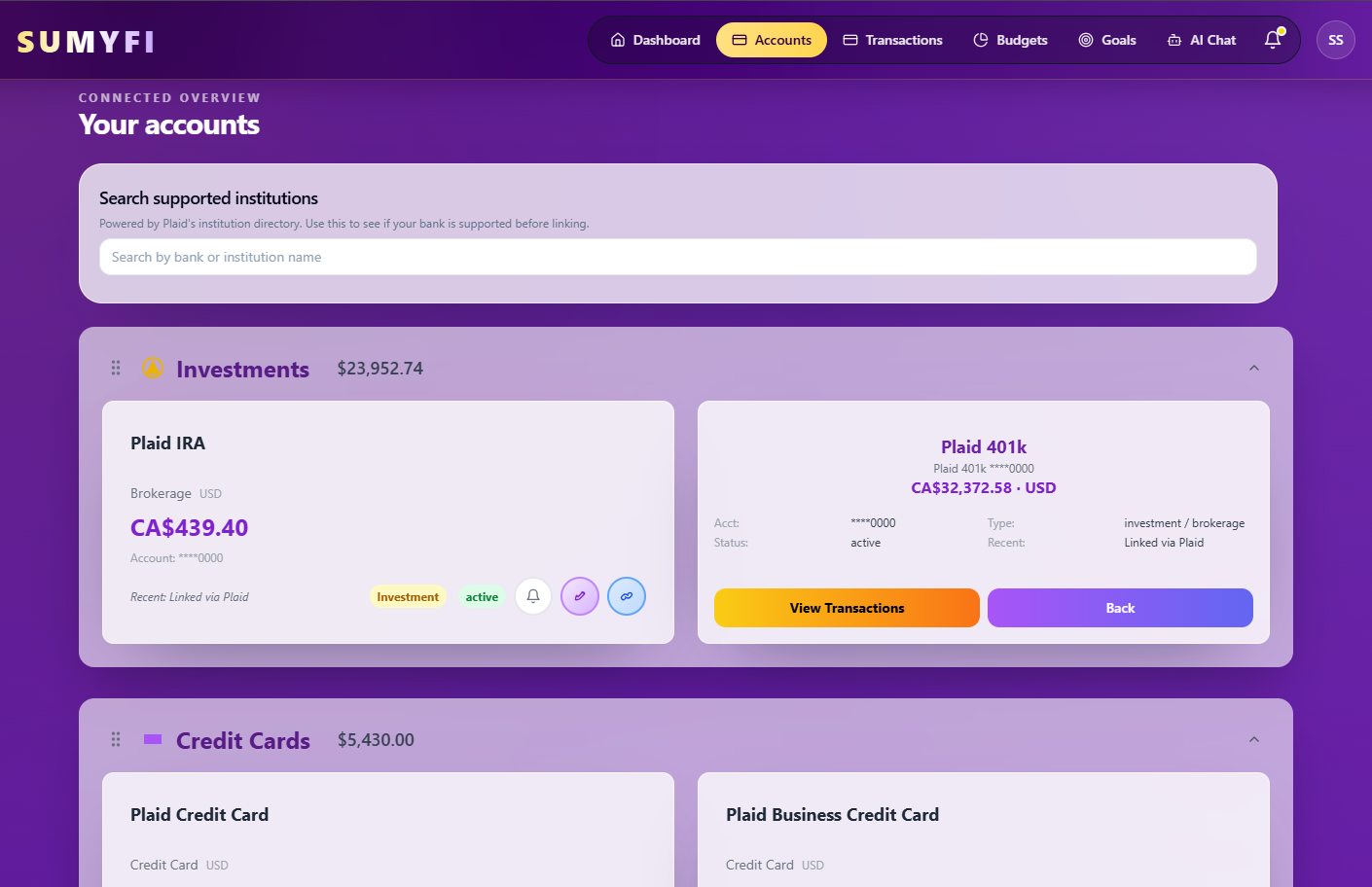
Bring checking, savings, credit cards, and investments into one review surface.
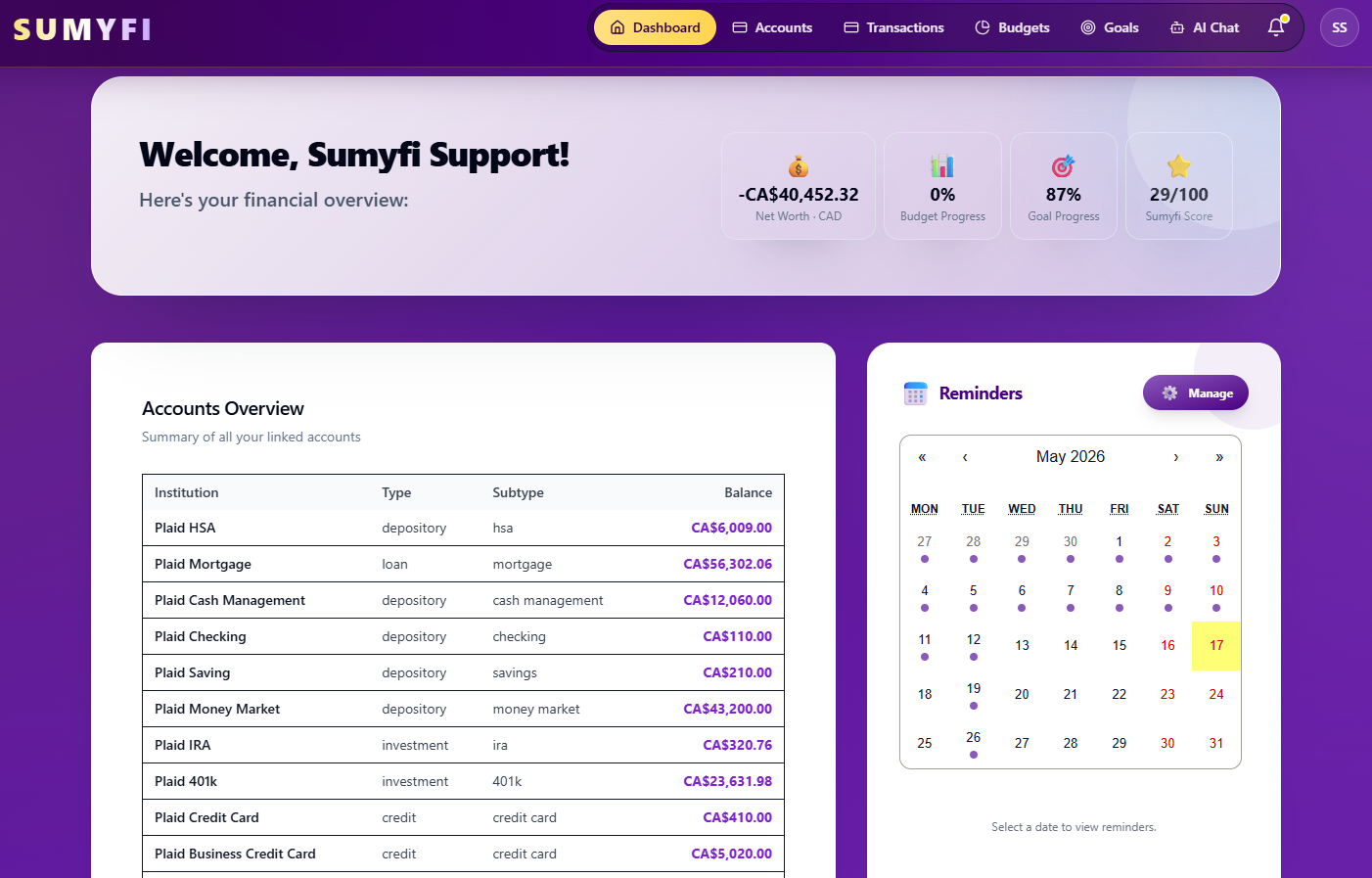
The dashboard is built to become the weekly place you orient yourself.
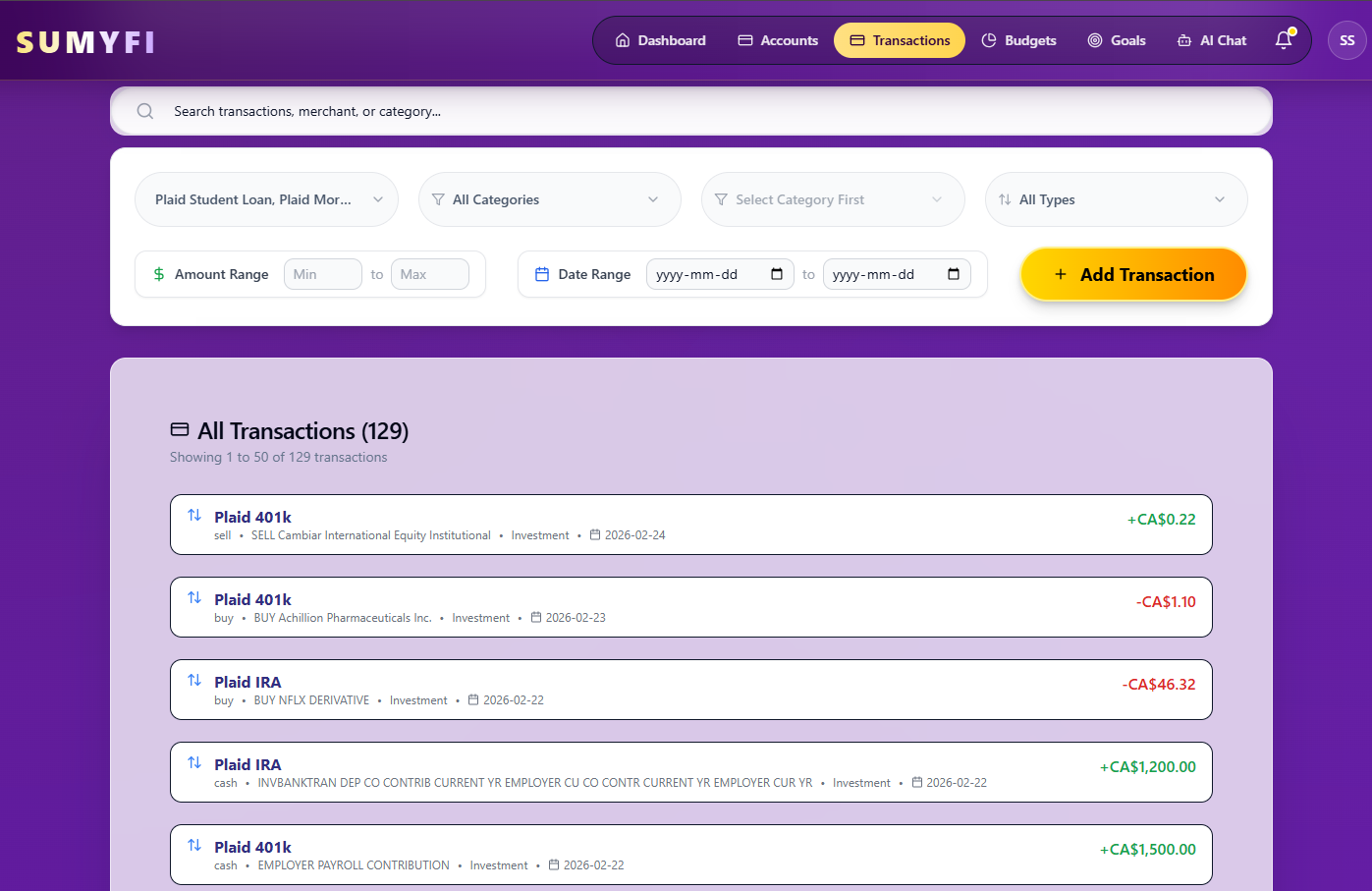
Transactions stay connected to the wider account picture instead of living in isolation.
Trust surfaces
Trust matters more than surface-level marketing in finance
In a YMYL category, buyers need visible support, security, coverage, and public accountability before they are comfortable connecting money data or acting on product guidance.
Security and privacy
Serious buyers need visible security, privacy, and data-handling pages before they trust a finance product.
Support and help center
A visible help center gives cautious buyers a clearer path before signup.
Institution coverage
Institution coverage matters because connected-account trust is part of the product story for dashboard and aggregation buyers.
Public launch signal
External product-discovery pages add another public trust surface beyond the marketing site itself.
Public roadmap on GitHub
A public roadmap repo gives buyers and readers another transparent trust surface around product direction and external mentions.
Proof block
What account-aggregation buyers need to believe
What matters is whether that aggregation is not just technically possible, but practically useful once all those accounts are connected into one dashboard.
Checking, savings, credit cards, investing
One dashboard instead of many logins
Clarity after aggregation
"I do not need another sync tool if I still have to figure out what matters on my own."
"The useful product is the one that turns all-account access into an actual review routine."
What matters in practice
What connect all bank accounts in one app needs to solve in real life
Connect All Bank Accounts in One App matters when the current setup still leaves too much guesswork. People may already have account access, a spreadsheet, a budgeting tool, or a subscription list, but they still do not feel clear on what changed, what is drifting, or what deserves attention first.
The useful solution is the one that turns raw money data into orientation. Sumyfi fits that need by keeping accounts, recurring spending, goals, and planning close enough together that the next decision is easier to make.
What to look for
- Built around helping people bring checking, savings, credit cards, and investment accounts into one unified dashboard
- Useful for everyday personal finance users
- Designed to reduce fragmented weekly money review
What to test first
The workflow should answer a few important questions quickly
A finance tool earns its place when it helps you answer practical questions without a lot of cleanup. Can you see what changed this week? Can you spot a recurring charge, a balance shift, or a category problem quickly enough to do something about it? Can you move from review into action without opening three more tools?
That is where many products still fall short. They centralize information but leave interpretation scattered. Sumyfi works better when the goal is to keep balances, recurring charges, goals, and next actions close enough together that the review feels usable instead of performative.
What to compare first
How to judge connect all bank accounts in one app without getting distracted by feature noise
The comparison framework is usually simpler than buyers expect. Look at whether the product makes account visibility easier, whether it explains spending clearly, whether recurring costs and goals stay connected to the rest of the money picture, and whether the workflow still feels manageable after a busy month.
That is where Sumyfi tends to stand out. It is built to help users see the broader financial picture quickly, interpret what changed, and keep planning visible without forcing a dozen separate tools or a heavy maintenance ritual.
What to look for
- Account visibility
- Spending clarity
- Goals and recurring-spend context
- Low-friction repeat use
- Trust and reliability
Why Sumyfi fits
Why Sumyfi makes more sense when the whole system matters
Sumyfi helps with this problem because it is not limited to one narrow money use case. Users can connect accounts, review recurring costs, track goals, and understand changes inside one environment instead of solving one visible symptom while leaving the rest of the system fragmented.
That broader fit matters for everyday personal finance users because the most useful finance app is usually the one that makes the next decision easier without demanding a complicated setup or a spreadsheet mindset. Sumyfi is most useful when the dashboard still helps after the first obvious problem has been handled.
How it fits real life
Why the everyday money routine matters more than the feature list
The best finance product is usually the one that fits how people already review money when life is busy. If the workflow requires too much cleanup, too many separate tools, or too much mental translation, it usually gets abandoned no matter how good the feature list sounds.
Sumyfi is built to reduce that fragmentation. The product helps users keep the bigger money picture visible while still making the next decision easier, which is what most serious shoppers are actually trying to buy.
The Modern Financial
The Modern Financial Predicament: Why Unification is Essential
For decades, managing personal finances has been a laborious, often manual, endeavor. The advent of online banking offered a window into individual accounts, but it failed to solve the overarching problem of fragmentation. Logging into five, ten, or even more separate portals to get a complete picture of your money is not only time-consuming but inherently inefficient and prone to oversight.
Consider the typical financial landscape of an individual today:
Each of these represents a silo of financial data. Without a centralized system, understanding your true cash flow, calculating your accurate net worth, identifying spending patterns, or even simply ensuring all bills are paid on time becomes a complex, multi-step process. This fragmentation leads to:
The imperative to connect all bank accounts in one app is therefore not a luxury, but a fundamental requirement for anyone aspiring to achieve genuine financial clarity and cultivate robust financial health in the 21st century.
What to look for
- Primary Checking Account: For daily spending and bill payments.
- High-Yield Savings Account: Often at a different institution for better interest rates.
- Credit Cards: Multiple cards for different rewards, credit lines, or spending categories.
- Investment Accounts: Brokerage accounts (stocks, ETFs, mutual funds), retirement accounts (401k, RRSP, IRA, TFSA).
- Loan Accounts: Mortgage, auto loan, student loans, personal loans.
- Other Digital Wallets/Accounts: PayPal, Venmo, crypto exchanges.
- Cognitive Overload: The mental burden of remembering multiple logins, passwords, and account balances.
- Delayed Insights: Critical financial decisions are often made based on incomplete or outdated information.
- Missed Opportunities: Inability to quickly identify surplus cash for savings, optimize debt repayment, or rebalance investments.
- Increased Stress & Anxiety: A pervasive feeling of not being in control of one's financial destiny.
- Manual Error Potential: Relying on spreadsheets or handwritten ledgers introduces human error, negating accuracy.
The Transformative Power
The Transformative Power of Connecting All Your Financial Accounts
The ability to connect all bank accounts in one app unlocks a cascade of benefits that fundamentally reshape how you interact with your money. It transforms a collection of disparate data points into a cohesive, actionable narrative of your financial life.
Holistic Financial Overview:
Holistic Financial Overview: Your Entire World at a Glance
The most immediate and profound benefit is the creation of a truly holistic financial overview. Instead of piecing together information from various sources, a unified dashboard presents:
This bird's-eye view provides an unprecedented level of transparency, enabling you to grasp your financial standing with epistemological clarity, often for the very first time.
What to look for
- Real-time Net Worth: Your total assets minus your total liabilities, updated dynamically. This is the ultimate barometer of your financial progress.
- Aggregated Account Balances: See the combined total of your checking, savings, credit, and investment accounts.
- Consolidated Cash Flow: Understand exactly where your money is coming from and where it's going across all accounts.
- Asset Allocation: For investment accounts, visualize how your portfolio is distributed across different asset classes.
Streamlined Budgeting &
Streamlined Budgeting & Expense Tracking
Traditional budgeting is often a tedious exercise in manual data entry. When you connect all bank accounts in one app, this process is revolutionized:
This automation liberates you from manual tracking, allowing you to focus on *acting* on your financial data rather than just collecting it.
What to look for
- Automatic Transaction Categorization: Advanced algorithms (often AI-driven) automatically categorize your spending, turning raw data into meaningful insights (e.g., "Groceries," "Utilities," "Entertainment").
- Real-time Budget Adherence: Track your spending against your budget categories in real-time, receiving alerts if you're nearing your limits.
- Identification of Spending Patterns: Easily spot areas where you might be overspending or identify recurring subscriptions you've forgotten about.
- Effortless Expense Reporting: Generate reports for tax purposes, business expenses, or simply to review your financial habits over time.
Enhanced Financial Planning
Enhanced Financial Planning & Goal Setting
Achieving financial goals - whether saving for a down payment, retirement, or a dream vacation - requires consistent monitoring and adjustment. A unified app provides:
What to look for
- Goal Tracking Integration: Link specific savings or investment accounts to your goals and watch your progress update automatically.
- Scenario Planning: Some advanced apps allow you to model the impact of different financial decisions on your goals.
- Performance Monitoring: For investment accounts, track the performance of your holdings alongside your overall financial picture.
Improved Debt Management
Improved Debt Management
Debt can feel like an insurmountable burden when viewed in isolation across multiple statements. Consolidating your liabilities offers:
What to look for
- Total Debt Overview: See all your credit card balances, loans, and mortgages in one place.
- Interest Rate Comparison: Easily identify which debts have the highest interest rates, guiding your debt repayment strategy (e.g., avalanche method).
- Payment Tracking: Monitor upcoming payment due dates and ensure timely payments to avoid fees and protect your credit score.
Proactive Fraud Detection
Proactive Fraud Detection
While banks employ sophisticated fraud detection, having all your transactions in one feed adds an extra layer of personal vigilance:
What to look for
- Quick Anomaly Detection: Easily spot unusual transactions across all your accounts. A charge that might go unnoticed in a single bank statement becomes glaringly obvious when viewed alongside all your other spending.
- Consolidated Alerts: Receive alerts for large transactions, low balances, or suspicious activity from a single source.
Time Savings &
Time Savings & Reduced Stress
Ultimately, the ability to connect all bank accounts in one app is a profound investment in your time and peace of mind. No more juggling multiple logins, no more manual spreadsheet updates, no more guessing about your financial standing. Just a clear, comprehensive, and up-to-date view of your entire financial world, empowering you to make informed decisions with confidence and significantly reduce financial stress.
How Does "Connect
How Does "Connect All Bank Accounts in One App" Actually Work? The Underlying Technology
The ability to seamlessly aggregate financial data from thousands of institutions is not magic; it's the result of sophisticated technological infrastructure and evolving regulatory frameworks. Understanding the mechanics behind this process can alleviate concerns about security and data privacy.
API Integration &
API Integration & Data Aggregation
At its core, connecting your accounts relies on Application Programming Interfaces (APIs). An API is essentially a set of rules and protocols that allows different software applications to communicate with each other.
1. Direct API Connections: Ideally, financial institutions (banks, credit unions, brokerages) offer dedicated APIs that allow authorized third-party apps like Sumyfi to securely request and receive specific types of data (e.g., transaction history, account balances). These connections are highly secure and efficient.
2. Indirect Data Aggregation (Screen Scraping): In cases where a financial institution does not offer a direct API, some aggregators historically used a method called "screen scraping." This involves the aggregation service programmatically logging into your bank's website using your credentials (which you provide to the aggregator) and then "scraping" the data from the web page. While this method has evolved with more secure protocols, it is generally less preferred than direct API connections due to potential fragility and security implications if not handled with extreme care. Modern, reputable apps like Sumyfi prioritize direct API connections for enhanced security and reliability.
Sumyfi leverages robust data aggregation partners that maintain secure, encrypted connections with a vast network of financial institutions across the US and Canada. These partners specialize in establishing and maintaining these connections, ensuring reliability and compliance.
Open Banking &
Open Banking & Data Sharing Protocols
The concept of "Open Banking" is a global movement aimed at giving consumers more control over their financial data. It mandates or encourages financial institutions to open up their data (with customer consent) via secure APIs to authorized third-party providers.
Sumyfi operates within these evolving frameworks, prioritizing connections that align with the principles of secure, consent-driven data sharing. This ensures that your data is accessed ethically and transparently.
What to look for
- In Canada: The Canadian government has been actively exploring and implementing an open banking framework, aiming to enhance competition and innovation in the financial sector while prioritizing consumer data protection.
- In the US: While there isn't a single, overarching "Open Banking" regulation like in some other countries, the Consumer Financial Protection Bureau (CFPB) has been working towards rules under Section 1033 of the Dodd-Frank Act, which would require financial institutions to make consumer financial data available to consumers and authorized third parties.
Data Encryption &
Data Encryption & Security Measures
Security is paramount when dealing with financial data. When you connect all bank accounts in one app, the data is protected through multiple layers of encryption and security protocols:
What to look for
- End-to-End Encryption: Data is encrypted both when it's in transit (from your bank to Sumyfi's servers) and when it's at rest (stored on Sumyfi's servers). This means unauthorized parties cannot read the data even if they intercept it.
- Bank-Level Security: Reputable apps like Sumyfi employ security measures comparable to those used by major financial institutions, including firewalls, intrusion detection systems, and regular security audits.
- Tokenization: Instead of storing your raw banking credentials, many systems use tokenization. This means a unique, encrypted "token" is created for your connection, which is then used for subsequent data requests, rather than your actual username and password.
Read-Only Access: A
Read-Only Access: A Crucial Distinction
It is critical to understand that when you connect all bank accounts in one app like Sumyfi, the access granted is almost exclusively read-only.
This read-only access is a fundamental security feature, ensuring that even in the highly unlikely event of a breach, your funds remain secure within your financial institutions.
What to look for
- No Funds Movement: Sumyfi cannot initiate transactions, transfer money between accounts, or make payments on your behalf. Its function is purely to aggregate and display your financial information.
- Segregation of Credentials: Your banking credentials are never stored directly on Sumyfi's servers in a readable format. They are securely handled by the data aggregation partners, who then provide encrypted tokens for data access.
Authentication Protocols
Authentication Protocols
Modern financial aggregation relies on secure authentication methods:
By understanding these underlying technologies, users can feel confident that the process to connect all bank accounts in one app is engineered with robust security and privacy at its forefront.
What to look for
- OAuth (Open Authorization): A common standard for delegated authorization. Instead of sharing your credentials directly with Sumyfi, you authorize Sumyfi (via its data partner) to access your bank data through your bank's own login portal. Your bank then issues a temporary token to Sumyfi, granting specific, limited access.
- Multi-Factor Authentication (MFA): Many banks and financial apps require MFA (e.g., a code sent to your phone) for login. Sumyfi's connection process often accommodates or requires these MFA steps, adding an extra layer of security to your connections.
Sumyfi: Engineering the
Sumyfi: Engineering the Future of Unified Personal Finance
While the concept of connecting all bank accounts in one app has been around for some time, the execution has often been hampered by clunky interfaces, limited connectivity, slow data refresh rates, and a lack of true integration. Sumyfi was built from the ground up to address these shortcomings, delivering a modern, agile, and supremely powerful personal finance hub.
Sumyfi isn't just another financial aggregator; it's a meticulously engineered ecosystem designed to provide unparalleled clarity, control, and peace of mind over your entire financial life.
Beyond Basic Aggregation:
Beyond Basic Aggregation: Sumyfi's Unique Value Proposition
Many first-generation apps offered aggregation, but Sumyfi goes further. We believe that seeing your data is only the first step; *understanding* it and *acting* on it is where true financial empowerment lies. Sumyfi's unique value proposition centers on:
What to look for
- Actionable Intelligence: Transforming raw data into clear, actionable insights that guide better financial decisions.
- Seamless User Experience: A sleek, intuitive interface that makes complex financial management feel effortless.
- Robust & Reliable Connectivity: Ensuring your data is always up-to-date and accessible from a vast network of institutions.
- Proactive Financial Management: Tools that anticipate your needs and help you stay ahead of your finances.
Lightning-Fast Setup &
Lightning-Fast Setup & Intuitive Onboarding
We understand that your time is valuable. Sumyfi's onboarding process is designed for speed and simplicity. In just a few minutes, you can:
1. Create your account: A straightforward process with minimal friction.
2. Initiate connections: Search for your banks, credit unions, brokerages, and other financial institutions.
3. Securely authenticate: Using industry-standard, encrypted protocols, linking your accounts is both quick and secure.
Unlike bulky legacy choices that can feel like navigating a labyrinth, Sumyfi's agile engineering ensures a lightning-fast setup, allowing you to connect all bank accounts in one app and begin gaining insights almost immediately.
Seamless Connectivity Across
Seamless Connectivity Across Thousands of Institutions: US & Canada
One of Sumyfi's cornerstone strengths is its expansive network. We pride ourselves on offering seamless connectivity to:
This extensive coverage means that whether you're in New York or Toronto, Vancouver or Miami, you can confidently connect all bank accounts in one app with Sumyfi, ensuring no financial stone is left unturned.
What to look for
- Thousands of Banks: From the largest national banks to local credit unions.
- Credit Card Issuers: All major providers and many smaller ones.
- Investment Brokerages: Covering a wide spectrum of platforms for stocks, bonds, mutual funds, ETFs, and retirement accounts (401k, RRSP, IRA, TFSA).
- Loan Providers: Mortgages, auto loans, student loans, and personal loans.
- Other Financial Services: Including digital wallets and specific fintech platforms.
Agile Engineering &
Agile Engineering & Continuous Innovation
Sumyfi is built on a foundation of agile engineering principles. This means:
This commitment to continuous innovation ensures that Sumyfi remains at the forefront of personal finance technology, consistently delivering a slick, responsive, and powerful solution.
What to look for
- Rapid Development Cycles: We continuously release updates, improvements, and new features based on user feedback and evolving market needs.
- Scalable Architecture: Our platform is designed to handle a growing user base and increasing data complexity without compromising performance.
- Cutting-Edge Technology: We leverage the latest advancements in AI, machine learning, and data security to provide a superior user experience.
Crystal-Clear Dashboard &
Crystal-Clear Dashboard & Actionable Insights
The Sumyfi dashboard is a masterpiece of intuitive design. It's not just aesthetically pleasing; it's engineered for clarity and immediate comprehension.
What to look for
- Visual Summaries: Quickly grasp your net worth, cash flow, and spending patterns through elegant charts and graphs.
- Customizable Views: Tailor the dashboard to prioritize the financial information most important to you.
- Drill-Down Capabilities: Easily dive into specific accounts, transactions, or categories for granular detail.
- Proactive Alerts: Receive intelligent notifications about unusual spending, upcoming bills, or progress towards your goals.
Automated Transaction Categorization
Automated Transaction Categorization
The bane of manual budgeting is categorization. Sumyfi tackles this with sophisticated automation:
This feature alone saves countless hours and provides a level of accuracy that manual methods simply cannot match.
What to look for
- Intelligent Algorithms: Our system learns from your spending habits, accurately categorizing transactions with minimal manual input.
- Customizable Rules: Create your own rules for specific merchants or transaction types, ensuring perfect categorization every time.
- Split Transactions: Easily split a single transaction across multiple categories (e.g., a grocery run that included household items).
Real-Time Net Worth
Real-Time Net Worth Tracking
Your net worth is the ultimate measure of your financial progress. Sumyfi provides:
What to look for
- Dynamic Updates: As your account balances change, your net worth is recalculated and updated in real-time.
- Historical Trends: Visualize how your net worth has evolved over time, celebrating your financial growth.
- Asset & Liability Breakdown: Clearly see the components contributing to your net worth, from investments to debts.
Comprehensive Budgeting &
Comprehensive Budgeting & Goal Setting Tools
Sumyfi integrates robust budgeting and goal-setting functionalities directly into your unified financial view:
What to look for
- Flexible Budgeting: Create budgets that adapt to your lifestyle, whether it's zero-based, 50/30/20, or a custom approach.
- Goal Linking: Link specific accounts or savings targets to your financial goals (e.g., "Down Payment Fund," "Retirement Savings").
- Progress Visualization: See at a glance how close you are to achieving your financial milestones.
Subscription Management
Subscription Management
The hidden drain of forgotten subscriptions is a common financial pitfall. Sumyfi helps you identify and manage them:
Sumyfi is more than an app; it's your personal financial co-pilot, meticulously designed to empower you with the clarity and control needed to navigate your financial journey with confidence.
Experience the Sumyfi difference. Stop juggling accounts and start mastering your money. Sign up today and connect all bank accounts in one app!
What to look for
- Automatic Detection: Our system scans your transactions to identify recurring subscriptions.
- Consolidated View: See all your subscriptions in one place, along with their costs and renewal dates.
- Actionable Insights: Easily decide whether to keep, cancel, or renegotiate services.
Addressing Key Concerns:
Addressing Key Concerns: Security, Privacy, and Control
The decision to connect all bank accounts in one app naturally raises questions about security, privacy, and control over sensitive financial data. Sumyfi understands that trust is paramount, and we've engineered our platform with the highest standards of protection.
Data Security: A
Data Security: A Paramount Priority
Sumyfi employs a multi-layered security architecture designed to protect your data at every stage:
What to look for
- Advanced Encryption Standards: All data, both in transit and at rest, is encrypted using industry-leading protocols (e.g., AES-256 for data at rest, TLS 1.2+ for data in transit). This ensures that your information is unreadable to unauthorized parties.
- Secure Infrastructure: Sumyfi's systems are hosted on highly secure, compliant cloud infrastructure, benefiting from robust physical and environmental security measures.
- Regular Security Audits & Penetration Testing: We engage independent security experts to conduct regular audits and penetration tests to identify and remediate any potential vulnerabilities.
- Firewalls & Intrusion Detection Systems: Our networks are protected by sophisticated firewalls and continuously monitored by intrusion detection and prevention systems to guard against unauthorized access.
- Access Controls: Strict internal access controls ensure that only authorized personnel, on a need-to-know basis, can access sensitive information, and all access is logged and audited.
Privacy Policies &
Privacy Policies & Data Usage
Your privacy is a non-negotiable principle at Sumyfi.
What to look for
- No Data Selling: Sumyfi explicitly states that we do not sell your personal financial data to third parties. Your data is used solely to provide and improve the services you've signed up for.
- Transparent Privacy Policy: Our privacy policy is clear, concise, and easily accessible, detailing what data is collected, how it's used, and your rights regarding your information.
- User Consent: We only access data for which you have explicitly provided consent, and you have the ability to revoke that consent at any time by disconnecting accounts.
- Anonymized Data for Improvements: We may use anonymized and aggregated data (data that cannot be linked back to you personally) for research, analytics, and to improve our services and features.
Read-Only Access Explained
Read-Only Access Explained
As previously mentioned, when you connect all bank accounts in one app with Sumyfi, the access granted is strictly read-only. This means:
This fundamental design choice provides an ironclad barrier against any unauthorized financial transactions originating from the Sumyfi platform.
What to look for
- Sumyfi can *see* your transactions and balances.
- Sumyfi *cannot* move money, make payments, or execute trades.
- Your funds remain safe and secure within your respective financial institutions.
Compliance with Financial
Compliance with Financial Regulations
Sumyfi adheres to relevant data protection and financial regulations in both the US and Canada. While specific certifications vary, our commitment includes:
What to look for
- SOC 2 Compliance: Sumyfi aims for or adheres to SOC 2 (Service Organization Control 2) standards, which are a set of auditing standards developed by the American Institute of Certified Public Accountants (AICPA). SOC 2 reports evaluate an organization's information systems relevant to security, availability, processing integrity, confidentiality, and privacy.
- PIPEDA (Canada) & CCPA/GDPR Principles (US): We operate in alignment with the principles of privacy regulations like Canada's Personal Information Protection and Electronic Documents Act (PIPEDA) and the spirit of US state-level privacy laws (e.g., CCPA) and international standards like GDPR, ensuring responsible handling of personal data.
Multi-Factor Authentication (MFA)
Multi-Factor Authentication (MFA)
To further safeguard your Sumyfi account, we recommend and support Multi-Factor Authentication (MFA). By enabling MFA, you add an extra layer of security that requires more than just your password to log in, typically a code sent to your mobile device. This significantly reduces the risk of unauthorized access to your Sumyfi dashboard.
Sumyfi's unwavering commitment to security and privacy ensures that when you choose to connect all bank accounts in one app with us, you're not just gaining financial clarity; you're doing so within a fortress of digital protection.
The Evolution of
The Evolution of Personal Finance Apps: Why Sumyfi Stands Apart
The journey of personal finance management has seen several iterations, each attempting to solve the perennial problem of financial chaos. From manual ledgers to spreadsheets, and then to first-generation aggregation apps, the landscape has evolved. However, Sumyfi represents the next evolutionary leap, setting a new benchmark for what a unified financial hub can achieve.
The Spreadsheet Era:
The Spreadsheet Era: Manual, Error-Prone, Time-Consuming
Before the widespread adoption of online banking, and even for many years after, the humble spreadsheet was the primary tool for budgeting and tracking.
While spreadsheets still have their place for highly specific, niche financial modeling, they are fundamentally ill-suited for the dynamic, real-time demands of modern personal finance management.
What to look for
- Pros: Highly customizable, free (if you own the software).
- Cons:
- Manual Data Entry: Every transaction, every balance update had to be manually inputted, a monumental task.
- Error Prone: Human error was inevitable, leading to inaccuracies.
- Time-Consuming: What little time it saved in calculation was lost in data entry.
- Static & Outdated: Information was only as current as your last update.
- Lack of Integration: No automatic categorization, no real-time net worth.
First-Generation Aggregators (e.g.,
First-Generation Aggregators (e.g., Mint, YNAB, Monarch, Rocket Money)
The early 2000s saw the rise of the first wave of financial aggregation apps, pioneering the concept of connecting bank accounts. These apps were revolutionary for their time, offering automatic transaction downloads and basic categorization.
While these apps provided valuable services, they often faced challenges:
What to look for
- Mint: A trailblazer, Mint popularized the idea of seeing all your accounts in one place. It offered basic budgeting, net worth tracking, and bill reminders. However, over time, it became known for a somewhat cluttered interface, aggressive advertising, and sometimes inconsistent connectivity, particularly in Canada. Its future is also uncertain given recent announcements.
- YNAB (You Need A Budget): Focused on a strict "zero-based budgeting" philosophy, YNAB excels at helping users meticulously plan every dollar. While powerful for dedicated budgeters, its learning curve can be steep, and its primary focus is budgeting, not a holistic financial hub.
- Monarch Money: A newer entrant, Monarch offers a clean interface and robust features. It's a strong contender but often comes with a premium price tag, and its institution coverage, while good, may not be as extensive or optimized for the specific nuances of both US and Canadian institutions as a purpose-built solution.
- Rocket Money (formerly Truebill): Known for its subscription management and bill negotiation features, Rocket Money is excellent for finding and canceling unwanted services. However, its broader financial planning and investment tracking capabilities might not be as deep as a comprehensive personal finance hub.
- Inconsistent Connectivity: Frequent disconnections or slow data refreshes.
- Limited Geographical Scope: Many focused primarily on the US market, with patchy support for Canadian institutions.
- Cluttered Interfaces: Over time, some became bloated with features or ads, detracting from the core experience.
- Feature Silos: Strong in one area (e.g., budgeting) but weaker in others (e.g., investment tracking, net worth).
- Lack of Proactive Insights: Primarily reporting tools, less focused on intelligent guidance.
Sumyfi: The Next-Generation
Sumyfi: The Next-Generation Hub
Sumyfi enters this landscape not as a mere iteration, but as a thoughtfully engineered next-generation solution, learning from the strengths and weaknesses of its predecessors. When you choose to connect all bank accounts in one app with Sumyfi, you're opting for a superior experience across the board:
| Feature / App | Sumyfi | Generic Legacy App (e.g., Older Mint) |
|:------------ |:------------------------------------- |:------------------------------------ |
| UI/UX | Slick, intuitive, modern, customizable | Often cluttered, dated, less flexible |
| Connectivity| Thousands (US & CA), robust, reliable | Often US-centric, inconsistent |
| Data Refresh| Lightning-fast, real-time | Can be slow, frequent disconnections |
| Automation | AI-powered categorization, smart insights | Basic rules, less intelligent |
| Net Worth | Real-time, dynamic, detailed | Often static, less integrated |
| Budgeting | Flexible, integrated, goal-linked | Basic, often rigid |
| Subscription Mgmt. | Auto-detection, consolidated view | Often limited or manual |
| Geographic Focus | US & Canada (purpose-built) | Primarily US, limited CA support |
| Ads/Monetization | Ad-free, value-driven | Often ad-supported, cross-
What to look for
- Superior UI/UX: Sumyfi's dashboard is a testament to modern design principles - clean, intuitive, and visually appealing. Information is presented in a way that is easy to digest, reducing cognitive load and enhancing clarity.
- Broader Institution Coverage (US & Canada): Engineered from the ground up for seamless integration across thousands of financial institutions in *both* the United States and Canada, Sumyfi eliminates the frustration of unsupported banks or unreliable connections, a common pain point with older apps.
- Faster Data Refresh Rates: Our agile engineering and optimized data aggregation partnerships ensure that your financial data is refreshed quickly and reliably, providing you with the most up-to-date picture of your finances.
- More Powerful Automation: Sumyfi's AI-powered transaction categorization is highly accurate and learns from your habits, minimizing manual corrections. Beyond categorization, our system offers smart insights and proactive alerts that go beyond basic reporting.
- Truly Unified Experience: Unlike apps that excel in one area but are weak in others, Sumyfi offers a truly integrated experience for net worth tracking, comprehensive budgeting, goal setting, and subscription management. All these features work synergistically within a single, cohesive framework.
- Focus on Empowerment, Not Just Reporting: Sumyfi isn't just about showing you numbers; it's about giving you the tools and insights to understand those numbers, make better decisions, and ultimately achieve your financial aspirations. It's about proactive guidance, not just retrospective reporting.
- No Clutter, No Distractions: We believe in a focused, ad-free experience that prioritizes your financial well-being.
FAQs
Frequently asked questions about connect all bank accounts in one app
Is Sumyfi really a strong option for connect all bank accounts in one app?
Yes, especially if the real goal behind the search is reducing fragmentation. Sumyfi is strongest for users who want connected accounts, clear budgeting, visible goals, recurring-spend awareness, and modern AI-assisted explanations in one place rather than separate disconnected tools.
What matters most when comparing options for connect all bank accounts in one app?
Account connectivity, spending clarity, recurring-charge visibility, budgeting depth, goal support, trust posture, and ease of repeat use matter most. Those factors influence whether the tool becomes part of your real routine or remains a short-lived experiment.
How does Sumyfi help people researching connect all bank accounts in one app day to day?
Sumyfi helps by keeping the wider money picture visible for people trying to bring checking, savings, credit cards, and investment accounts into one unified dashboard. That makes it easier to understand tradeoffs, track progress, and act on recurring patterns without rebuilding the context in separate tools.
What makes a finance app easier to keep using over time?
Low-friction review loops matter most. If the dashboard helps you connect accounts, understand patterns quickly, and take the next action without extensive manual cleanup, you are much more likely to stay engaged. That ongoing usability matters more than a long feature list.
Who is Connect All Bank Accounts in One App usually best for?
It is usually best for everyday personal finance users who want clearer financial visibility without building a heavy manual system. Sumyfi is strongest when the user wants practical weekly clarity more than niche complexity for its own sake.
Supporting articles
Read related explainers before you commit
These blog articles add broader context around budgeting habits, expense tracking, automation, and product-fit questions so readers can keep digging into the same decision from a few useful angles.
Blog explainer
How to Track Expenses Without Stress
Explains why synced transactions and lower-friction review matter more than more data.
Read article
Blog explainer
Automate Your Budget with Sumyfi
A practical guide for turning connected accounts into a repeatable weekly money habit.
Read article
Blog explainer
Best Budgeting App in 2026
Useful for buyers who are comparing dashboards versus stricter budgeting tools.
Read article
Keep exploring
Continue the same decision journey
These related guides keep the search useful for both visitors and search engines by routing buyers into the next relevant comparison, budgeting, dashboard, or net-worth question.
Related guide
How to Switch from Mint
moving from Mint to a cleaner financial tracking system for accounts, subscriptions, savings goals, and weekly money review
Read How to Switch from Mint
Related guide
Best Subscription Tracker App
finding recurring charges, monitoring bills, and reducing waste from forgotten subscriptions
Read Best Subscription Tracker App
Related guide
Best Savings Tracking Software
tracking savings goals, progress, and recurring contributions inside a broader financial dashboard
Read Best Savings Tracking Software
Related guide
AI Personal Finance App
using AI to explain spending, prioritize goals, and simplify money decisions
Read AI Personal Finance App
Related guide
Sumyfi vs Rocket Money
comparing a broader finance dashboard against a tool many shoppers associate with subscription visibility
Read Sumyfi vs Rocket Money
Related guide
Sumyfi vs Monarch
comparing Sumyfi with another premium-style personal finance experience
Read Sumyfi vs Monarch
Topic cluster
Keep exploring the same decision journey
More account aggregation search pages
Explore adjacent pages in the same topic so the search journey stays focused instead of jumping between unrelated finance queries.
Account Aggregation Search
Best Finance Dashboard USA
seeing all money data in one clean American finance dashboard
Account Aggregation Search
Best Finance Dashboard Canada
using a unified Canadian dashboard to monitor spending, balances, and financial progress
Account Aggregation Search
App to Track All Accounts
tracking every financial account in one place without relying on spreadsheets
Account Aggregation Search
App That Connects 12,000+ Institutions
connecting thousands of banks and financial institutions through one experience
Related use cases and adjacent searches
Branch into nearby searches that tend to appear in the same decision journey, from alternatives to dashboards to budgeting help.
Account Aggregation Search
Track My Expenses Automatically
seeing expenses update automatically so spending review takes less work
Account Aggregation Search
Personal Finance App With Automatic Transaction Tracking
combining automatic transaction sync with budgeting, goals, and money insights
Account Aggregation Search
Unified Finance Dashboard Canada
building one unified dashboard for Canadian bank accounts, cards, and goals
Account Aggregation Search
Unified Finance Dashboard USA
building one unified dashboard for American bank accounts, cards, and investing data
Guide hub
Browse the full Sumyfi topic cluster
Move from one question to the next through budgeting, dashboard, subscription, AI, and comparison guides that support the same decision journey.