Sumyfi vs Rocket Money
In an era where financial complexity seems to grow exponentially, the quest for a robust, intuitive, and truly comprehensive personal finance management solution has never been more critical. Gone are the days of cumbersome spreadsheets and fragmented apps; today's savvy individual demands an all-in-one hub that not only tracks but empowers. This deep dive pits two prominent players against each other: Sumyfi and Rocket Money. While both aim to simplify your financial life, their approaches, capabilities, and ultimate value propositions diverge significantly.
Financial institutions supported for connected account visibility.
Budgets, goals, recurring spending, and account data in one place.
Security, legal, AI usage, and support surfaces are public and reviewable.
What to know before you choose
A better finance system should reduce friction, not just rename it.
Sumyfi vs Rocket Money matters when the current setup still leaves too much guesswork. People may already have account access, a spreadsheet, a budgeting tool, or a subscription list, but they still do not feel clear on what changed, what is drifting, or what deserves attention first.
The useful solution is the one that turns raw money data into orientation. Sumyfi fits that need by keeping accounts, recurring spending, goals, and planning close enough together that the next decision is easier to make. That also matters in a Rocket Money comparison, where the real choice is whether a narrower tool is enough or a broader system will hold up better over time.
If you want one clean place to understand spending, track progress, review recurring charges, and move faster on decisions, Sumyfi is the product The product should lead you to next.
At a glance
What this comparison covers
Table of contents
Jump to the part you actually care about
What to compare first
Three things to decide before you pick a tool
See whether Sumyfi vs Rocket Money actually solves the wider workflow problem behind the search.
Best for everyday personal finance users who want comparing a broader finance dashboard against a tool many shoppers associate with subscription visibility.
Use it like a fair workflow comparison with Rocket Money, not a shallow feature table.
Buyer checklist
What to compare before you pick a tool
- Can the product support connected accounts and a clean cross-account view?
- Does the dashboard explain spending, or only list transactions?
- Can budgets, goals, subscriptions, and trends work inside one system?
- Will the tool still feel manageable after the first month of use?
- Does the company look trustworthy enough for financial data and long-term use?
Why Sumyfi
Built for a complete money workflow, not a partial fix
This is not just a feature shootout. It is a workflow decision between a more subscription-centered product path and a broader financial operating system.
Comparison table
Sumyfi vs Rocket Money
This is not just a feature shootout. It is a workflow decision between a more subscription-centered product path and a broader financial operating system.
| Decision area | Sumyfi | Rocket Money |
|---|---|---|
| Primary workflow | One place for accounts, budgets, goals, recurring money decisions, and AI-supported explanations for people researching sumyfi vs rocket money. | Often built around a narrower workflow tied more specifically to the main use case behind this search. |
| Account visibility | Designed to keep everyday spending and the bigger financial picture visible together instead of splitting them into separate tools. | May emphasize one slice of the money picture more than the full system. |
| Ease of ongoing use | Built to reduce maintenance so the dashboard is easier to keep using week after week. | Can be useful, but may require more manual review, heavier setup, or a more specialized workflow. |
| Planning support | Supports budgeting, goal tracking, forward-looking decisions, and a cleaner review process in one experience. | Planning support varies depending on the product and the subscription tier you choose. |
| Trust surface | Public support, security, privacy, and AI usage pages help lower risk for serious shoppers before signup. | Trust signals depend on the company, and not every buyer gets the same level of clarity upfront. |
| Best fit | Best for people who want to compare a broader finance dashboard against a tool many shoppers associate with subscription visibility without juggling separate tools and disconnected reviews. | Best for users who already know they want a narrower product centered on sumyfi vs rocket money. |
Product screenshots
See the product behind the copy
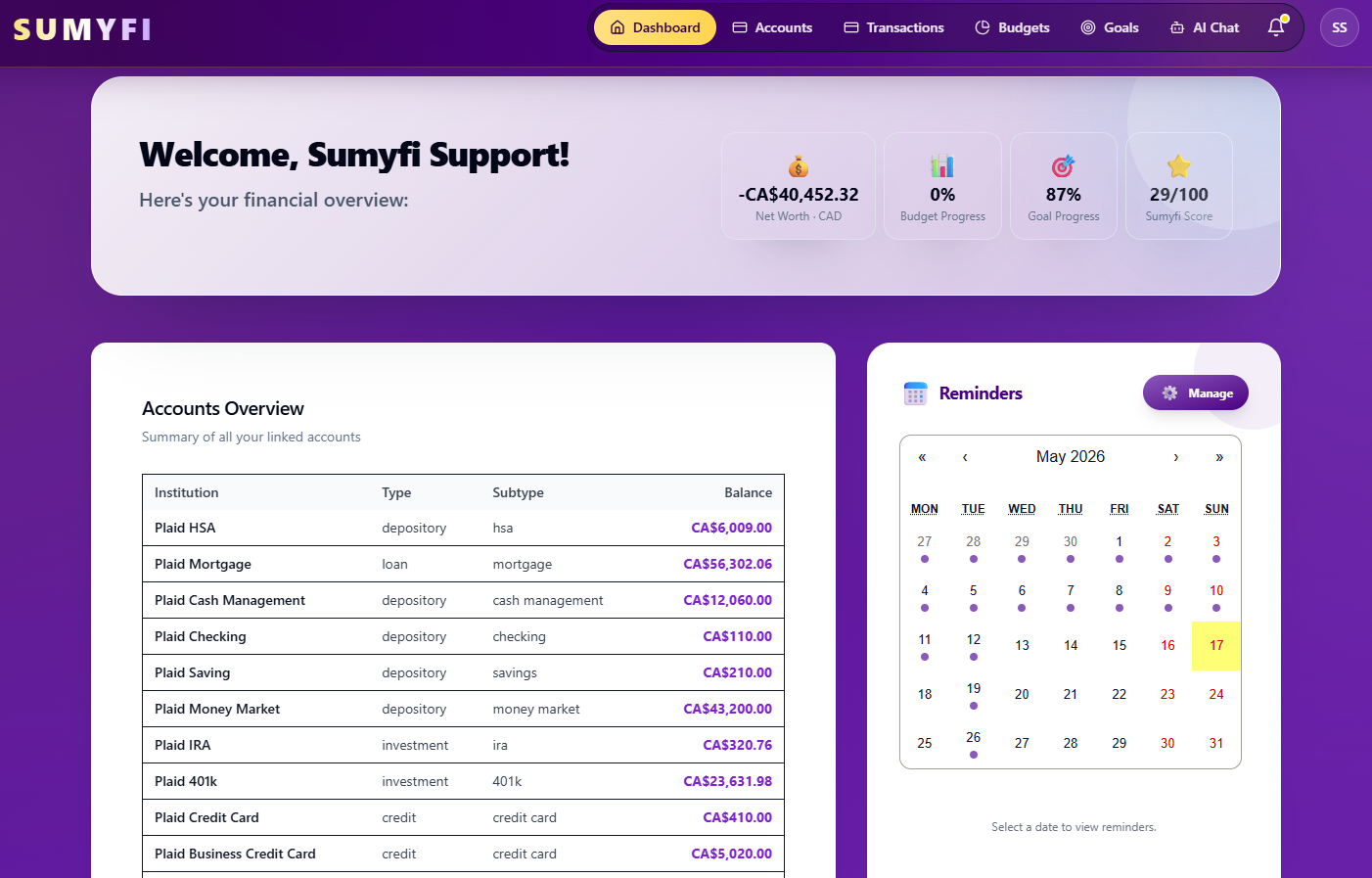
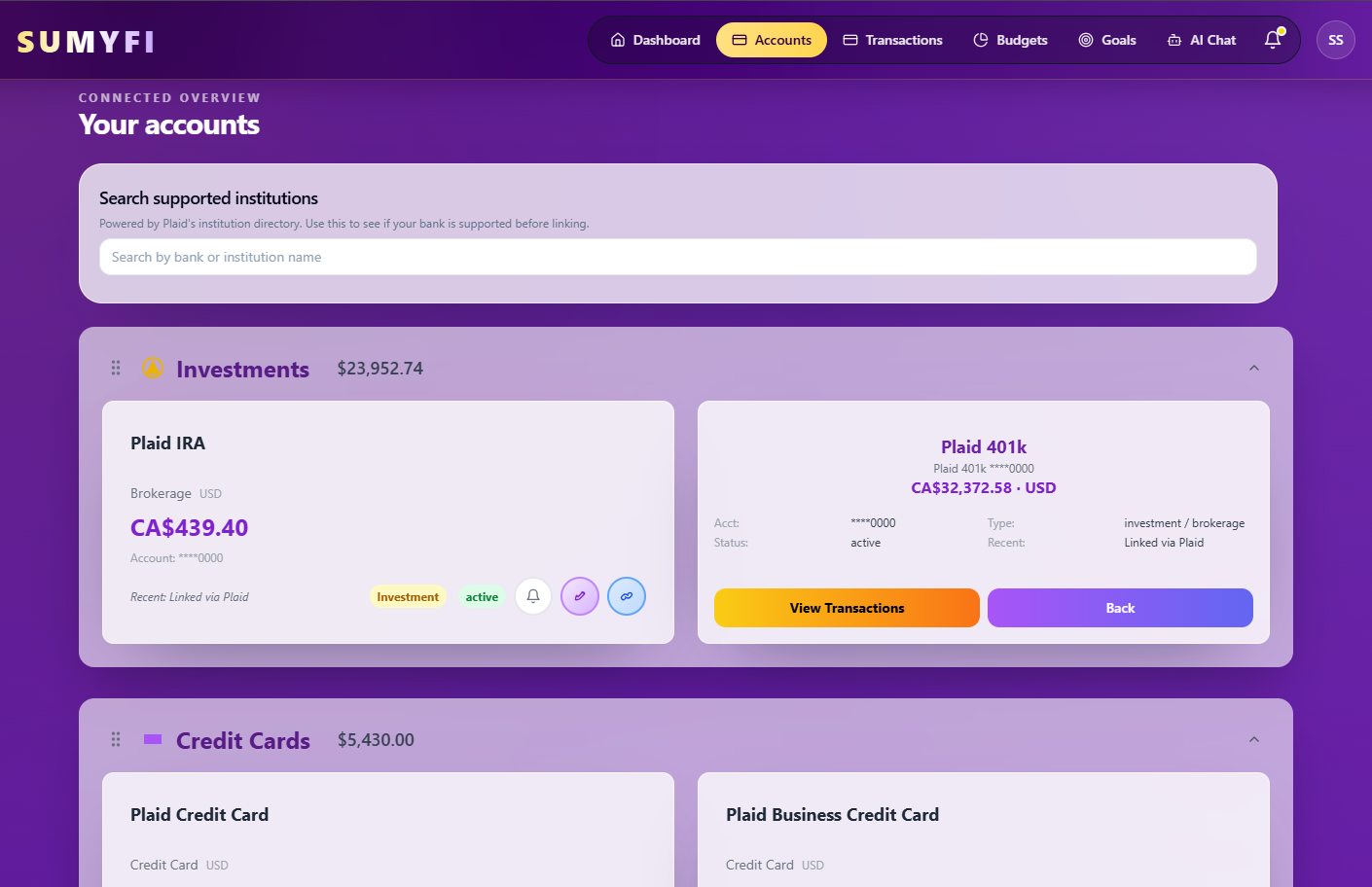
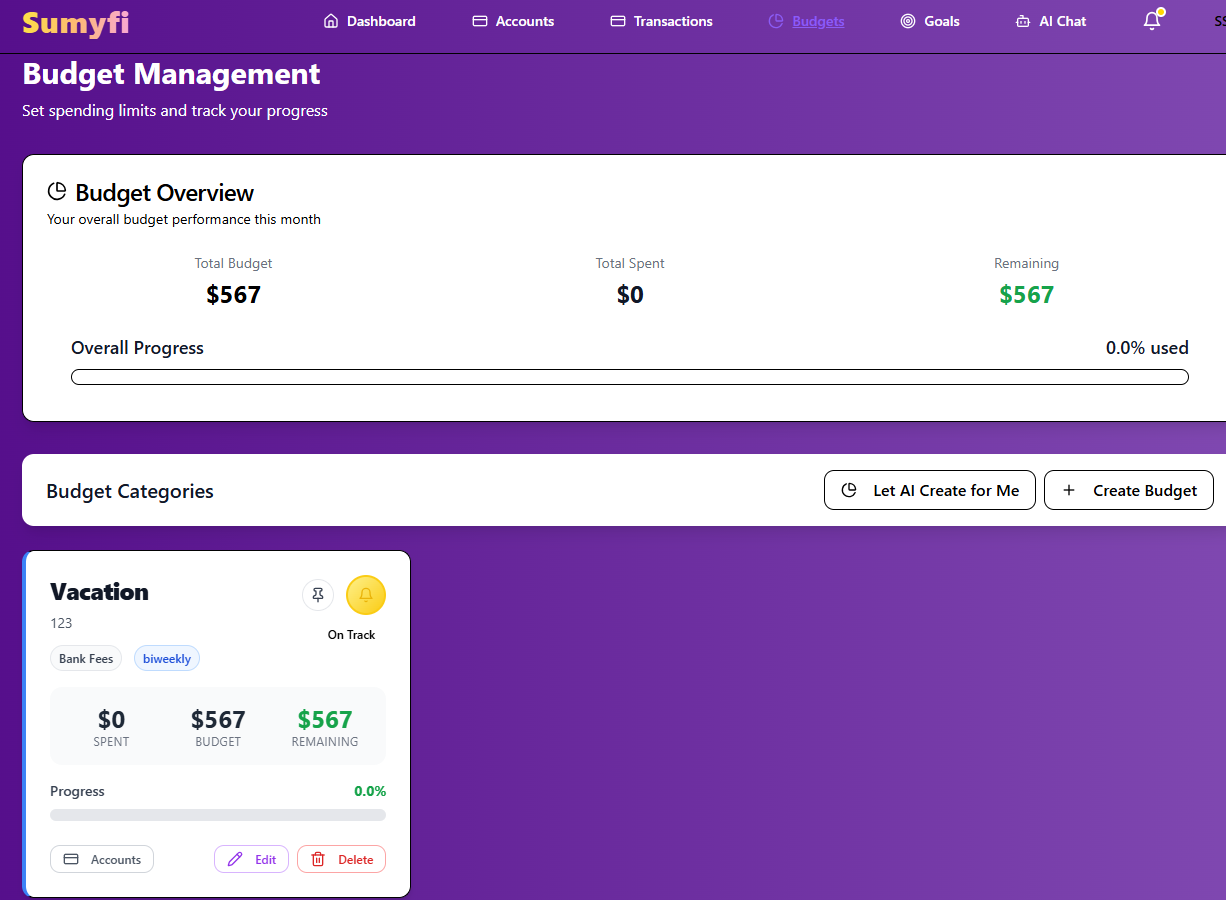
The screenshots below make the dashboard, accounts, budgeting, AI, reminders, and progress surfaces more concrete for serious buyers.

Comparison pages work better when buyers can actually see the product surface they would be using.

Account coverage and visibility are part of the real comparison, not just the pricing table.

Budgets, goals, and recurring review should be weighed as one system when you compare tools.
Trust surfaces
Trust matters more than surface-level marketing in finance
In a YMYL category, buyers need visible support, security, coverage, and public accountability before they are comfortable connecting money data or acting on product guidance.
Security and privacy
Serious buyers need visible security, privacy, and data-handling pages before they trust a finance product.
Support and help center
A visible help center gives cautious buyers a clearer path before signup.
Institution coverage
Institution coverage matters because connected-account trust is part of the product story for dashboard and aggregation buyers.
Public launch signal
External product-discovery pages add another public trust surface beyond the marketing site itself.
Public roadmap on GitHub
A public roadmap repo gives buyers and readers another transparent trust surface around product direction and external mentions.
Proof block
What What matters is whether for bottom-funnel shoppers
What matters most is whether it clearly shows the difference between a subscription-centered workflow and a broader financial operating system that keeps recurring charges in context.
Subscription focus vs broader dashboard
Recurring charges in context
Better fit for connected planning
"If I am already reviewing subscriptions, I want the same product to help with the rest of my money too."
"This comparison is really about whether one narrow win is enough, or whether the whole system needs to improve."
What matters in practice
What sumyfi vs rocket money needs to solve in real life
Sumyfi vs Rocket Money matters when the current setup still leaves too much guesswork. People may already have account access, a spreadsheet, a budgeting tool, or a subscription list, but they still do not feel clear on what changed, what is drifting, or what deserves attention first.
The useful solution is the one that turns raw money data into orientation. Sumyfi fits that need by keeping accounts, recurring spending, goals, and planning close enough together that the next decision is easier to make. That also matters in a Rocket Money comparison, where the real choice is whether a narrower tool is enough or a broader system will hold up better over time.
What to look for
- Built around helping people compare a broader finance dashboard against a tool many shoppers associate with subscription visibility
- Useful for everyday personal finance users
- Designed to reduce fragmented weekly money review
What to test first
The workflow should answer a few important questions quickly
A finance tool earns its place when it helps you answer practical questions without a lot of cleanup. Can you see what changed this week? Can you spot a recurring charge, a balance shift, or a category problem quickly enough to do something about it? Can you move from review into action without opening three more tools?
That is where many products still fall short. They centralize information but leave interpretation scattered. Sumyfi works better when the goal is to keep balances, recurring charges, goals, and next actions close enough together that the review feels usable instead of performative.
What to compare first
How to judge sumyfi vs rocket money without getting distracted by feature noise
The comparison framework is usually simpler than buyers expect. Look at whether the product makes account visibility easier, whether it explains spending clearly, whether recurring costs and goals stay connected to the rest of the money picture, and whether the workflow still feels manageable after a busy month.
That is where Sumyfi tends to stand out. It is built to help users see the broader financial picture quickly, interpret what changed, and keep planning visible without forcing a dozen separate tools or a heavy maintenance ritual.
What to look for
- Account visibility
- Spending clarity
- Goals and recurring-spend context
- Low-friction repeat use
- Trust and reliability
Why Sumyfi fits
Why Sumyfi makes more sense when the whole system matters
Sumyfi helps with this problem because it is not limited to one narrow money use case. Users can connect accounts, review recurring costs, track goals, and understand changes inside one environment instead of solving one visible symptom while leaving the rest of the system fragmented.
That broader fit matters for everyday personal finance users because the most useful finance app is usually the one that makes the next decision easier without demanding a complicated setup or a spreadsheet mindset. Sumyfi is most useful when the dashboard still helps after the first obvious problem has been handled.
Comparison angle
What matters most when choosing between Sumyfi and Rocket Money
Buyers comparing Sumyfi with Rocket Money are usually not choosing between random apps. They are deciding whether a narrower workflow is enough or whether a broader money system will create more value over time. That matters because the better choice is often the product that stays useful after the first use case is solved.
Sumyfi is strongest when the user wants accounts, spending visibility, goals, and recurring money decisions to reinforce one another instead of splitting across multiple tools. That broader fit is often what makes the difference in a serious comparison search.
The Evolving Landscape
The Evolving Landscape of Personal Finance: Why Your Choice Matters
The digital revolution has transformed nearly every facet of our lives, and personal finance is no exception. We've moved from ledger books to spreadsheets, and now, to intelligent, interconnected platforms. The sheer volume of financial data-multiple bank accounts, credit cards, investments, loans, and subscriptions-makes manual tracking an exercise in frustration and inaccuracy. This complexity necessitates a sophisticated tool, not just a simple tracker.
Rocket Money entered the scene primarily as a subscription management and bill negotiation tool, evolving to offer broader budgeting features. It carved a niche by helping users identify and cancel unwanted subscriptions, a common pain point.
Sumyfi, however, was engineered from the ground up with a more ambitious vision: to be the ultimate modern personal finance hub. It's designed to replace the need for multiple apps and manual effort, providing a unified, intelligent, and effortlessly navigable platform for *all* your financial needs. When considering Sumyfi versus Rocket Money, it's crucial to understand this fundamental difference in philosophy and scope. Sumyfi isn't just about cutting costs; it's about building lasting financial intelligence and control.
Sumyfi vs Rocket
Sumyfi vs Rocket Money: A Head-to-Head Feature Comparison
To truly understand the distinction between these two platforms, we must delve into their core functionalities. This section offers an intricate "Sumyfi vs Rocket Money" breakdown across key areas.
Net Worth Tracking:
Net Worth Tracking: Beyond the Basics
Your net worth is the truest measure of your financial health. It's not just about how much money you have in your checking account, but the sum total of your assets minus your liabilities.
Sumyfi doesn't just display numbers; it provides dynamic, interactive dashboards that visualize your net worth trends over time, allowing you to identify growth patterns, understand the impact of your financial decisions, and project future wealth. Its agile engineering ensures lightning-fast data refreshes, so your net worth is always current. This isn't just tracking; it's a powerful analytical tool that empowers strategic financial planning.
The Sumyfi Advantage: Sumyfi's net worth tracking is designed for the modern investor and planner. It's an empowering dashboard that makes complex financial health understandable and actionable, far surpassing basic aggregation.
Ready to see your true financial picture? [Experience Sumyfi's superior net worth tracking today!](https://www.sumyfi.com/signup)
What to look for
- Sumyfi's Comprehensive Approach: Sumyfi excels in delivering a crystal-clear, real-time snapshot of your entire financial universe. It seamlessly connects with thousands of financial institutions across the US and Canada, pulling in data from:
- Bank Accounts: Checking, savings, money market.
- Investment Portfolios: Stocks, bonds, mutual funds, ETFs, retirement accounts (401k, IRA, RRSP, TFSA).
- Real Estate: Track property values with integrated estimates.
- Other Assets: Vehicles, collectibles, and even manual assets you wish to include.
- Liabilities: Mortgages, personal loans, student loans, credit card debt.
- Rocket Money's Capabilities: Rocket Money offers net worth tracking, but it often feels more like an aggregation of account balances rather than a deeply integrated analytical feature. While it connects to various accounts, its primary focus historically has been on spending and debt reduction. The visualizations can be less dynamic, and the depth of insight into investment performance or complex asset tracking may not match Sumyfi's robust capabilities. For users whose primary goal is merely to see their account balances in one place, it can suffice, but for those seeking a holistic, analytical view of their wealth, it often falls short.
Budgeting & Spending
Budgeting & Spending Insights: Precision vs. Simplicity
Effective budgeting is the cornerstone of financial stability. It requires not just tracking where your money goes, but also setting limits, understanding patterns, and making informed choices.
The Sumyfi Advantage: Sumyfi transforms budgeting from a chore into an empowering strategy. Its intelligence and flexibility provide a level of control and insight that allows users to truly optimize their spending and accelerate their financial goals.
What to look for
- Sumyfi: Flexible, Customizable, and Intelligent: Sumyfi's budgeting system is built for flexibility and precision.
- Customizable Categories: Create as many categories and subcategories as you need, tailored precisely to your spending habits and financial goals.
- AI-Powered Insights: Sumyfi goes beyond simple categorization. Its intelligent algorithms learn your spending patterns, identify trends, and offer proactive insights into where you can save or optimize.
- Predictive Budgeting: Based on your historical data and upcoming bills, Sumyfi can help you forecast your cash flow, ensuring you stay ahead of your finances.
- Goal-Based Budgeting: Link your spending directly to your financial goals, whether it's saving for a down payment, retirement, or a vacation. Sumyfi helps you visualize your progress and adjust your budget accordingly.
- "Roll-over" Budgets: Underspend in one category? Sumyfi allows you to roll over the surplus to the next month, providing greater flexibility and realism in your financial planning.
- Rocket Money: Rule-Based and Streamlined: Rocket Money offers budgeting tools that are generally rule-based and aim for simplicity. It allows users to set spending limits for categories and track progress. Its strength lies in its ability to quickly identify "excess" spending, particularly on subscriptions. However, its categorization can sometimes feel less granular, and its insights might be more focused on immediate cost-cutting rather than long-term, holistic financial planning. While effective for basic expense tracking, it might lack the depth and customization required for complex financial situations or advanced goal setting.
Transaction Automation &
Transaction Automation & Categorization: The Engine of Efficiency
The sheer volume of daily transactions can quickly overwhelm manual tracking. Automation is key to maintaining an accurate and up-to-date financial picture.
The Sumyfi Advantage: Sumyfi's intelligent automation significantly reduces the time and effort spent on managing transactions, ensuring your financial data is always clean, categorized, and ready for analysis, making it a true replacement for manual spreadsheets.
What to look for
- Sumyfi: Advanced Automation and Learning Algorithms: Sumyfi's transaction management is a testament to its agile engineering.
- Smart Categorization: Automatically categorizes transactions with remarkable accuracy. But it doesn't stop there; its machine learning algorithms continuously improve, learning from your manual adjustments and custom rules.
- Custom Rules Engine: Create powerful, granular rules to automatically categorize specific vendors, amounts, or transaction types. This means less manual intervention and more accurate data.
- Bulk Editing: Need to re-categorize multiple transactions? Sumyfi's slick interface allows for quick bulk edits, saving you valuable time.
- Split Transactions: Easily split a single transaction across multiple categories (e.g., a grocery store trip that includes both groceries and household items).
- Tagging and Notes: Add custom tags and notes to transactions for even deeper organization and searchability, invaluable for tax purposes or detailed analysis.
- Rocket Money: Standard Categorization and Bill Tracking: Rocket Money provides standard transaction categorization, often based on merchant data. It's effective for general oversight and identifying recurring bills. While it does allow for some customization and renaming, its automation capabilities might not be as sophisticated or adaptable as Sumyfi's learning algorithms and advanced rule sets. Its strength in this area often ties back to its core feature: identifying and tracking recurring payments for subscription management. For users with straightforward spending patterns, it's functional, but for those with diverse transactions requiring nuanced categorization, Sumyfi offers a more robust solution.
Financial Institution Connectivity:
Financial Institution Connectivity: Breadth, Depth, and Reliability
The utility of any personal finance app hinges on its ability to connect reliably and securely with your financial institutions.
The Sumyfi Advantage: For users in both the US and Canada, or those with a wide array of financial accounts, Sumyfi's superior breadth, depth, and reliability of financial institution connectivity ensures a truly unified and hassle-free experience.
What to look for
- Sumyfi: Unparalleled Reach and Robustness: Sumyfi prides itself on its extensive and highly reliable connectivity.
- Thousands of Institutions: Connects seamlessly with thousands of banks, credit unions, investment firms, and lenders across both the United States and Canada. This broad coverage is a significant advantage, especially for users with diverse financial relationships or those living in Canada, where some US-centric apps fall short.
- Robust API Connections: Utilizes cutting-edge API technology to ensure secure, stable, and fast data synchronization. This minimizes connection drops and ensures your data is always up-to-date.
- High Refresh Rates: Your financial data is refreshed frequently, providing near real-time updates to your dashboard.
- Secure Data Handling: Employs bank-grade security protocols (encryption, read-only access) to protect your sensitive financial information.
- Rocket Money: Strong US Coverage, Variable Canadian Support: Rocket Money also boasts extensive connectivity, particularly within the United States. It connects to many major banks and financial institutions. However, its coverage in Canada, while present, may not be as comprehensive or as consistently reliable as Sumyfi's purpose-built, dual-country integration. Users with niche banks or specific investment platforms might find Sumyfi's broader reach more accommodating. The reliability of connections can vary, a common challenge for all aggregators, but Sumyfi's agile engineering team prioritizes consistent uptime and rapid resolution of any connectivity issues.
User Experience &
User Experience & Interface: Intuitive Power vs. Functional Utility
A powerful tool is only as good as its usability. The interface dictates how easily you can access insights and manage your finances.
The Sumyfi Advantage: Sumyfi doesn't just present data; it curates an experience. Its slick dashboard and intuitive design transform complex financial management into an empowering and even enjoyable process, making it significantly easier to stay on top of your money.
[Discover the Sumyfi difference with a free trial and experience true financial clarity!](https://www.sumyfi.com/signup)
What to look for
- Sumyfi: Slick, Modern, and Intuitive: Sumyfi's user interface is a cornerstone of its appeal.
- Modern Aesthetic: A clean, contemporary design that is visually appealing and easy on the eyes.
- Customizable Dashboard: Tailor your dashboard to display the information most relevant to you-net worth, budget progress, upcoming bills, investment performance-all at a glance.
- Intuitive Navigation: Designed for effortless exploration, even for complex financial data. Find what you need quickly without digging through layers of menus.
- Visualizations: Rich, interactive charts and graphs make understanding your financial data engaging and insightful.
- Seamless Mobile Experience: A powerful, fully featured mobile app that mirrors the desktop experience, allowing you to manage your finances on the go.
- Rocket Money: Functional and Direct: Rocket Money's interface is generally functional and direct, prioritizing the execution of specific tasks, particularly around subscription management and bill tracking. While it has improved over time, some users might find it less customizable or visually engaging than more modern alternatives. The focus is often on getting to the "action" (e.g., canceling a subscription) rather than providing a holistic, customizable financial overview. For users who prefer a no-frills, task-oriented approach, it can be effective, but for those who value a beautiful, insightful, and adaptable financial dashboard, Sumyfi offers a more premium experience.
Security & Data
Security & Data Privacy: Guarding Your Financial Life
In an age of constant digital threats, the security and privacy of your financial data are paramount.
The Sumyfi Advantage: While both platforms prioritize security, Sumyfi's commitment extends to a proactive, agile engineering approach to data protection and a transparent privacy policy that fosters trust, ensuring your financial life is not just managed, but also meticulously guarded.
What to look for
- Sumyfi: Unwavering Commitment to Protection: Sumyfi employs a multi-layered security architecture to safeguard your information.
- Bank-Grade Encryption: All data, both in transit and at rest, is secured using advanced encryption protocols (e.g., 256-bit AES encryption).
- Read-Only Access: Sumyfi only ever has read-only access to your financial accounts. It cannot move money, make transactions, or initiate any financial actions on your behalf.
- Multi-Factor Authentication (MFA): Adds an extra layer of security to your account login.
- Regular Security Audits: Sumyfi undergoes continuous security assessments and adheres to industry best practices to protect against evolving threats.
- Transparent Privacy Policy: A clear and concise privacy policy outlines exactly how your data is collected, used, and protected, putting you in control. Sumyfi is built on the principle that your data is yours.
- Rocket Money: Standard Industry Security: Rocket Money also implements standard industry security measures, including encryption, multi-factor authentication, and read-only access to financial accounts. They emphasize their commitment to protecting user data. Like Sumyfi, they do not store your bank login credentials directly but use secure third-party aggregators. Both platforms understand the critical importance of security.
Sumyfi's Distinct Advantages:
Sumyfi's Distinct Advantages: Why Modern Finance Demands More
Beyond the feature-by-feature comparison, Sumyfi stands out due to its fundamental design philosophy and engineering prowess.
The All-in-One Hub
The All-in-One Hub Philosophy: Beyond Fragmented Solutions
Many personal finance apps excel at one specific task-be it budgeting, investing, or subscription tracking. Sumyfi's core innovation is its commitment to being a truly all-encompassing hub.
What to look for
- One Platform, Total Control: Imagine replacing half a dozen apps and all your manual spreadsheets with a single, elegant solution. That's Sumyfi. It integrates net worth tracking, budgeting, transaction automation, goal setting, and insights into one cohesive ecosystem.
- Eliminating Financial Silos: By bringing all your financial data together, Sumyfi eliminates the "silo effect" where different aspects of your finances are managed in isolation. This holistic view is crucial for making informed, interconnected financial decisions. You don't just see your budget; you see how it impacts your net worth, your investments, and your long-term goals.
Agile Engineering &
Agile Engineering & Future-Proofing
Sumyfi is built on a modern technology stack, allowing for rapid innovation and continuous improvement.
What to look for
- Responsive to User Needs: Its agile engineering team is constantly refining the platform, adding new features, and enhancing existing ones based on user feedback and evolving financial trends. This means Sumyfi is not just a static tool but a dynamic, growing solution.
- Cutting-Edge Technology: Leveraging the latest advancements in data aggregation, AI, and user interface design, Sumyfi ensures a smooth, fast, and reliable experience. This contrasts with some legacy platforms that may struggle with technical debt or slower adaptation to new financial products and institutions.
- Scalability: Sumyfi is designed to grow with you, capable of handling increasing financial complexity as your wealth and investments expand.
Seamless Setup &
Seamless Setup & Unparalleled Ease of Use
The initial barrier to entry for many financial apps is the setup process. Sumyfi prioritizes a lightning-fast and intuitive onboarding experience.
What to look for
- Quick Onboarding: Get started in minutes. Sumyfi guides you through connecting your accounts with clear, concise instructions.
- Effortless Integration: Its robust connectivity ensures that linking your financial institutions is a smooth, reliable process, minimizing frustration.
- Designed for Clarity: The user-friendly interface means you spend less time figuring out how to use the app and more time understanding and managing your money.
Empowering Financial Control,
Empowering Financial Control, Not Just Tracking
While Rocket Money often focuses on finding savings (which is valuable), Sumyfi's mission is broader: to empower you with complete financial control and intelligence.
What to look for
- Actionable Insights: Sumyfi doesn't just show you data; it helps you interpret it. Its intelligent insights highlight areas for improvement, opportunities for growth, and progress towards your goals.
- Goal Achievement: By linking your daily financial actions to your long-term aspirations, Sumyfi helps you stay motivated and on track, fostering a sense of accomplishment and progress.
- Holistic Well-being: True financial well-being comes from understanding your entire financial picture and having the tools to navigate it confidently. Sumyfi provides that comprehensive foundation.
Who is Sumyfi
Who is Sumyfi For? Who is Rocket Money For?
Understanding the target audience for each platform can further clarify the "Sumyfi vs Rocket Money" decision.
What to look for
- Rocket Money is Ideal For:
- Individuals primarily concerned with identifying and canceling unwanted subscriptions.
- Users looking for assistance with bill negotiation to save money on recurring services.
- Those who need a basic overview of their spending and account balances without deep analytical tools.
- People seeking a free tier for basic financial tracking.
- Sumyfi is the Ultimate Solution For:
- Anyone seeking an all-in-one personal finance hub to replace manual spreadsheets and fragmented apps.
- Individuals and families in both the US and Canada who need robust, reliable connectivity across diverse financial institutions.
- Savvy investors and wealth builders who require comprehensive net worth tracking, including investments and real estate, with insightful historical analysis.
- Users who demand intelligent, flexible budgeting with custom categories, AI-powered insights, and goal-based planning.
- Professionals and busy individuals who value advanced transaction automation, smart categorization, and a slick, intuitive user interface that saves time.
- Those who want to move beyond just "saving money" to truly mastering their entire financial ecosystem and building long-term wealth.
- Anyone tired of fragmented financial tools and ready for a modern, agile, and empowering solution.
The Verdict: Why
The Verdict: Why Sumyfi Stands Apart in the Sumyfi vs Rocket Money Debate
In the dynamic landscape of personal finance technology, the choice between Sumyfi and Rocket Money boils down to your ultimate financial aspirations. While Rocket Money excels in its niche of subscription management and bill negotiation, offering a valuable service for cost-conscious consumers, it operates within a more confined scope.
Sumyfi, on the other hand, is engineered for the future of personal finance. It's not just a tool for saving money; it's a platform for building wealth, achieving financial clarity, and gaining complete control. Its agile engineering, lightning-fast setup, and slick dashboard interface deliver an unparalleled user experience. Sumyfi's comprehensive net worth tracking, intelligent budgeting, advanced transaction automation, and seamless connectivity across thousands of institutions in both the US and Canada position it as the superior, modern solution for anyone serious about mastering their financial destiny.
If you're looking for a temporary fix or a singular solution for subscription woes, Rocket Money might suffice. But if you're ready to embrace a holistic, empowering, and truly modern approach to personal finance management-one that replaces manual spreadsheets and provides a unified hub for every aspect of your financial life-then Sumyfi is the unequivocal choice.
[Ready to transform your financial life? Join Sumyfi today and experience the future of personal finance!](https://www.sumyfi.com/signup)
Conclusion
Conclusion
The "Sumyfi vs Rocket Money" comparison reveals a clear distinction: one is a specialized tool, while the other is a comprehensive ecosystem. Sumyfi is meticulously crafted to be your all-in-one personal finance hub, offering a level of depth, integration, and intuitive design that redefines what's possible in financial management. From its robust net worth tracking to its intelligent budgeting and seamless connectivity across North America, Sumyfi empowers you with the knowledge and tools to confidently navigate your financial world.
Don't settle for fragmented solutions or basic trackers. Elevate your financial intelligence and take decisive control.
[Start your journey to financial mastery with Sumyfi today!](https://www.sumyfi.com/signup)
FAQs
Frequently asked questions about sumyfi vs rocket money
Is Sumyfi really a strong option for sumyfi vs rocket money?
Yes, especially if the real goal behind the search is reducing fragmentation. Sumyfi is strongest for users who want connected accounts, clear budgeting, visible goals, recurring-spend awareness, and modern AI-assisted explanations in one place rather than separate disconnected tools.
What matters most when comparing options for sumyfi vs rocket money?
Account connectivity, spending clarity, recurring-charge visibility, budgeting depth, goal support, trust posture, and ease of repeat use matter most. Those factors influence whether the tool becomes part of your real routine or remains a short-lived experiment.
How does Sumyfi help people researching sumyfi vs rocket money day to day?
Sumyfi helps by keeping the wider money picture visible for people trying to compare a broader finance dashboard against a tool many shoppers associate with subscription visibility. That makes it easier to understand tradeoffs, track progress, and act on recurring patterns without rebuilding the context in separate tools.
What makes a finance app easier to keep using over time?
Low-friction review loops matter most. If the dashboard helps you connect accounts, understand patterns quickly, and take the next action without extensive manual cleanup, you are much more likely to stay engaged. That ongoing usability matters more than a long feature list.
Who is Sumyfi vs Rocket Money usually best for?
It is usually best for everyday personal finance users who want clearer financial visibility without building a heavy manual system. Sumyfi is strongest when the user wants practical weekly clarity more than niche complexity for its own sake.
Supporting articles
Read related explainers before you commit
These blog articles add broader context around budgeting habits, expense tracking, automation, and product-fit questions so readers can keep digging into the same decision from a few useful angles.
Blog explainer
Best Budgeting App in 2026
A wider market explainer that helps buyers compare product philosophy, not only features.
Read article
Blog explainer
Best Budget App in Canada
Useful when comparisons overlap with Canada-specific product-fit questions.
Read article
Blog explainer
Best Budget App for Couples
Useful when the comparison is really about shared-expense workflow and visibility.
Read article
Keep exploring
Continue the same decision journey
These related guides keep the comparison useful for both visitors and search engines by routing buyers into the next relevant comparison, budgeting, dashboard, or net-worth question.
Related guide
How to Switch from Mint
moving from Mint to a cleaner financial tracking system for accounts, subscriptions, savings goals, and weekly money review
Read How to Switch from Mint
Related guide
Connect All Bank Accounts in One App
bringing checking, savings, credit cards, and investment accounts into one unified dashboard
Read Connect All Bank Accounts in One App
Related guide
Best Subscription Tracker App
finding recurring charges, monitoring bills, and reducing waste from forgotten subscriptions
Read Best Subscription Tracker App
Related guide
Best Savings Tracking Software
tracking savings goals, progress, and recurring contributions inside a broader financial dashboard
Read Best Savings Tracking Software
Related guide
AI Personal Finance App
using AI to explain spending, prioritize goals, and simplify money decisions
Read AI Personal Finance App
Related guide
Sumyfi vs Monarch
comparing Sumyfi with another premium-style personal finance experience
Read Sumyfi vs Monarch
Topic cluster
Keep exploring the same decision journey
More Rocket Money comparison searches
Keep exploring nearby buyer-intent pages for people comparing Sumyfi with Rocket Money and similar alternatives.
Alternative Search
Rocket Money Alternative USA
finding a broader finance dashboard alternative for American shoppers comparing options
Alternative Search
Best Rocket Money Alternative
looking for a more complete finance platform than a subscription-first money tool
Alternative Search
Rocket Money Alternative Canada
finding a broader money dashboard for Canadians who want more than subscription cleanup
Comparison Search
Sumyfi vs Monarch
comparing Sumyfi with another premium-style personal finance experience
Related use cases and adjacent searches
Branch into nearby searches that tend to appear in the same decision journey, from alternatives to dashboards to budgeting help.
Comparison Search
Sumyfi vs Empower
comparing Sumyfi against a platform many shoppers consider for high-level financial visibility
Comparison Search
Sumyfi vs Credit Karma
comparing broader money management against a credit-focused financial tool
Comparison Search
Sumyfi vs Mint
comparing Sumyfi against the legacy standard many former Mint users still reference
Guide hub
Browse the full Sumyfi topic cluster
Move from one question to the next through budgeting, dashboard, subscription, AI, and comparison guides that support the same decision journey.